
Wholesale Copper Pails and Buckets (Bakraç)
Copper pails, bought by the crate
A pail is the only copper vessel a person carries while it is full, and everything about it is decided by that. We supply hand-hammered solid copper pails — the Anatolian bakraç, a compact swing-handled vessel used for milk, ayran, water and table service — in red copper, antique oxide and nickel, to restaurants, dairies, hotels, prop houses and homeware buyers, in graded sizes with the handle joint specified in writing.
Tell us what goes in it and who carries it. A pail that holds cold ayran on a table, a pail that a waiter walks with and a pail that stands on a shelf as decoration are three different specifications, and the difference sits in the handle joint and the lining rather than in the shape.
A copper pail, known in Turkish as a bakraç, is a small straight-sided vessel with a swing handle, used to carry and serve liquids — traditionally milk, ayran and water. Its defining engineering problem is that the entire filled weight hangs from two small joints on the rim, which is why the handle attachment is the specification that matters most.
Carried full, not just filled
A pail is specified around its loaded weight. Everything else — sheet thickness, rim, handle joint — follows from that one figure.
The joint is the product
Ears, bail and the way they are fixed decide whether a pail lasts a decade or a season. Have the method written into the order.
Lining follows the contents
Ayran and yoghurt drinks are acidic. A pail intended for them is specified tin-lined inside, and that is stated on the order rather than assumed.
Graded sizes, one form
The range steps up in width and capacity while keeping the same profile, so a mixed order still reads as one family on a table.
Hand-hammered surface
The faceted body hides the handling marks a carried vessel inevitably collects, which is the practical reason it has always been hammered.
Matched replacement
Ordered against a written specification and a retained sample, a top-up run years later still belongs to the same service.
What a bakraç is — and the three vessels it gets confused with
A bakraç is a milk and serving pail: compact, straight-sided, with a swing handle on two rim ears. It is not a household bucket, not an ice bucket and not a sauna bucket. Those three have different proportions, different linings and different failure modes, and ordering one when you meant another is the most expensive mistake in this category.
The word bucket does a lot of damage here, because in English it covers everything from a builder’s pail to a chilled wine holder. The Anatolian bakraç is a specific object with a specific history. It is the vessel a household used to carry milk from an animal to a kitchen, to draw water, and then to bring ayran or water to a table. It is small enough to carry in one hand at a walking pace, straight or gently tapered in the body, and it lives on a swing handle rather than a fixed one so that it can be set down and stacked without the handle getting in the way.
A household bucket is the wrong comparison in almost every respect. It is much larger, it is designed to be dragged, filled from a tap and emptied roughly, and nobody cares what its interior does to what is inside it because the answer is usually water and soap. A bakraç is a food vessel, and that single difference drives the lining question that runs through the rest of this page.
An ice bucket is a different object again. Its whole design problem is condensation and thermal shock — a vessel that is cold on the inside and warm on the outside sweats, and the water has to go somewhere. That is a genuinely separate specification and it belongs on its own page, not here.
A sauna bucket is the third neighbour and the easiest to separate. It is deeper, straighter, always comes with a ladle, and it exists to throw water onto hot stones, which means steam, heat cycling and a wooden or heat-insulated handle are its central concerns. Again: a different problem, deliberately handled elsewhere.
What all this means in practice is that an enquiry saying copper bucket tells us almost nothing. An enquiry saying a pail for serving cold ayran at table, carried by waiting staff tells us the size band, the lining, the handle specification and the finish in one sentence.
Filled weight: the number that decides the whole specification
Filled weight is the figure everything else follows from, and it is almost never on a product page. A pail’s empty weight is a small fraction of what a person actually lifts, because water and milk are dense, and the difference between the smallest and the largest vessel in a range is far greater when both are full.
The arithmetic is simple and it is worth doing before ordering rather than afterwards. Water weighs one gram per millilitre. Milk and ayran are slightly denser, a little over one gram per millilitre, because of the solids in them. So a pail holding a litre and a bit of liquid carries a little over a kilogram of contents; a pail holding a little over three litres carries a little over three kilograms. Add the body of the vessel itself — in this range, roughly seven hundred grams at the small end and a shade over a kilogram at the large end — and the picture changes completely.
In round terms: the smallest pail in the range is under two kilograms when full, which anybody can carry in one hand all evening. The largest is heading towards four and a half, which is a real load on a swing handle held in four fingers, and it is a different object in service even though it looks like the same thing on a shelf.
Copper contributes more to that number than most buyers expect. The Royal Society of Chemistry gives copper a density of 8.96 grams per cubic centimetre, which is heavier than steel per unit volume and more than three times aluminium. A copper pail feels substantial in the hand at a size where a steel one would feel flimsy, and that is a large part of its appeal — but it also means sheet thickness is not a free decision. Every additional tenth of a millimetre of sheet is weight the person carrying it pays for on every trip.
The range here runs from roughly six tenths of a millimetre to nine tenths in the body, which is the sensible band for a carried vessel: thick enough that a rim survives being knocked against a counter, thin enough that the empty weight stays reasonable. Heavier sheet is available where a pail is genuinely abused, and it is worth asking for if the vessel is going into a commercial kitchen rather than onto a table.
There is one more consequence of filled weight that shows up only in service. A pail filled to the brim slops, and slopping is how a floor becomes slippery and how a waiter’s sleeve becomes a laundry problem. Working capacity is realistically somewhere below nominal capacity, and the practical answer is usually to buy one size larger than the volume you actually need to carry.
The handle: ears, bail, and where a pail really fails
A swing handle transfers the entire filled weight of a pail into two small points on the rim. Those two joints are where pails fail, and the method used to make them — riveting, soldering, or a folded lug — is the single specification a trade buyer should put in writing rather than assume from a photograph.
The anatomy is worth naming properly because it makes conversations with any supplier clearer. The bail is the arched handle itself. The ears, sometimes called lugs, are the fittings on opposite sides of the rim that the bail pivots in. The pivot is the point of contact between the two. When a full pail is lifted, the load path runs from the liquid into the base, up the walls, into the rim, and then through the ears into the bail — concentrated, at the last step, into two small areas of metal.
Riveted against soldered
A riveted ear is a mechanical joint. A shaped piece of metal is fixed through the wall of the vessel with one or more rivets, so the load is carried by the rivet shank in shear. It survives heat, it survives shock, and if it works loose it does so visibly and slowly rather than all at once. It is more labour, it leaves visible rivet heads inside and out, and some buyers dislike the look.
A soldered ear is a metallurgical joint. The fitting is bonded to the body with a filler metal that melts well below copper’s own melting point. Done properly it is strong, it is clean, and it leaves a smooth body with nothing protruding. Its two weaknesses are honest and predictable: solder softens with heat long before copper does, and a soldered joint carries shock loads less forgivingly than a rivet, so a pail swung down hard onto a stone floor is asking more of it.
Neither method is universally right, and any supplier who tells you otherwise is describing their own workshop rather than your use. What is not acceptable is not knowing. Ask which joint you are being quoted, have it written into the specification alongside the sheet thickness, and confirm it on a physical sample before a series runs. If a pail is going to be carried full, several times a service, by staff who are in a hurry, the joint is the part of the object you are actually buying.
Geometry, which matters almost as much
Two details decide whether a pail hangs comfortably. The pivots should sit at or above the vessel’s centre of gravity when it is full, otherwise the pail wants to tip as it swings and the contents move. And the bail should be long enough that knuckles clear the rim, which sounds trivial until somebody carries a full pail of cold liquid and finds their fingers pressed against a wet metal edge for twenty metres.
For service use, ask whether the bail stays upright when released or falls to the side. A bail that falls flat is easier to stack and store. A bail that stays up is faster to pick up on a busy pass. Both are legitimate and they are decided at the ear, not afterwards.
Sizes, and what each one is actually for
Pail sizes in this range are graded by number and by rim width, stepping from roughly thirteen to seventeen centimetres across, with capacities running from a little over a litre to a little over three. The steps are close enough that the family reads as one set and far enough apart that each size has a genuine job.
The smallest size is a table vessel. It holds enough cold ayran or water for a small table, it is light enough to be passed around, and it is the size that sells best into retail and gift because it looks right on a shelf without dominating it. It is also the practical choice for serving something rich in small quantities — a sauce, a compote, a syrup — where a larger vessel would look half empty.
The middle size is the workhorse. It carries a useful amount without becoming a two-handed object, and it is the one most restaurants end up standardising on. If you are buying a single size for a floor, this is almost always it.
The largest size is a carrying vessel first and a serving vessel second. Full, it is a genuine load, and it belongs in the hands of staff rather than guests. It is also the size that photographs best as a prop, which is why prop houses, food stylists and hotel display teams tend to ask for it specifically.
The hand-hammered surface runs through all of them. That texture is not only decorative: a faceted surface scatters reflections, so the scuffs and small dents that a carried vessel inevitably collects disappear into the pattern instead of sitting on a flat field. It is the reason working copper has been hammered for as long as it has been made, and it is why a hammered pail still looks intentional after a year while a mirror-smooth one looks tired.
Because the profile is shared across the sizes, a mixed order nests visually even when the individual pieces are doing different jobs. That matters on a buffet or a display where three sizes stand together, and it is worth specifying the same finish across sizes for exactly that reason.
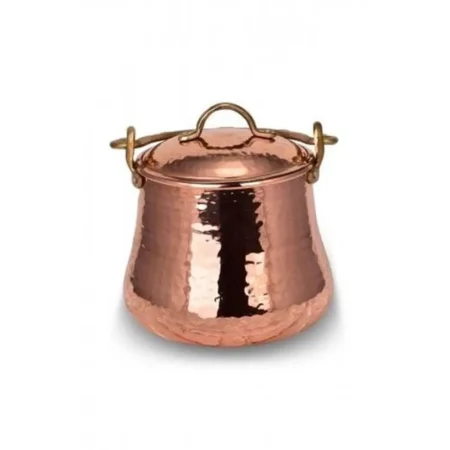
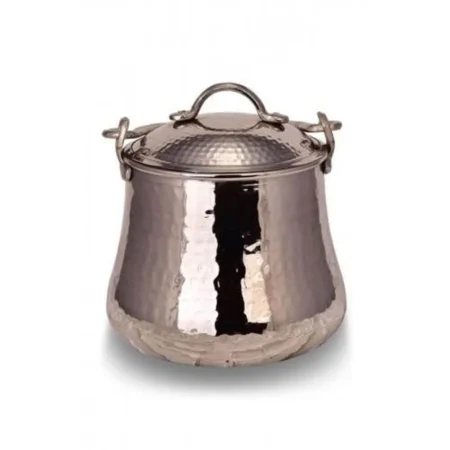
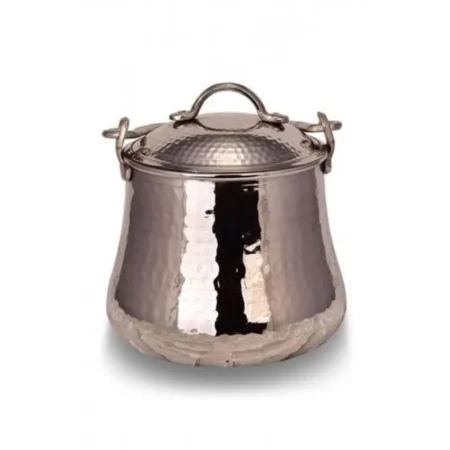
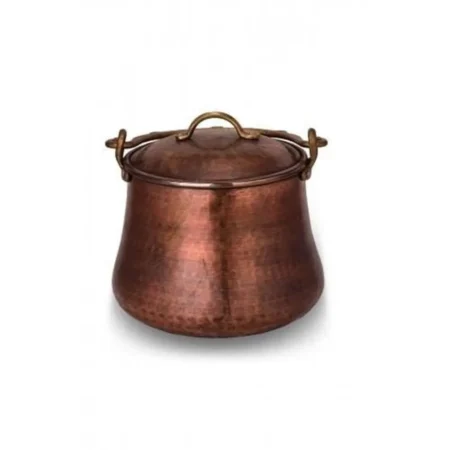
9 items in stock right now, from 13 cm to 17 cm. Other sizes and finishes are produced to order.
Lining: what goes in the pail decides the interior
Tin lining exists so that acidic food does not sit against bare copper. Ayran, yoghurt drinks, fruit juices and most things a serving pail actually holds are acidic, so a pail intended for them is specified tin-lined inside. A pail bought for water, ice display or decoration is a different specification.
This is the question that separates a correct order from an expensive one, and it is decided by contents rather than by appearance. Copper reacts with acids, and dissolved copper in food is the reason food contact rules treat the metal the way they do. The FDA Food Code is unusually direct about it: copper is not to be used in contact with food that has a pH below six, with a narrow exception for distilling equipment. Ayran sits well below that threshold, as do most fruit juices, wine, vinegar dressings and anything containing lemon.
In the European Union the starting point is Regulation (EC) No 1935/2004, the framework regulation on materials and articles intended to come into contact with food. The words that carry the weight are intended to come into contact: scope follows intended use, which is precisely why the same body can be a food vessel or a display object depending on what you tell us. The technical document most laboratories and buyers work from for metals is the Council of Europe guidance on metals and alloys in food contact materials, which sets release limits for copper and for the other metals present in an alloy.
We should be plain about what we hold and what we do not. We do not hold a food contact test report for these pails. If your market requires one, say so before an order is placed: testing can be arranged at cost, and the price is quoted before work starts rather than discovered at a border. A supplier who answers that question with a vague reassurance is selling you a problem, and so is one who describes an unlined interior as suitable for food. We will not do either.
One practical note about tin, because it changes how a lined pail is treated. Tin is a soft metal with a low melting point, which is exactly why it goes on by hand and exactly why a lined vessel must never be heated empty or put near a flame. Re-tinning is normal periodic maintenance on a lined vessel in heavy service, not a fault and not a warranty question, and it is worth budgeting for rather than being surprised by.
Finishes, and how a carried vessel ages
Three finishes run through this range: bright red copper, antique oxide and nickel. On a vessel that is carried, handled and set down wet, the finish decision is mostly about how visible handling marks are, and the ranking is consistent — oxide hides most, nickel next, bright copper least.
Bright red copper is the finish that sells the photograph. It is also the finish that shows a fingerprint the moment a hand touches it, and a pail is touched more than almost any other copper object in a room. In a display, a window or a styled shoot it is unbeatable. On a service floor it needs somebody assigned to polishing, and in most venues that person does not exist.
Antique oxide is copper deliberately darkened, with the recesses of the hammering left dark and the raised facets warmer. Because it starts dark, further darkening from handling and humidity blends in rather than standing out, and no polishing rota is required at all. For anything going into daily service without a dedicated cleaning routine, this is usually the right answer.
Nickel plating reads silver rather than copper. It sits comfortably in a room styled around stainless steel, it shows water marks considerably later than bare bright copper, and it is a common choice where a vessel needs to look clean at a glance. The trade-off should go into your own product copy if you resell: plating is a coating measured in microns, so it cannot be polished back the way bare copper can, and a worn rim eventually shows copper beneath. Never clean a plated pail with copper polish.
What none of these finishes do is stop copper being copper. There is no permanent surface here and none is promised: bare copper darkens in air and faster in damp, which is why a pail left wet overnight comes out patched rather than evenly toned. Empty it, wipe it and store it dry and upside down, and the appearance of a set stays uniform for years. Leave standing liquid in it and no finish will save you.
Buying for restaurants, hotels, dairies and display
Trade buyers of copper pails fall into four groups with genuinely different needs: table service, back-of-house carrying, food display, and styling or props. The same body serves all four, but the lining, the handle joint and the finish are specified differently for each, and mixing them in one order is normal.
Table and service use
A pail on a table is a serving vessel, so the lining question is live and the finish needs to survive constant handling without a polishing rota. Size is usually decided by how many people share one, and the common mistake is buying too large: a half-empty pail looks mean, and a full one slops when it is carried. Buy the size that is comfortably full at the portion you actually serve.
Back-of-house carrying
Here the handle joint is the entire decision and appearance barely matters. Specify the heaviest sheet in the range, have the joint method written down, and expect the pail to be dropped. It is also worth buying spares in the first order rather than topping up later, because small repeat quantities are the least efficient purchase anyone makes.
Display, buffet and styling
For display the job is visual and the load is light, so the specification relaxes in every direction except one: consistency. Three pails on a buffet must look like three pails from the same family, which means the same finish, the same batch where possible, and a retained sample on a shelf so a replacement in three years still matches. Prop houses and food stylists usually want the largest size and the brightest finish, because both photograph hardest.
Retail, gifting and marking
Copper pails sell well as gifts and as kitchen decoration, and for a retail shelf the decision that changes the quotation is packaging rather than the vessel. Branded boxes, sleeves and printed cartons are a separate line, quoted separately rather than buried in a unit price. A house name, crest or inventory code can be engraved, stamped or laser-marked, usually on the body below the rim or on the base. Send vector artwork and placement is confirmed on a sample before a run starts; fine engraving on a hammered surface needs checking against the real texture rather than promising in advance.
Ordering from Türkiye: enquiry, sample, series
Ordering copper pails from Türkiye runs in three steps. An enquiry describes the contents and the carrier rather than a catalogue code, a sample fixes the finish, the joint and the lining in physical form, and the series is produced against that retained sample. Export paperwork on the Turkish side is quoted as a service.
Begin with five answers: what goes in the pail, who carries it, which sizes, which finishes, and an approximate quantity with a destination country. There is no published minimum figure, and that is deliberate rather than evasive — one size in one finish and a mixed list across three sizes and three finishes are different problems, and any single number would be wrong for most of the range. Send the list and a destination and we will say straight away whether it works as an export shipment.
The sample step is the one buyers skip and later regret. Finish names travel badly between suppliers and between languages: antique means one thing in one workshop and something visibly different in another, and hammered covers everything from a fine all-over texture to a few deep strikes. Agree a physical sample, keep it, and quote future runs against it. Samples are chargeable, which is normal in this trade, and the cost is trivial against a mismatched reorder.
Packing matters here because pails nest and bare copper marks bare copper. Vessels travel separated rather than stacked directly, with the bails secured so they cannot swing and score the body in transit — that last detail is the one most often left out, and it is the one that produces a crate of scratched rims. Carton dimensions and gross weights go out with the quotation so your forwarder can quote against real figures instead of estimates.
On customs we say what we know and no more. Copper household articles of this kind sit in Chapter 74 of the Harmonized System, under heading 7418, but classification responsibility belongs to the importer and their broker and we will not pretend otherwise. The World Customs Organization maintains the nomenclature at that level; national subheadings and duty rates are set locally and confirmed at the date of shipment. Export documentation on the Turkish side is prepared here and quoted as a service rather than assumed to be included, and there is no contracted carrier on our side, so transport is arranged by you or your forwarder. The customs declaration in the destination country stays with the importer, because only a party established there can make it. The detail is on our importing page.
How we work
BakırBul works through a long-term production partnership rather than a plant of its own. We specify the piece, our partner produces it, and we carry it under our own name, check it in our own warehouse and ship it from there. Sizes and forms outside the standard range are made to drawing.
Copper is selected from the workshops of Kahramanmaraş and other Anatolian copper towns, brought into our own warehouse, checked against the order and shipped from there. Two things follow from that arrangement and both favour the buyer. Because we specify rather than resell whatever a catalogue happens to contain, a repeat order can be matched to what you received last time. And because checking happens in our own warehouse before a shipment leaves, the rejects are ours rather than yours.
Where a form does not exist in the range — a deeper body, a lidded pail, a longer bail, a size between two standard numbers — new tooling is made at the workshop we work with when the quantity justifies it, and the tooling belongs to the buyer who paid for it. What we will not do is copy a design that belongs to somebody else, and any surface that is intended to meet food is tinned rather than left bare.
Request a quotation
Send the contents, the sizes, the finishes, an approximate quantity and a destination country, and say whether the pails are carried by staff or handled by guests. That is enough for a price and a realistic lead time. If the pails will hold ayran, juice or anything acidic, say so, because it fixes the interior specification.
Frequently Asked Questions
What is a bakraç and how is it different from a bucket?
A bakraç is an Anatolian milk and serving pail: compact, straight-sided, with a swing handle on two rim ears, made to be carried full in one hand. A household bucket is far larger, made to be dragged and emptied roughly, and nothing about its interior is specified for food. The pail is a food vessel, and that drives the lining question entirely.
How heavy is a copper pail when it is full?
Far heavier than the empty weight suggests, because liquid dominates. Water weighs a gram per millilitre and milk and ayran slightly more, so a pail holding a little over three litres carries more than three kilograms of contents on top of its own body weight. The smallest size in this range stays under two kilograms full; the largest approaches four and a half.
Is the handle riveted or soldered?
It is a specification rather than a given, and it should be written into your order instead of assumed from a photograph. A riveted ear carries load mechanically and fails slowly and visibly. A soldered ear is cleaner and smoother but softens with heat and takes shock less forgivingly. Ask which joint you are quoted and confirm it on a physical sample before a series runs.
Does a copper pail need a tin lining?
It depends entirely on what goes in it. Ayran, yoghurt drinks, juices and anything with lemon are acidic, and acidic contents against bare copper are exactly what tin lining exists to prevent. A pail intended for them is specified tin-lined. A pail bought for water, for display or as a prop is a different specification, and we will not describe an unlined interior as suitable for food.
Can I use it for ice, or in a sauna?
Those are neighbouring products rather than this one. An ice bucket’s central problem is condensation and thermal shock, and a sauna bucket’s is steam, heat cycling and a heat-insulated handle with a matching ladle. Both are specified differently and both are dealt with separately. Tell us which you actually want and we will point you at the right body.
Can a copper pail go on a stove or over a fire?
No, and it is not made for it. This is a carrying and serving vessel, not a cooking pot: the handle joint is the weakest point under heat, and a tin lining is a soft, low-melting metal that must never be heated empty. Treat the pail as a cold vessel and it will last for decades. Treat it as a pan and you will damage the joint first.
Do you hold a food contact certificate?
No, and we will not imply otherwise. We do not hold a food contact test report for these pails. If your market requires one, say so before an order is placed: testing can be arranged at cost and the price is quoted before work starts. A supplier who answers that question with a vague reassurance is selling you a problem rather than a document.
Which finish lasts best in daily service?
Antique oxide, in most rooms. It starts dark, so handling marks and humidity blend in rather than standing out, and it needs no polishing rota. Nickel is next and suits rooms styled around silver tones, though it must never be cleaned with copper polish. Bright red copper is the most striking and the most demanding, and it needs somebody assigned to it.
Do you have a minimum order?
There is no published figure, and that is deliberate rather than evasive. One size in one finish and a mixed list across sizes and finishes are different problems, and any single number would be wrong for most of what we carry. Send the list with quantities and a destination country and we will tell you immediately whether it works as an export shipment.
How are copper pails packed for export?
Separated rather than stacked directly, because bare copper marks bare copper, and with the bails secured so they cannot swing and score the bodies in transit. That last detail is the one most often left out of a packing specification and the one that produces a crate of scratched rims. Carton dimensions and gross weights go out with the quotation for your forwarder.
The 2026 catalogue — the full range with codes, sizes and weights: open or download it here. For trays, plates, pitchers and bowls see copper serveware, if you are furnishing a property see copper for restaurants and hotels, and the cleaning routine in full is on our copper care page.
Send us your list
The contents, the sizes, the finishes, an approximate quantity and a destination country is enough to start. We come back the same day.
Last updated: 20 September 2026