
Wholesale Copper Baking Trays
Copper oven trays, bought by the crate
An oven tray is the only piece of copper in a kitchen that is deliberately heated well past the boiling point of water, and that is what separates it from every other tray in a catalogue. We supply hand-hammered solid copper baking and roasting trays — round, sided, graded by diameter, in bright red copper — to bakeries, patisseries, restaurants, hotel kitchens and homeware buyers, with the lining and the working temperature written into the order rather than left to chance.
Tell us the dish and the oven temperature you actually bake at. Baklava at a long slow heat, börek at a moderate one and a roast under a hard top heat are three different requirements, and the difference decides the lining, the sheet thickness and the depth.
Copper baking trays are round sided trays used for oven work — baklava, börek, kadayıf, bakes and roasts. The governing specification is the lining: tin melts near 232 degrees Celsius, which sits inside the range a domestic oven can reach, so the working temperature has to be agreed before a tinned tray is ordered.
Tin sets the ceiling
A tin lining melts near 232 degrees Celsius. That single figure decides the safe working temperature of every lined tray in this category.
Sided, not flat
These are oven trays with real walls, several centimetres deep, made to hold syrup, fat and batter. A flat serving tray is a different product.
It browns faster
Copper moves heat into the base quickly and evenly, so a recipe written for a steel tray usually needs less time or a lower setting.
Graded round sizes
The range steps up in diameter across a wide span, so a kitchen can standardise on two or three sizes that stack and share a profile.
Re-tinning is maintenance
A lining in heavy service wears and is renewed periodically. It is a scheduled cost rather than a fault, and it is worth budgeting for.
Matched replacement
Ordered against a written specification and a retained sample, a top-up run years later still belongs to the same set.
The number that governs a copper baking tray
Tin melts at 231.9 degrees Celsius. Copper melts at 1084.6. In a lined copper tray the tin is therefore the limiting component by a factor of nearly five, and every sensible instruction about ovens, grills and direct flame in this category follows from that one comparison rather than from caution.
The figures come from the periodic table rather than from a supplier’s opinion: the Royal Society of Chemistry gives tin a melting point of 231.93 degrees Celsius, and copper 1084.62. What that means in a kitchen is that the copper body of a tray is effectively indestructible at any oven temperature, and the lining inside it is not.
This is unusual among cookware materials and it is why copper carries instructions that steel and aluminium do not. A steel tray has no component that softens below red heat. A lined copper tray has a soft, low-melting metal spread thinly across its working surface, and that metal is the part that touches food. Treat the number as a ceiling and a copper tray lasts decades. Ignore it and the lining pools, thins and eventually exposes bare copper to the food.
It is worth being precise about what melting actually looks like, because buyers imagine something dramatic. It is not. An overheated lining develops a mottled, silvery-grey appearance where the tin has moved, sometimes with visible beads or a duller patchy surface, and the tray still works perfectly well as an object. What has changed is that the food contact surface is no longer uniform, and at that point the tray goes for re-tinning rather than into a bin. That is a repair, not a write-off, which is one of the reasons copper is still bought by professional kitchens at all.
Two practical cushions sit between an oven setting and that outcome, and they are the reason lined copper trays are used every day across the region without incident. The first is that a tray with food in it is not at oven temperature: while there is moisture in the contents, evaporation holds the metal far closer to the boiling point of water than to the air temperature of the cavity. The second is that ovens lag. A tray put into a preheated oven climbs towards the set temperature rather than arriving at it. Neither cushion helps a dry, empty tray left in a hot oven, which is exactly the case that causes problems.
Oven temperatures in practice: what is safe and what is not
A tinned copper tray belongs in the ordinary baking band rather than at the top of an oven’s range. Moderate settings are comfortable, the highest settings on a domestic dial approach the melting point of tin, and radiant grill elements exceed it by a wide margin regardless of what the dial says.
Most oven work sits well below the ceiling. Baklava is baked long and moderately, börek and savoury pastry sit in the same band, milk puddings and bakes lower still, and a normal roast runs at a temperature that gives a lined tray no trouble at all. In those uses the tin is nowhere near its limit and the tray behaves like any other piece of bakeware, except that it browns better.
The cases to think about are three. The first is the top of the dial: many domestic ovens reach around 250 degrees and some fan ovens overshoot their set point during the preheat cycle. That is inside the danger zone for tin, and a tray sitting empty in that oven while it preheats is the worst version of it. The second is the grill or broiler element, which is radiant rather than convective: the surface facing it gets far hotter than the air in the cavity, and a lined tray put directly beneath one can be damaged in minutes at any dial setting. The third is a direct flame — a hob burner, a barbecue, an open fire — where the metal takes heat far faster than any oven delivers it.
The operating rules that follow are short and worth printing for a kitchen. Do not heat a lined tray empty. Do not put it under a grill element. Do not put it on a direct flame or a hot hob. Keep oven work in the normal baking band rather than at the maximum, and if a recipe genuinely demands the top of the range, use a different body for it and say so when you order — an unlined tray for that one job is a legitimate answer, and choosing it deliberately is different from discovering the problem afterwards.
One more habit prevents most accidental damage: take the tray out when the food comes out. A copper tray left in a cooling oven, or worse in an oven that is then turned back up for the next dish, is where linings quietly die.
Tinned or bare: what we will and will not supply
Tin lining exists so that food does not sit against bare copper, and an oven tray is unambiguously a food contact article. Any surface intended to meet food is specified tinned rather than left bare. An unlined tray is a legitimate product for decorative or non-food use, and it is not described as suitable for baking.
The traditional trade did leave some trays bare, and buyers sometimes ask for that on heritage grounds. The answer here is a policy rather than an argument: the food contact surfaces of pieces we supply are tinned. It is a narrow position and a deliberate one, because the alternative is putting a judgement call about acidity, contact time and quantity onto a customer who has no way of making it.
The legal framing is worth knowing even if nobody asks you for a document. In the European Union the starting point is Regulation (EC) No 1935/2004, the framework regulation on materials and articles intended to come into contact with food; the operative words are intended to come into contact, so scope follows intended use. The technical reference most laboratories work from for metals is the Council of Europe guidance on metals and alloys in food contact materials, which sets release limits for copper and the other metals in an alloy. In the United States the FDA Food Code restricts copper in contact with food below pH six — which covers tomato, lemon, vinegar and a great deal of what ends up in a roasting tray.
We should also be plain about what we do not have. We do not hold a food contact test report for these trays, and we are not going to imply that a common material and a long tradition amount to a certificate. If your market requires testing, say so before an order is placed: it can be arranged at cost and the price is quoted before work starts rather than discovered at a border.
Re-tinning, and why it is not a fault
A tin lining is a thin layer of soft metal applied by hand, and in daily commercial use it wears. It abrades under utensils, it thins at the points that take the most contact, and in a bakery running the same tray twice a day it will eventually need renewing. That is maintenance on the same footing as sharpening a knife, and it is one of the reasons a copper tray has a working life measured in decades while a coated steel tray does not — a worn lining is renewable, a worn non-stick coating is not.
What accelerates it is worth listing: metal utensils, scouring, dishwashers, and heat at the top of the range. What slows it is wooden or silicone tools, hand washing, and keeping to moderate oven settings. Budget for periodic re-tinning on trays in heavy service and it becomes a line item rather than a surprise.
How copper bakes differently, and how to adjust for it
Copper takes up heat and spreads it faster than any other common cookware metal, so a copper tray delivers a more even base heat and browns faster than steel. The practical consequence is that recipes written for steel trays usually need a slightly lower setting or a shorter time, checked earlier than the recipe says.
This is the reason copper is used in professional kitchens at all, and it is worth understanding rather than taking on trust. Heat arriving at one part of a tray is carried sideways through the metal quickly, so hot spots even out instead of concentrating. The Copper Development Association documents the conductivity figures that sit behind this; in practical terms copper is several times better at it than steel and noticeably better than aluminium.
In a baking tray the effect shows up in the base. Pastry bases set and colour evenly instead of pale in the middle and dark at the edge, syrup-soaked sweets caramelise uniformly across the tray, and a roast browns underneath rather than stewing. For baklava in particular, where the bottom layers have to crisp under a heavy load of syrup, an even base is the difference between a good tray of it and a soggy one.
The flip side is that things happen sooner. A recipe timed on a steel or aluminium tray will run ahead on copper, and the first batch is almost always the one that teaches a kitchen this. The sensible approach for a new set of trays is to drop the oven setting slightly, check at around three-quarters of the stated time, and write down what actually worked. After one or two bakes the numbers settle and nobody thinks about it again.
A second, quieter effect matters for service. Copper also gives heat up quickly, so a tray taken out of the oven starts losing heat at once rather than holding it — which is good if you want carry-over cooking to stop, and less good if you wanted the tray to keep food hot on a counter. Where a tray is going straight to a table, plan for the food to cool at a normal rate rather than expecting the metal to do the work of a hot cabinet.
Sheet thickness, warping and thermal shock
Copper baking trays are made from relatively thin sheet compared with saucepans, and that is deliberate: a tray needs to respond to oven heat quickly rather than store it. The trade-off is that thin sheet is more sensitive to sudden temperature changes, which is what causes a tray to distort.
The trays in this range run roughly half a millimetre to seven tenths in the body, and finished weights sit between around four hundred and sixty grams and a little over a kilogram depending on diameter. That is the sensible band for oven work. Much thicker sheet would slow the tray down, add cost and weight, and buy nothing in an oven where the heat is applied evenly from all sides anyway; much thinner sheet would flex under a loaded tray.
Warping comes almost entirely from thermal shock rather than from heat itself. Metal expands when it is heated, and if one part of a tray changes temperature much faster than the rest, the resulting stress can leave a permanent distortion — usually a base that no longer sits flat. The situations that cause it are specific and avoidable: pouring cold water into a hot tray, running a hot tray under a cold tap, setting a hot tray onto a wet metal surface, and putting a cold tray under a grill element.
The habit that prevents nearly all of it is simply to let a tray cool before it meets water. Out of the oven, onto a rack or a wooden board, left alone until it is comfortable to handle, and then washed. In a busy kitchen that means enough trays to rotate rather than one tray washed hot between bakes, and that is worth reflecting in the quantity you order.
A tray that has warped slightly is not scrap. Bases can often be flattened, and a tray that rocks on a bench still bakes perfectly well in an oven where it sits on a shelf. But it is easier not to do it in the first place.
Diameter and depth: fitting the oven, and fitting the dish
Copper baking trays in this range are round and sided, graded by diameter from small individual sizes up to large family trays, with walls several centimetres deep. Diameter is chosen against the oven cavity and the portion count; depth is chosen against how much liquid, syrup or fat the dish produces.
Start with the oven, because that constraint is fixed. Measure the internal width of the cavity and the usable width of the shelf, not the width of the door, and subtract a margin so air can move around the tray — a tray that fills a cavity edge to edge blocks circulation and bakes unevenly in exactly the way copper is bought to prevent. In a domestic oven the largest sizes in this range fit comfortably; in a compact or built-under oven they may not, and that is worth checking with a tape measure rather than with optimism.
Then look at the dish. Round trays suit the foods they evolved for: baklava and kadayıf are cut in patterns that work on a circle, börek is rolled and coiled into one, milk puddings and bakes portion neatly from one. A round tray in a rectangular oven wastes the corners, which is the honest cost of the format, and in exchange it stacks compactly, it has no corners for pastry to burn in, and it goes to a table looking like a serving piece rather than like equipment.
Depth is the specification people underestimate. Walls of four to five and a half centimetres are enough to hold syrup on a tray of baklava without it running over, to keep rendered fat off an oven floor, and to contain a batter that rises. If the dish is shallow — flatbread, a thin börek, biscuits — the same depth costs nothing. If the dish is wet, depth is the whole game, and a shallow tray is how ovens get cleaned on a Sunday.
For a kitchen buying a working set, the practical advice is to standardise on two sizes rather than one and to buy more of the middle size than of the extremes. Nested storage is easier with a shared profile, and a stack of one family takes up markedly less shelf than an assortment.
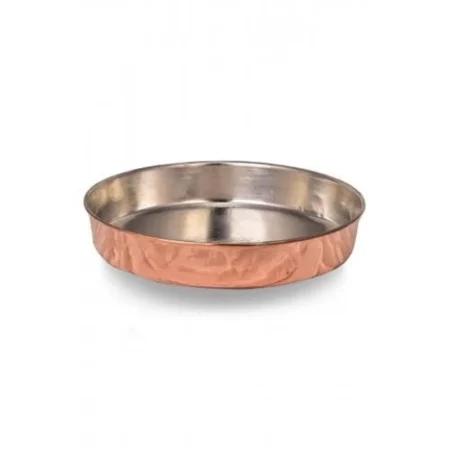
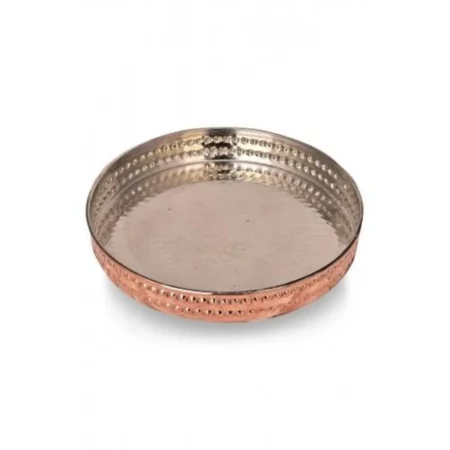
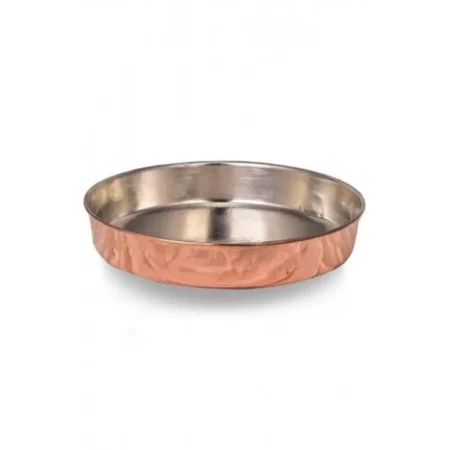
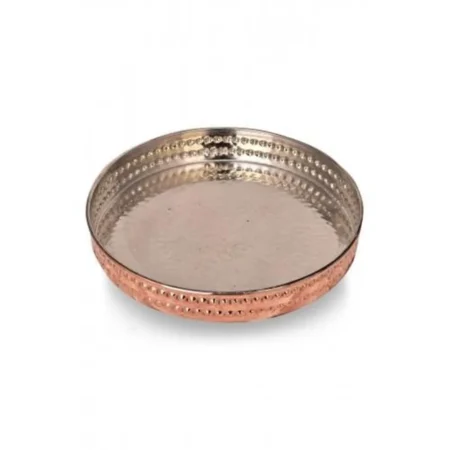
22 items in stock right now, from 16 cm to 36 cm. Other sizes and finishes are produced to order.
Knives, scoring and the real wear mechanism
The fastest way to wear a tin lining is not heat. It is a knife. Baklava and similar pastries are scored in the tray before baking and cut in the tray after, and every pass of a blade takes a little lining with it, which is why baklava trays are the ones that come back for re-tinning first.
This is the single most useful thing a supplier can tell a buyer in this category, and it is almost never said. The lining is a soft metal measured in a thin layer; a sharp steel blade drawn across it under pressure cuts through it to the copper beneath in a small number of passes. A tray used for baklava twice a week is therefore on a completely different wear curve from a tray used for roasting vegetables, even though both spend the same time in the oven.
There is no way to make this go away entirely, because the technique requires cutting in the tray — that is how the syrup reaches the layers. What can be done is to manage it deliberately. Score with a light hand rather than pressing through to the metal on the first pass. Keep a dedicated set of trays for cut pastries and a separate set for everything else, so the wear is concentrated where you have planned for it. And put re-tinning on a schedule for that set rather than waiting for somebody to notice bare copper under the bottom layer.
The same logic applies to serving utensils more generally. Metal spatulas, spoons and scrapers all abrade a lining; wooden and silicone tools do not. In a kitchen where copper trays go to a table and guests serve themselves, that is worth a word to front of house, because a guest with a metal serving slice will do more damage in one evening than an oven does in a year.
An oven tray is not a serving tray
Oven trays and serving trays share a name in English and almost nothing else. An oven tray is sided, lined for food contact and built to be heated. A serving tray is flat or shallow-rimmed, often decorative, and made to be carried and looked at. Buying one when you meant the other is the commonest error in this category.
The difference is easiest to see in the walls. Everything on this page has real sides, because it has to hold liquid at temperature. A serving tray, a platter or a sini — the large round tray used as a low table top and for carrying — is flat or nearly so, with a rim that stops things sliding rather than a wall that holds syrup. Put a wet bake on a serving tray and it will be on the floor.
The second difference is the surface. An oven tray’s interior is a working surface and it will be scored, stained and eventually re-tinned; that is normal. A serving tray’s surface is on display, often engraved, and it is judged on appearance. Ordering an engraved piece for oven work means paying for hand engraving that will be hidden by food and dulled by heat cycling, and ordering a plain oven tray for a display is a waste of a good tray.
If what you actually need is the display and service side of the category — hammered platters, sini, chargers and presentation pieces — that range is covered in detail on our hammered copper trays page, and the serving bodies more broadly on the copper serveware page. A great many enquiries that begin with the word tray turn out to belong there rather than here, and it is cheaper to establish that in an email than in a container.
Hobs, grills and induction: where an oven tray does and does not go
An oven tray is an oven item. It works in gas, electric and fan ovens, which heat the cavity rather than the metal, and it should be kept away from grill elements and direct flame. Hob compatibility is therefore rarely the right question for this product, but it is asked often enough to answer directly.
Copper does not work on an induction hob. Induction generates heat by inducing currents in a ferromagnetic base, and copper is not ferromagnetic, so a solid copper body placed on an induction surface simply does not heat — many hobs will not even recognise it and will report an error instead. This is physics rather than a quality question, and any solid copper pan advertised as working on induction has had a steel disc attached to it, which makes it a different product.
For a baking tray, though, that limitation is almost always irrelevant, and it is worth saying clearly so nobody talks themselves out of an order. An oven heats the air in its cavity and the tray inside it, and the type of hob on top of the appliance has nothing to do with it. A kitchen fitted with induction throughout is entirely unaffected where oven trays, serveware, coffee pots and drinkware are concerned, and those are the categories we would steer such a kitchen towards.
The one place it matters is the habit of starting a dish on the hob and finishing it in the oven. That step needs a body designed for it rather than a thin sided tray, and on an induction kitchen it needs a different construction again; an interface disc will work but it adds cost, weight and a slow response, and the honest advice is usually to use a pan you already have for the hob stage and the copper tray for the oven stage. If hob compatibility is a real constraint for your kitchen, the full comparison is set out on our copper and induction page, which explains what copper does not do on an induction hob and what it does perfectly well on gas, electric and ceramic instead.
Buying for bakeries, restaurants and retail
Trade buyers of copper oven trays divide into production kitchens, front-of-house operations and resellers, and they want different things from the same body. Production wants wear life and a re-tinning plan. Front of house wants a tray that goes from oven to table. Resellers want packaging and a story that survives translation.
Bakeries and production kitchens
Here the tray is equipment and the decisions are quantity and maintenance. Buy enough trays to rotate so that none of them is ever washed hot, keep cut-pastry trays separate from general baking trays, specify the heavier end of the sheet range if trays are stacked loaded, and put re-tinning on a schedule from the beginning. It is also worth agreeing a written specification and keeping a sample, because a kitchen that standardises on a diameter will be reordering that diameter for years.
Restaurants and hotel kitchens
Oven-to-table service is the reason most restaurants buy copper rather than steel, and the specification shifts accordingly: appearance matters, so the outside of the tray is part of the product and handling marks are visible. Brief staff on two things — the tray comes out of the oven as hot as the oven, so mitts are not optional, and metal serving utensils wear the lining. Both are five-second instructions that prevent months of damage.
Retail and gift
Copper bakeware sells well as a kitchen gift and as a traditional item, and for a shelf the decision that changes the quotation is packaging rather than the tray. Branded boxes, sleeves, inserts and printed cartons are a separate line, quoted separately rather than buried in a unit price. If you resell these trays, put the temperature and utensil guidance into your own product copy: a customer who is told nothing will eventually report normal lining wear as a defect, and that is a return you did not need to accept.
Marking
A house name, crest or inventory code can be engraved, stamped or laser-marked. On oven trays the sensible placement is the underside or the outer wall rather than the interior, since the interior is a working surface and will be cut. Send vector artwork and placement is confirmed on a sample before a run starts; fine engraving on a hammered surface needs checking against the real texture rather than promising in advance.
Ordering from Türkiye: enquiry, sample, series
Ordering copper baking trays from Türkiye runs in three steps. An enquiry describes the dish and the oven rather than a catalogue code, a sample fixes the diameter, the depth and the lining in physical form, and the series is produced against that retained sample. Export paperwork on the Turkish side is quoted as a service.
Begin with four answers: what you bake and at what temperature, which diameters and depths, an approximate quantity, and a destination country. There is no published minimum figure, and that is deliberate rather than evasive — one diameter for a production kitchen and a mixed list for a retail range are different problems, and any single number would be wrong for most of what we carry. Send the list and a destination and we will say straight away whether it works as an export shipment.
The sample step is the one buyers skip and later regret. Take the sample, measure it against your own oven shelf, load it with the dish you actually make, and bake it once. That single test answers the diameter question, the depth question and the timing adjustment in one afternoon, and it costs almost nothing compared with a container of trays that are two centimetres too wide for the shelf. Samples are chargeable, which is normal in this trade.
Packing is straightforward for trays because they nest, but bare copper nested against bare copper marks itself, so pieces travel interleaved rather than stacked directly, cornered, and boxed in stack heights one person can lift. Carton dimensions and gross weights go out with the quotation so your forwarder can quote against real figures instead of estimates, and so you can compare landed cost properly rather than comparing unit prices.
On customs we say what we know and no more. Copper household articles of this kind sit in Chapter 74 of the Harmonized System, under heading 7418, but classification responsibility belongs to the importer and their broker and we will not pretend otherwise. The World Customs Organization maintains the nomenclature at that level; national subheadings and duty rates are set locally and confirmed at the date of shipment. Export documentation on the Turkish side is prepared here and quoted as a service rather than assumed to be included, and there is no contracted carrier on our side, so transport is arranged by you or your forwarder. The customs declaration in the destination country stays with the importer, because only a party established there can make it. The detail is on our importing page.
How we work
BakırBul works through a long-term production partnership rather than a plant of its own. We specify the piece, our partner produces it, and we carry it under our own name, check it in our own warehouse and ship it from there. Diameters and depths outside the standard range are made to drawing.
Copper is selected from the workshops of Kahramanmaraş and other Anatolian copper towns, brought into our own warehouse, checked against the order and shipped from there. Two things follow from that arrangement and both favour the buyer. Because we specify rather than resell whatever a catalogue happens to contain, a repeat order can be matched to what you received last time. And because checking happens in our own warehouse before a shipment leaves, the rejects are ours rather than yours.
Where a size does not exist in the range — a diameter sized to a particular oven shelf, a deeper wall, a rectangular body — new tooling is made at the workshop we work with when the quantity justifies it, and the tooling belongs to the buyer who paid for it. What we will not do is copy a design that belongs to somebody else, and any surface that is intended to meet food is tinned rather than left bare.
Request a quotation
Send the dish, the oven temperature you bake at, the diameters and depths you need, an approximate quantity and a destination country. That is enough for a price and a realistic lead time. If the trays are for cut pastries, say so, because it changes the maintenance plan and the quantity we would suggest.
Frequently Asked Questions
What temperature can a copper baking tray take?
The copper body is unaffected by any oven temperature, but the tin lining inside it melts at around 232 degrees Celsius, and that is the real ceiling. Ordinary baking — baklava, börek, bakes and roasts at moderate settings — is comfortably inside it. The top of a domestic dial and a radiant grill element are not, and an empty tray heats fastest of all.
What happens if the tin gets too hot?
It moves. An overheated lining goes mottled and patchy where the tin has run, sometimes with visible beads, and the food contact surface is no longer uniform. The tray itself is undamaged, because copper melts nearly five times higher. At that point the tray goes for re-tinning, which is a repair rather than a write-off and one of the reasons copper is still bought by professional kitchens.
Can a copper tray go under the grill?
No. A grill or broiler element is radiant, so the surface facing it reaches temperatures far above the air in the cavity regardless of what the dial says, and a lined tray can be damaged in minutes. The same applies to a direct flame, a barbecue and a hot hob. Keep copper trays to convective oven work.
Do copper trays work on an induction hob?
Copper does not work on induction — it is not ferromagnetic, so the hob cannot heat it and many models will not recognise it at all. For a baking tray this almost never matters, because an oven heats the cavity and the tray inside it, so an induction kitchen is entirely unaffected for oven work, serveware and coffee pots. Only a hob-to-oven step needs a different body.
Does food bake faster in a copper tray?
Usually, yes. Copper takes up and spreads heat faster than steel or aluminium, so the base colours more evenly and sooner. A recipe timed on a steel tray tends to run ahead on copper. Drop the setting slightly, check at around three-quarters of the stated time for the first few bakes, and write down what actually worked.
Why does my baklava tray wear out faster than the others?
Because of the knife, not the oven. Cut pastries are scored in the tray before baking and cut in it afterwards, and a steel blade drawn across a soft lining takes a little of it each time. Keep a dedicated set for cut pastries, score with a light hand, and put those trays on a re-tinning schedule rather than waiting for bare copper to show.
What is re-tinning and how often is it needed?
Re-tinning is the renewal of the lining by hand, and it is scheduled maintenance rather than a fault — the reason a copper tray has a working life measured in decades while a coated steel tray does not. Frequency depends entirely on use: cut pastries and metal utensils wear it quickly, gentle baking with wooden tools very slowly. Budget for it on trays in daily service.
Why has my tray gone out of shape?
Almost always thermal shock rather than heat. Pouring cold water into a hot tray, running it under a cold tap, or setting it onto a wet metal surface makes one part of the metal contract faster than the rest and can leave a permanent distortion. Let trays cool on a rack before they meet water, which in a busy kitchen means owning enough trays to rotate.
Is this the same as a copper serving tray?
No, and the two get confused constantly. An oven tray is sided, lined and built to be heated; a serving tray or sini is flat or shallow-rimmed, often engraved, and made to be carried and looked at. Put a wet bake on a serving tray and it ends up on the floor. If display and service is what you need, that range is covered separately.
Do you have a minimum order?
There is no published figure, and that is deliberate rather than evasive. One diameter for a production kitchen and a mixed list for a retail range are different problems, and any single number would be wrong for most of what we carry. Send the list with quantities and a destination country and we will tell you immediately whether it works as an export shipment.
The 2026 catalogue — the full range with codes, sizes and weights: open or download it here. For pots and pans see copper cookware, for flat serving pieces and sini see hammered copper trays, and the cleaning and re-tinning routine in full is on our copper care page.
Send us your list
The dish, the oven temperature, the diameters and depths, an approximate quantity and a destination country is enough to start. We come back the same day.
Last updated: 20 September 2026