
Copper for Restaurants, Hotels and Cafés
Copper for restaurants, hotels and cafés
Hospitality is where copper is judged hardest. A piece that looks superb in a photograph has to survive a service, a wash-up, a stack and a year of being carried by people in a hurry. We supply handmade Turkish copper to restaurants, hotel groups, cafés, caterers and coffee houses, and we would rather tell you which pieces will not last in your kitchen than sell you a set you replace in a season.
Tell us the venue rather than a product list — covers, service style, what your hobs are, who washes up — and we will propose the pieces and flag the ones we would not put in your kitchen.
BakırBul supplies handmade Turkish copper to restaurants, hotel groups, cafés and caterers: service trays, mezze and presentation plates, cezve coffee sets, pitchers, drinkware and cooking bodies. Specifications are kept on file so replacements match, finishes are chosen for a washing rota rather than a photograph, and copper pans are not offered for induction lines.
Specification kept on file
Repeat orders are matched to your original written specification, so a replacement tray matches the ones already in service.
Finishes that survive a rota
We steer venues towards aged and brushed surfaces, because nobody has time to polish bright copper nightly.
Tinning explained, not glossed
Tin wears faster in commercial service than at home. We tell you the maintenance cycle before you order, not after.
Front and back of house
Hand-hammered where the guest sees it, machine-forged where nobody does. The price gap is real and we quote both.
Sizes to your stations
Diameters and heights are made to your constraint when the range does not have them.
Property-wide consistency
Lobby, restaurant, room and spa pieces can share one finish so the property reads as one identity.
Induction kitchens — the honest answer first
Copper is not ferromagnetic, so an induction hob cannot detect a copper pan and copper cookware does not work on an induction line. An interface disc will make it heat but removes the responsiveness that made copper worth buying. Trays, plates, pitchers, drinkware and coffee service are unaffected by the hob.
Copper is not magnetic. An induction hob will not detect a copper body, so copper pans do not work on induction and no supplier can make them work by describing them differently. If your line is induction throughout, we will tell you that before you order rather than after.
There are only two routes, and both have a cost. An interface disc — a ferrous plate that sits between the hob and the pan — will make an induction hob heat a copper pan, but it defeats the reason you wanted copper in the first place: the responsiveness disappears, because you are now heating a steel plate that heats the pan. The second route is the one most induction venues actually take: use copper where it earns its place and use something else on the hob. Trays, serving plates, pitchers, drinkware, sugar and coffee service, and presentation pieces are entirely unaffected by what your hob is, and that is where copper does its work in a modern kitchen anyway.
Gas, solid electric plates, open fire, charcoal and oven use are all fine. So is the traditional Turkish coffee service, which is heated over sand, gas or a small flame rather than on a hob. Our full note on this is on the page about copper and induction hobs.
Where copper actually earns its place in a venue
Copper earns its place where guests see it. Front of house means trays, mezze and presentation plates, lidded dishes opened at the table, pitchers, sugar and spice sets and the coffee service. Back of house means cooking bodies where cost matters more than surface. Splitting the order that way stretches the budget.
The venues that get the most out of copper are the ones that are deliberate about where it goes. Copper in front of the guest changes how a room feels; copper hidden behind the pass is just an expensive pan. Split the order that way and the budget goes further.
Front of house
Trays carrying coffee and tea, mezze and presentation plates, lidded dishes that are opened at the table, water pitchers, sugar and spice sets, drinkware, and the assembled coffee service. These are the pieces guests photograph, and they are the reason a copper order pays for itself in a way that a stainless order does not. This is where hand-hammered work belongs: the irregular surface reads as craft at arm’s length and hides handling marks at the same time.
Back of house
Cooking bodies, sahan for hot dishes going straight to the table, deep pots for volume, and the pans used for a dish that genuinely benefits from copper’s responsiveness. Here appearance matters less and cost matters more, so machine-forged bodies are usually the right answer. The exception is the sahan or the pan that arrives at the table still sizzling — that is a front-of-house piece that happens to be cooked in.
Hotel rooms, lobby and spa
Room trays, water pitchers and glasses, small bowls, candle holders and planters in public areas, and incense and decorative pieces where the property has that character. The value here is consistency: one finish running from the lobby through the restaurant to the room reads as a deliberate identity, and it is very cheap to achieve if it is specified at the start and very expensive to retrofit.
What survives commercial service, and what does not
Three specification details decide whether a copper set is still in service after three years: wall gauge, because thin bodies dent and warp; handle attachment, because a riveted handle survives being dropped and a light solder joint does not; and finish, because aged and brushed surfaces absorb handling marks that bright copper displays.
Three specification details separate a copper set that is still in service after three years from one that is quietly retired after one.
Wall thickness. A thin body dents when it is knocked and warps when it is heated hard. Every product page carries the gauge, and for a venue we will steer you heavier than a domestic buyer would choose. Heavier costs more per piece and costs less per year.
Handle attachment. This is the failure point on mugs, pitchers and pans alike. A riveted handle survives being dropped and being carried when full. A lightly soldered handle does not. Ask any supplier how the handle is fixed and treat a vague answer as an answer.
Finish. Aged oxide and scotch-brushed surfaces absorb handling marks. Bright red copper displays every one of them. This is not a quality difference — it is a labour decision, and it should be made by whoever is responsible for the polishing rota rather than by whoever chose the interior scheme.
Tin lining in a commercial kitchen
Tin wears faster in commercial service than at home because the same pieces run through service nightly. Watch for copper colour appearing through the silver-grey lining on the working surface; when it covers a meaningful area the piece is re-tinned and returns to service. Budget for it on anything that meets acid.
Every surface that meets food is tin-lined, because bare copper reacts with acidic food. Tin is soft, and in a venue running the same pieces through service every day it wears faster than it does in a home. That is not a defect and it is not a reason to avoid copper; it is a maintenance line, in the same way that knives need sharpening.
The practical version: watch for copper colour appearing through the silver-grey tin on the working surface. When it appears over a meaningful area, the piece goes for re-tinning and comes back into service. Budget for it on the pieces that see acid — mezze plates, cooking bodies, anything that meets lemon, vinegar, tomato or yoghurt — and effectively never for pieces that only carry closed cups.
Tell us your service volume when you order and we will specify accordingly, because the honest recommendation for a venue doing two hundred covers a night is different from the one for a boutique café. The detail is on the food safety page and the routine is on living with copper.
Washing, storage and staff
Copper in a venue is hand washed, dried immediately and stored so pieces do not grind against each other. Commercial dish machines run hot with aggressive detergent, dulling the exterior, shortening the life of the tin and stressing soldered joints. This is a closing-routine question and belongs in staff training from day one.
We do not claim our pieces are dishwasher safe, and we would rather lose an order than make that claim. Commercial dish machines run hot with aggressive detergent; they dull the exterior, shorten the life of the tin and stress soldered joints. Copper in a venue is hand washed, dried immediately, and stored so pieces do not grind against each other.
This is a staff training question more than a product question, and the venues that succeed with copper write it into the closing routine on day one. A single laminated card at the wash-up station does more for the lifespan of a copper set than any specification we can put in a quotation. Ask us for the wording and we will send it.
Buying for a property rather than for a room
Two habits make a hospitality copper order behave over time. Keep a written specification — body, diameter, gauge, finish, marking, handle type — so a replacement ordered later matches what is on the floor. And order visible pieces in matched batches, because the same finish name still has to meet the same batch standard.
Two things make a hospitality copper order behave well over time. The first is a written specification you keep — body, diameter, gauge, finish, marking, handle type — so that a replacement ordered eighteen months later matches what is already on the floor. We keep it on our side too, but a property that holds its own copy never has a mismatch argument.
The second is ordering in matched batches. The same finish name still has to be applied to the same batch standard, and a set assembled from three orders across a year will drift slightly even when everything is specified correctly. If you are opening a venue, order the visible pieces together and treat later purchases as replacements rather than as extensions.
Marking, and copper that carries your name
Trays, plate rims and drinkware bases take a mark well. Hand engraving is permanent and reads as craft; laser marking repeats identically across a large run; base stamping keeps the mark invisible to the guest but traceable in the stockroom, which is what most hotel groups choose. Embossing needs tooling.
Trays, plate rims and the bases of drinkware take a mark well. Hand engraving is permanent and reads as craft; laser marking repeats identically across a large run and suits a logo with tight geometry; base stamping keeps the mark invisible to the guest but traceable in the stockroom, which is what most hotel groups want. Where a run justifies tooling, embossed work is possible too.
For groups and for brands, pieces can carry your identity rather than ours across packaging and marking. The route and its limits are on the custom and private label page.
The Turkish coffee service, run properly in a venue
A Turkish coffee service is an assembly rather than a single item: a cezve sized to the number of cups it will pour, a tray, cups with holders, a sugar bowl and a water glass. It is brewed over sand, gas or a small flame, never on an induction hob, and it is the copper piece guests photograph most.
Turkish coffee is served from a cezve, and the single most common purchasing error is buying one body size for the whole service. A cezve pours properly when it is filled to roughly the level it was designed for; run half full and the foam that the ritual is judged on never builds. Venues that serve one, two and four cups need the bodies that match, and that is a cheaper correction at the quotation stage than after a season of apologising for flat coffee.
The heat source is the second decision. Sand beds give the slow, even rise that produces the best foam and they read as theatre at a counter; a small gas flame does the same job with less ceremony and less training. What does not work is an induction hob, because copper is not magnetic and the hob will not detect the cezve at all — a venue running an induction line brews the coffee on a sand bed or a gas ring beside it. The physics is covered on copper and induction hobs.
Wear behaves differently here than elsewhere in the kitchen. Coffee is not strongly acidic, so the tin lining of a cezve lasts a long time compared with a mezze plate; what actually fails is the handle joint and, on hard-used bodies, the pour lip. Specify riveted attachment for counter service and keep a spare body per station.
The service is an assembly, not an item, and it reads best when the cezve, tray, cup holders and sugar bowl share one finish. Turkish coffee culture and tradition is inscribed on UNESCO’s Representative List of the Intangible Cultural Heritage of Humanity, alongside other Turkish entries listed by UNESCO — worth knowing if the service is part of how the room presents itself rather than just a drink on the menu.
Compliance and the documents procurement will ask for
Hospitality procurement usually asks for three things before a copper order is approved: confirmation that food-contact surfaces are lined and with what metal, the food-contact rules that apply in the country of use, and the export paperwork split. None of that is a certificate of approval, because for cookware no such document exists.
The first question is always the lining, and it should be answered by naming a metal. Tin is the traditional and appropriate lining for handmade copper; “food-grade coating” that never names what it is should not pass a purchasing review. Every food-contact surface we quote is tinned, and decorative bodies are quoted as decorative so a buyer never has to guess which is which.
The second is the rule set that applies where the venue operates, which follows the country of use rather than the country of purchase. In the European Union that is Regulation (EC) No 1935/2004, with the Council of Europe metals and alloys guide published through the EDQM as the technical reference. For a venue in the United States the operative text is the FDA Food Code, which is written for retail food establishments and restricts bare copper in contact with acidic food and drink — a tinned interior is what answers it. Where a group requires laboratory migration testing on a specific piece, it is arranged before shipping and priced, and it needs to be raised at quotation rather than at delivery.
The third is the paperwork split. We prepare the Türkiye-side export documents as a priced service; the customs declaration in your country has to be made by a party established there. Setting that out in writing before the first shipment is what keeps a container out of a holding bay. Detail sits on food contact and compliance and on importing copper cookware.
How copper reads under venue lighting
Copper changes character with the light it sits under. Warm low-colour-temperature lamps push red copper towards orange and flatter oxide; cool daylight makes nickel and scotch-brushed surfaces read closest to stainless. Finishes should be approved on a physical sample under the venue’s own lighting rather than from a supplier photograph.
Almost every disappointing copper order we hear about was approved from a photograph. Studio lighting is neutral and generous; a dining room at service is neither. Warm lamps at low colour temperature push red copper towards orange and make an oxide finish look richer than it does in daylight, while cool or daylight-balanced light flattens red copper and brings nickel and scotch-brushed surfaces close to the stainless already on the table.
Hammered surfaces are the most light-dependent of all, because the whole effect is scatter. Under candlelight or a single warm downlight a hammered tray or plate breaks the reflection into dozens of small highlights and looks alive; under flat ambient light the same piece can look merely textured. That is the reason hammered work dominates evening service and smooth bodies often suit a bright breakfast room better. The same logic drives charger plate selection, covered on copper charger plates in bulk.
The practical rule is short. Approve the finish on a physical sample, in the room, under the lamps that will actually be on, and look at it at the distance a guest sits rather than at arm’s length. If the property mixes warm and cool zones — a daylit lobby and a candlelit restaurant — expect one finish to look like two, and decide deliberately whether you want consistency of specification or consistency of appearance. Tray bodies and their finishes are set out on hand hammered copper trays, and spa and bath pieces on copper hammam bowls.
The groups venues order most
Photographs, diameters, gauges and finishes sit on every product page. The catalogue is in Turkish; ask us about anything you cannot read.
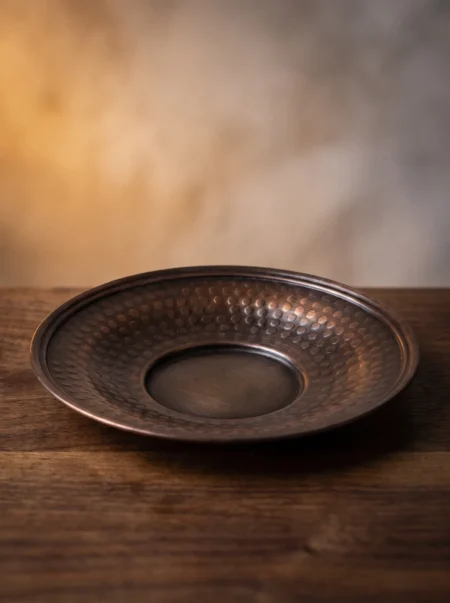 Service traysRound, oval and rectangular bodies for coffee, tea and bar service.See the range
 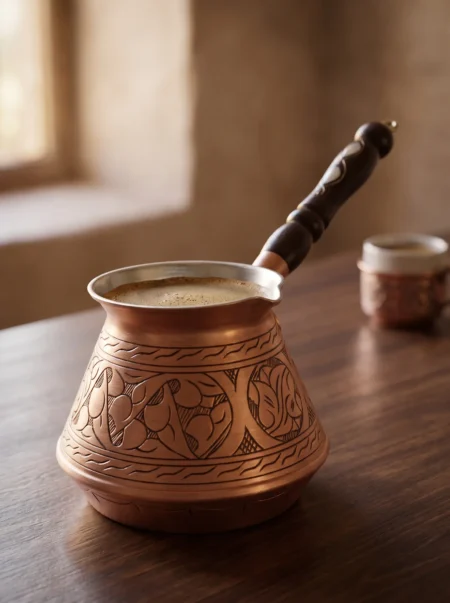 Turkish coffee potsCezve from single-cup to seven-cup bodies for counter service.See the range
 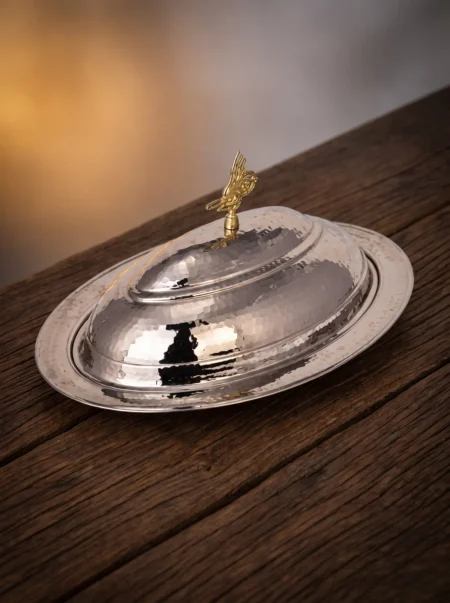 Mezze and presentation platesShallow plates, lidded dishes and shared-service bodies.See the range
 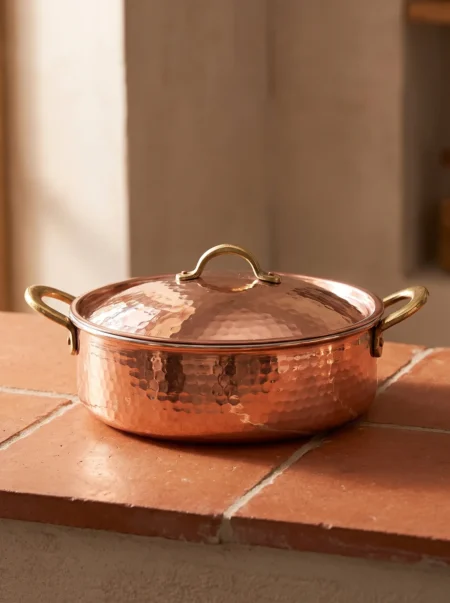 Pots and casserolesSingle-portion bodies through to large-diameter volume cooking.See the range
  Water pitchersLidded and open bodies for table and room service.See the range
 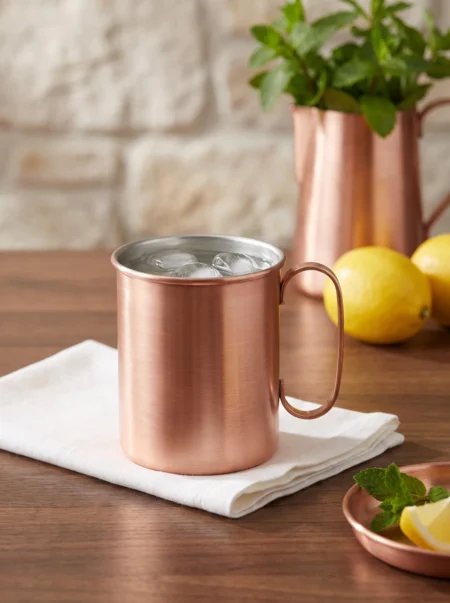 Drinkware in bulkTumblers, mugs with a handle and stemmed goblets, marked if you want.See the range
 How we work
BakırBul writes the specification, a long-term production partner makes the piece, and the goods go out under BakırBul’s own name. For a property that matters in one specific way: a single party is accountable from quotation through delivery to the replacement ordered two years later, rather than a chain in which nobody owns the specification.
We work through a long-term production partnership — we specify the piece, our partner produces it, and we carry it under our own name. Copper is selected from the workshops of Kahramanmaraş and other Anatolian copper towns, brought into our own warehouse, checked against the order and shipped. Where a venue needs a diameter, a depth or a handle that is not in the range, we have it made to your drawing.
For a property, that matters in a specific way: one party is accountable from quotation to delivery to the replacement you order two years later, rather than a chain in which nobody owns the specification.
Request a quotation
A venue quotation works best from the service rather than a product list: covers, service style, what your hobs are, who washes up and roughly what is needed. The answer comes back with a price, a realistic lead time and a note of anything we would not recommend for that kitchen.
Tell us the venue, the covers, the service style, what your hobs are and roughly what you need. If you are opening, send the concept and let us propose the list. We answer with a price, a realistic lead time and a note of anything we would not recommend for your kitchen.
What hospitality buyers ask
Can we use copper pans on our induction line?
No. Copper is not magnetic and an induction hob cannot detect it. An interface disc will make it heat, but it removes the responsiveness that made copper worth buying. Most induction venues use copper for service, presentation and drinkware instead, where the hob is irrelevant.
Are the pieces dishwasher safe?
We do not make that claim. Commercial machines dull the exterior, shorten the life of the tin and stress soldered joints. Hand washing and immediate drying is what we specify, and it belongs in the closing routine rather than in a staff member’s memory.
How often will pieces need re-tinning?
It depends entirely on what they meet. Pieces that carry closed cups may never need it. Pieces that meet lemon, vinegar, tomato or yoghurt through a nightly service will need it far sooner than a domestic buyer would expect. Tell us the covers and the dishes and we will give you a realistic expectation rather than a comfortable one.
Which finish do you recommend for a busy room?
Oxide or scotch-brushed. Both absorb handling marks and neither needs polishing. Bright red copper is beautiful and needs a rota; if no one owns that rota, do not order it.
Can copper serving plates be cut on?
Not with a steel knife. The tin lining is soft and will mark. Copper plates are presentation and shared-service pieces, and the venues that treat them that way keep them looking new for years.
Will you match a replacement to what we already have?
Yes, provided the original specification exists. We keep it on our side and we recommend you keep a copy, because a replacement matched to a written spec is exact and a replacement matched to a photograph is a negotiation.
Do you supply hotel room amenities?
Yes — trays, pitchers, glasses, small bowls, candle holders and decorative pieces, in the same finish as the public areas if you want the property to read as one identity. Specify it at the start; retrofitting a finish across a property is expensive.
Hand-hammered or machine-forged for a venue?
Hand-hammered for anything a guest sees and holds, machine-forged for back of house. The price gap is large enough that splitting the order this way is usually what makes a copper project affordable.
What is the minimum for a venue order?
There is no published figure, because a single tray diameter and a full opening list are different problems. Send the list and we will tell you straight away whether it works as an export shipment.
Do you provide documents for import?
We prepare the Türkiye-side export paperwork, and that service is priced rather than assumed. The customs declaration in your own country has to be made by a party established there. The division of responsibility is set out on the importing page.
Can pieces carry our logo?
Yes — engraving, laser marking and base stamping, and embossed work where the run justifies tooling. Base stamping is what most hotel groups choose, because the guest sees the piece and the stockroom sees the mark.
The 2026 catalogue — the full range with codes, sizes and weights: open or download it here. See also trays, plates, pitchers and bowls and food contact and compliance.
Tell us about the venue
Covers, service style and your hob type is enough to start. We come back the same day.
Last updated: 11 September 2026