
Wholesale Copper Candle Holders and Candlesticks
Copper candle holders, bought by the case
A candle holder is the one decorative object in a room that has an open flame sitting in it, and that single fact decides everything about how it should be specified. We supply solid copper candle holders, chambersticks and candlesticks — saucer-based hand holders with and without a handle, pieces with an integral pricket pin, in red copper, antique oxide, nickel, dark brown and matt black — to hotels, restaurants, event stylists, homeware retailers and gift buyers.
Tell us the candle before you tell us the holder. The diameter of the candle you already buy, whether staff or guests light them, and how often a room is reset are the three answers that decide socket form, base width and finish.
Copper candle holders are metal stands that carry a burning candle, and the three specifications that matter are the socket size, the drip surface and the base width. Socket size must match the candle you already buy, the drip surface catches wax before it reaches furniture, and base width is what keeps the whole thing upright.
Metal, not resin
Copper melts far above anything a candle can reach, so the body cannot soften, deform or crack under a flame.
The saucer is the drip tray
A wide dish under the socket catches runs before they reach a tablecloth. It is the reason the chamberstick form survived.
Socket or pricket
A socket grips a taper by its diameter. A pin pierces a pillar and holds it. They take different candles and are not interchangeable.
Finishes that hide handling
Antique oxide, matt black and dark brown absorb fingerprints and heat marks that bright red copper puts on display.
Sold as single pieces
Each holder is packed alone, so a mixed order across finishes and heights is a packing question rather than a production one.
Matched later
Order against a written specification and a retained sample and a top-up run years later still belongs to the same set.
What a copper candle holder has to get right
A candle holder has four jobs: hold the candle straight, stop it moving, catch the wax that runs, and stay standing when somebody knocks the table. Decoration is the fifth job and the easiest one. Most complaints that reach a supplier come from the first four being specified by eye.
Almost every candle holder sold anywhere looks fine in a photograph, which is exactly why buyers get caught. The failures show up in use, and they are dull, repeatable failures: a taper that leans because the socket is a size too wide, a pool of wax on a linen tablecloth because the dish is a decorative rim rather than a real catchment, a piece that goes over when a chair is pushed back, and a bright surface that looks neglected after a fortnight because nobody has time to polish it.
The reason copper is the traditional material for this object is not fashion. It is a metal, so it does not soften, char or give off anything when a flame sits above it. The Royal Society of Chemistry records copper’s melting point at 1084.62 degrees Celsius, which is an order of magnitude above anything a candle does to the metal it stands in. Resin and painted composite holders are cheaper and they deform, discolour and eventually smell. Glass is beautiful and cracks when a hot wick end meets a cold surface. Wood is a fire risk that nobody in hospitality should be arguing about.
The second property is less obvious and it cuts both ways. Copper moves heat extremely well — it is the reference metal for thermal conductivity in ordinary use, and the Copper Development Association documents the figures behind the same property that puts it in cookware and in electrical work. In a candle holder that means the socket never builds a local hot spot, because heat is pulled away and spread through the body almost as fast as the flame delivers it. It also means the whole piece becomes warm to the touch, including the handle, after a candle has burned for an hour or two. That is normal, it is not a fault, and it is worth telling front-of-house staff before the first service rather than after the first complaint.
Socket size, pricket pins and the candle standards that actually exist
Socket diameter is the specification buyers skip and then live with. A taper socket grips the candle by its base diameter, and dinner candles cluster around a small number of widths rather than one universal size. A pricket pin does the opposite job: it pierces a pillar candle from below and holds it by the wax itself.
Start with the candle, because the candle is the thing you cannot change. Dinner and taper candles sold across Europe and the United Kingdom cluster around a base diameter close to 22 millimetres, with a slimmer family around 12 to 14 millimetres that is common in Scandinavia and in Christmas ranges. Tea lights are the one genuinely standardised item in the whole category: a metal cup a little under 40 millimetres across and around 16 millimetres tall, and a tea light from one brand drops into a cup sized for another. Pillar candles have no standard at all and run anywhere from 50 to 80 millimetres and beyond.
A socket that is a millimetre or two too wide is the single most common cause of a leaning candle, and a leaning candle drips down one side instead of burning evenly. The traditional fixes are all bodges: a wrap of foil, a twist of paper, a blob of soft wax pressed into the socket. They work, they are ugly, and in a dining room somebody will see them. Buying the socket to the candle removes the problem permanently.
A socket that is too tight is the other half of the same mistake, and it is worse in winter. Wax contracts as it cools, so a candle pushed into a snug socket while warm can grip hard once cold, and the usual way staff free it is with a knife. That is how sockets get scored. If your rooms are cold, specify the socket at the upper end of the tolerance rather than the lower.
The pricket pin — the integral spike found in the nostalgia and vintage chamberstick forms we carry — solves a different problem. There is no diameter to match because the pin goes into the wax, which means one holder takes pillars of several widths. In exchange it takes a firm push to seat a candle and it leaves a hole in the base of the stub, so half-used candles do not go back into a box neatly. For a venue that burns candles down and throws the stubs away, the pin is the easier object. For a household that saves half-burned tapers, the socket is.
There is also a practical safety argument for the pin that is rarely made. A pillar held on a pin cannot be lifted out by a sleeve or a napkin the way a loose taper can, which matters at a table where guests reach across a flame.
Wax: where it goes, and how it comes off
Wax management is the real workload behind a candle holder, and the design decides how much of it there is. A wide saucer under the socket catches runs before they reach a surface, a deep socket holds the last of the stub, and a smooth body releases set wax in one piece instead of in flakes.
Dripping is not really a property of the candle. It is a property of the draught. A candle burning in still air consumes its own melt pool and drips very little; the same candle beside an open door, under an air conditioning outlet or on a terrace burns unevenly, the pool breaches the rim on the cool side, and wax runs. That is why every serious candle holder form in history has a dish under it, and why the chamberstick — a saucer with a socket in the middle and often a handle on the rim — became the dominant domestic form long before electricity.
The holders in our range are built on exactly that geometry. The dish is the drip tray, not an ornament, and it is generously sized relative to the socket, so a candle that misbehaves in a draught still empties into the dish rather than onto the table. For outdoor terraces and anywhere with moving air, that margin is the specification that matters most, and it is worth asking for the wider dish even if the narrower piece photographs better.
Getting set wax out without damaging the metal
Two methods work and one does not. The first is cold: put the holder in a freezer for half an hour and the wax contracts away from the copper, so a set pool lifts out in one piece and a stub in a socket pops free with finger pressure. The second is warm: run hot water over the outside of the socket, or stand the piece in hot water, and wipe the softened wax out with a cloth before it sets again. Do not pour boiling water directly into a socket on a cold night if you can avoid it, and do not put a copper holder in a dishwasher.
The method that does not work is a knife. Copper is a soft metal, softer than the steel of a table knife, and a blade used to chip wax leaves scores that catch the light forever afterwards. In a venue this is the single instruction worth writing on the inside of the housekeeping cupboard door, because it is always well-meant and it is always permanent.
One habit halves the work. Do not let a taper burn all the way down into the socket. The last centimetre produces the most wax, the most soot and the most heat in the metal, and it buys almost no light.
Heat, soot and what a flame does to copper over time
Copper changes colour where a flame heats it. Around the socket of a holder in daily use a darker ring develops over weeks, and that is oxide forming faster in a hot spot rather than damage. It cannot be prevented, only blended into the finish, which is why finish choice matters so much here.
Copper reacts with oxygen in air to form a thin oxide film, and heat accelerates the reaction. Every copper object darkens; a candle holder simply darkens unevenly, fastest at the rim of the socket where the metal is hottest. On a bright red copper piece this reads as a ring, and it appears within a few weeks of nightly service. On an antique oxide, dark brown or matt black finish it blends into a surface that is already dark, which is why those finishes dominate hospitality orders and why bright copper dominates photographs.
Soot is a separate problem and it is fixable. A long wick burns with a larger, unstable flame that does not combust cleanly, and the carbon it throws lands on the nearest cold surface — which is the inside of your socket and the underside of your dish. Trim the wick to around five millimetres before each lighting and the deposit almost disappears. Untrimmed wicks in a draught are also what put black marks on ceilings above wall sconces, so this is not only a cleaning question.
Soot on copper wipes off with a soft cloth and a little warm water and detergent while it is fresh. Left for a season it bonds into the oxide layer and needs a metal polish to shift, which takes a small amount of surface with it every time. A brief wipe at reset is a better habit than a heavy clean once a quarter.
One thing a flame does not do is harm the metal structurally. There is no lacquer on these pieces to scorch or cloud, and nothing is applied over the copper that heat could lift. What you are managing is the colour of a bare metal surface, which is a maintenance choice rather than a defect, and it is the whole reason a dark finish is usually the right commercial answer.
Stability: base width, weight and the knock that goes unnoticed
Stability comes from base width and from where the mass sits, not from total weight. A saucer-based holder is hard to tip because the foot is wide relative to the flame height and the heaviest part of the object is at the bottom. A narrow-footed candlestick with a tall taper is the opposite arrangement.
The holders in this range sit on a dish roughly eleven to twelve and a half centimetres across, with overall heights running from about six centimetres up to twenty-two. Sheet thickness runs from half a millimetre to a full millimetre and finished weights from around a hundred and forty grams to a little over four hundred. Those figures describe a deliberately low, broad object: the footprint is wide, the mass sits in the dish, and the candle is the only tall element.
That geometry is the reason the chamberstick form has survived four centuries of being carried up staircases. It also makes it the safer choice for a restaurant floor, where the real hazard is not a dramatic accident but a pushed chair, a swung bag or a sleeve on a reach across the table. A holder that rocks and settles is a different object from one that goes over.
Two variables make tipping worse and both are under your control. The first is candle height: a tall taper raises the centre of gravity of the whole assembly and a long candle in a short holder is genuinely less stable than the same holder with a stub. The second is surface. A metal base on a glass or polished stone table slides, and something that slides ends up at the edge. A small felt disc under the base costs almost nothing and solves it, and it is easier to specify at the start than to retrofit across a floor.
For outdoor use, weight matters again for a different reason. Wind moves light objects, and a terrace is exactly where you least want a flame to move. Ask for the heavier pieces in the range for outdoor covers and keep the lightest ones indoors.
The forms buyers ask for: chambersticks, hand holders and tall sticks
Three forms cover nearly every enquiry. The chamberstick is a saucer with a socket and a handle, made to be carried. The handle-less hand holder is the same dish without the loop, made to sit. The tall candlestick lifts the flame above eye level on a table or a mantelpiece.
The chamberstick is the oldest of the three and the most practical. The handle on the rim means the piece can be picked up while lit without touching the hot dish, and the dish itself catches whatever runs while it is being moved. It reads immediately as traditional, which is why it sells well in gift and heritage retail, and it is the form most often photographed for hotel corridors and bedside tables.
The handle-less version is the quieter object. Without the loop it is symmetrical from every angle, which matters on a round table where guests sit all the way around, and it stacks and packs more compactly. The nostalgia and vintage lines we carry exist in both variants, several of them with an integral pin rather than a socket, so a buyer can choose the look and the candle type independently.
Taller candlesticks do a different job. At a dining table a flame at eye level is uncomfortable and it puts a hard highlight in the middle of every photograph; a flame above or below the line of sight does not. Height is therefore a lighting decision rather than a styling one, and the honest guidance is to buy a mix rather than a single height, then set a room with groups rather than pairs.
Wall-mounted sconces come up constantly in enquiries and they are a different category with a different risk profile: a flame near a vertical surface needs a backplate wide enough to protect the wall, and fixing into plasterboard is a real consideration. If that is what you are sourcing, say so at the enquiry stage, because it is made to drawing rather than picked from a shelf.
Finishes: red copper, antique oxide, nickel, dark brown and matt black
Five finishes run through this range and each one answers a different room. Bright red copper is the most striking and the most demanding. Antique oxide is the lowest-maintenance surface. Nickel reads silver instead of copper. Dark brown and matt black hide heat rings and fingerprints almost completely.
Bright red copper is the finish everybody pictures and the one that asks the most in return. It shows fingerprints within a service and a heat ring around the socket within weeks, and keeping it mirror-bright needs somebody genuinely assigned to polishing. In a shop window, a bridal display or a photographed interior it is unbeatable. On thirty restaurant tables reset twice a night it is a commitment.
Antique oxide is copper darkened deliberately, so the recesses sit dark and the raised areas stay warmer. Because it is already dark, further darkening from flame heat simply blends in, and no polishing rota is needed at all. For a venue that wants copper to look like copper without staffing it, this is usually the right answer.
Nickel plating changes the colour of the conversation. A plated holder reads silver, sits comfortably in a room styled around stainless steel or chrome, and shows marks later than bare bright copper. The trade-off is honest and worth writing into your own product copy if you resell: plating is a coating, so it cannot be polished back the way bare copper can, and a worn edge eventually shows copper underneath. Never clean a plated piece with copper polish.
Dark brown and matt black are the workhorses of this particular category and they are under-ordered. Both absorb the two marks that candle holders actually collect — the heat ring and the fingerprint — and both sit well in contemporary interiors where a bright metal would shout. If you are furnishing a floor rather than a window, start here and buy the bright pieces for display.
One note on coatings, because it is offered elsewhere in this trade. A clear lacquer stops tarnish and removes the maintenance question, and on a candle holder it is the wrong answer. The socket is the hottest part of the object, coatings do not enjoy repeated heating, and a clouded or lifted lacquer cannot be spot-repaired the way a bare copper surface can be simply wiped.
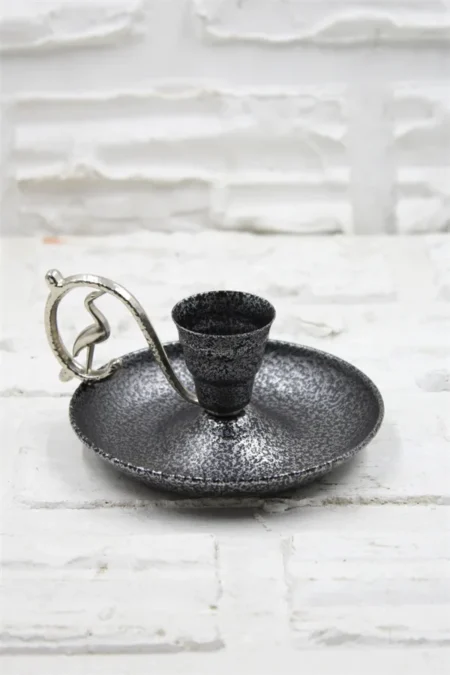
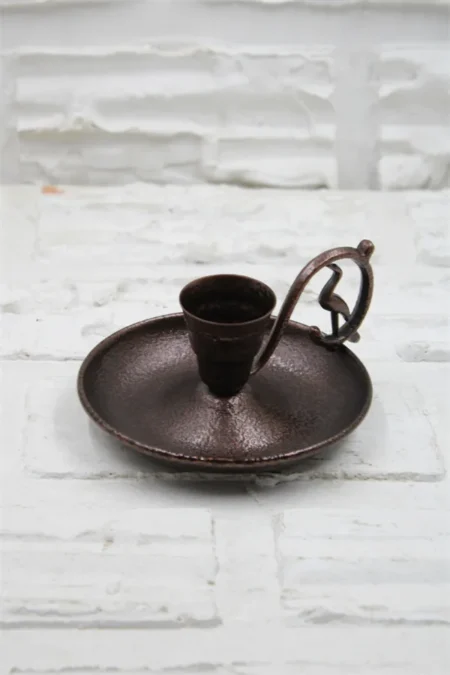
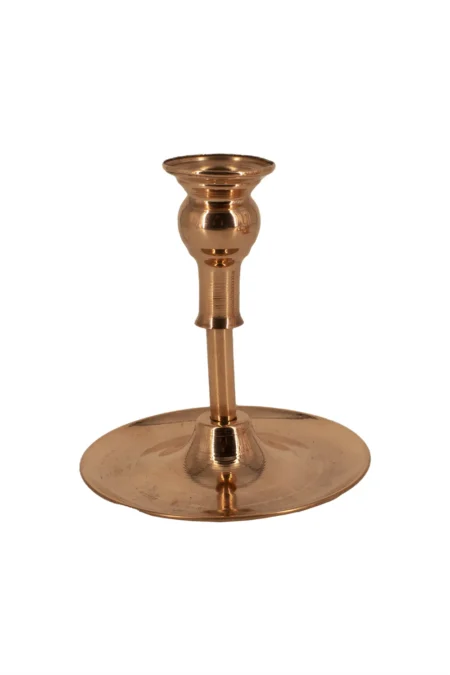
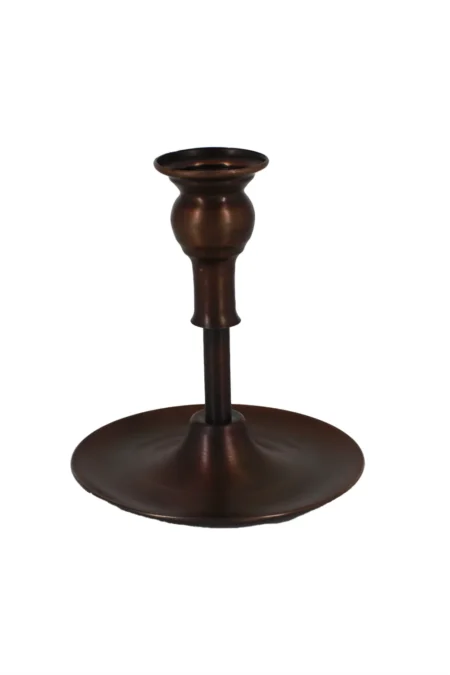
21 items in stock right now, from 6 cm to 22 cm. Other sizes and finishes are produced to order.
Fire safety: what we will say, and what we will not
Copper candle holders do not carry a fire-safety certificate and we will not imply one. What can be stated is material fact: copper is non-combustible, it does not soften at candle temperatures and it does not give off fumes. Everything else about open flame in a venue is governed by local rules and by supervision.
This matters commercially because buyers in hospitality are sometimes asked by an insurer or a fire officer for documentation, and there is a real temptation among suppliers to answer that question loosely. We would rather be plain: we do not hold a fire-safety test report for these pieces, and a claim we cannot support with test data on our own goods is not one we are entitled to repeat. If a tender requires a specific test, tell us before an order is placed and we will find out whether it can be arranged and at what cost, rather than discovering it at the point of delivery.
What is true and useful is narrower. The body is metal, so it cannot catch light, and the melting point cited earlier means a candle cannot deform it. There is no surface coating on these pieces to burn off. The dish under the socket is a physical barrier between molten wax and the surface underneath, which is the failure mode that actually damages furniture.
The rest is procedural and it belongs to the operator. Open flame in dining rooms, corridors and function spaces is regulated differently in almost every jurisdiction, and some venues are simply not permitted it. Where that is the case, the same holders take LED tea lights without any change of specification, which is worth knowing before you conclude that a copper order is off the table. We do not supply the lights themselves; we are telling you the holder is not the obstacle.
Two habits do more than any product choice. Do not leave a flame unattended, and keep candles away from curtains, menus, dried flower arrangements and anything else on a table that moves in a draught. Neither is a surprise; both are what an incident report ends up saying.
Buying for hotels, restaurants, retail and events
Trade buyers in this category are buying a consumable fitting rather than a permanent one. Candle holders are handled by every member of floor staff, carried between rooms, dropped, and occasionally taken home by guests, so replacement matching and packing sense matter more than the first unit price.
The question that decides whether a purchase was a good one is not how the holders look on arrival. It is whether a top-up run two or three years later is indistinguishable from the original. Order against a written specification — dish diameter, overall height, socket or pin, sheet thickness, finish name — keep a physical sample on a shelf, and a repeat is straightforward. Order from a photograph and a repeat is guesswork, and the mismatch is visible on every table in the room at once.
Attrition, and where the pieces go
Small, attractive, portable metal objects disappear from venues at a predictable rate, and event work is worse than restaurant work because pieces travel in crates and come back short. Build a spare allowance into the first order rather than reordering a handful at a time, because small top-up quantities are the least efficient thing anyone can buy. Some operators go further and stock a matching piece at reception so a guest who wants one can buy it honestly.
Mixed orders and packing
These holders are individually packed pieces rather than boxed sets, which makes a mixed order across finishes and heights a packing exercise rather than a production problem. That is genuinely useful for event stylists, who rarely want thirty identical objects and often want three heights in one finish. Say how the pieces will be stored between events and cartons can be specified to be restacked rather than opened once and thrown away.
Retail, gifting and marking
For retail shelves the important decision is whether the piece must stand upright in its packaging, because that changes the insert rather than the holder. Branded boxes, sleeves and printed cartons are available as a separate line and are quoted separately rather than buried in a unit price. A house name or crest can be engraved, stamped or laser-marked, usually on the underside of the dish where guests do not see it and stock control does. Send vector artwork and placement is confirmed on a sample before a run starts; fine engraving on a hammered surface needs checking against the actual texture rather than promising in advance.
Ordering from Türkiye: enquiry, sample, series
Ordering copper candle holders from Türkiye runs in three steps. The enquiry describes the candle and the room rather than a catalogue code, a sample fixes the finish and the socket in physical form, and the series is produced against that retained sample. Export paperwork on the Turkish side is quoted as a service.
Begin with four answers: the diameter of the candle you already buy or intend to buy, whether you want a socket or a pin, which finishes, and an approximate quantity with a destination country. There is no published minimum figure, and that is deliberate rather than evasive — a single height in a single finish and a mixed event list are entirely different problems, and one number would be wrong for most of the range. Send the list with quantities and a destination and we will say straight away whether it works as an export shipment.
The sample step is the one buyers skip and later regret. Finish names travel badly between suppliers and between languages: antique means one thing in one workshop and something visibly different in another, and hammered covers everything from a fine all-over texture to a few deep strikes. Agree a physical sample, keep it, and quote future runs against it. Samples are chargeable, which is normal in this trade, and the cost is trivial against a mismatched reorder.
Packing deserves more attention here than for flat goods. Copper marks copper, so pieces travel separated rather than nested, cornered and boxed in stack heights one person can lift. Carton dimensions and gross weights go out with the quotation so your forwarder can quote against real figures instead of estimates, and so you can compare landed cost properly rather than comparing unit prices.
On customs we say what we know and no more. Copper household articles of this kind sit in Chapter 74 of the Harmonized System, under heading 7418, but classification responsibility belongs to the importer and their broker and we will not pretend otherwise. The World Customs Organization maintains the nomenclature at that level; national subheadings and duty rates are set locally and confirmed at the date of shipment. Export documentation on the Turkish side is prepared here and quoted as a service rather than assumed to be included, and there is no contracted carrier on our side, so transport is arranged by you or your forwarder. The customs declaration in the destination country stays with the importer, because only a party established there can make it. The detail is on our importing page.
How we work
BakırBul works through a long-term production partnership rather than a plant of its own. We specify the piece, our partner produces it, and we carry it under our own name, check it in our own warehouse and ship it from there. Forms outside the standard range are made to drawing.
Copper is selected from the workshops of Kahramanmaraş and other Anatolian copper towns, brought into our own warehouse, checked against the order and shipped from there. Two things follow from that arrangement and both are in the buyer’s favour. Because we specify rather than resell whatever a catalogue happens to contain, a repeat order can be matched to what you received last time. And because checking happens in our own warehouse before a shipment leaves, the rejects are ours rather than yours.
Where a form does not exist in the range at all — a socket sized to an unusual candle, a taller stick, a wall piece — new tooling is made at the workshop we work with when the quantity justifies it, and the tooling belongs to the buyer who paid for it. What we will not do is copy a design that belongs to somebody else, and any surface that is intended to meet food is tinned rather than left bare. A candle holder meets wax and air rather than food, so a bare interior is the correct specification here rather than a saving.
Request a quotation
Send the candle diameter you use, a socket or pin preference, the finishes you want, an approximate quantity and a destination country. That is enough for a price and a realistic lead time. If the holders are going onto a retail shelf, say so, because packaging changes the quotation more than the piece does.
Frequently Asked Questions
What size candle fits a copper candle holder?
It depends on the socket, which is why the candle comes first. Dinner and taper candles across Europe and the United Kingdom cluster close to twenty-two millimetres at the base, with a slimmer family around twelve to fourteen. Tea lights are genuinely standardised at a little under forty millimetres across. Tell us the candle you already buy and the socket is specified to it.
What is the difference between a socket and a pricket pin?
A socket is a cup that grips a taper by its base diameter, so it only takes candles of roughly the right width. A pricket is a pin that pierces a pillar candle from underneath and holds it by the wax, so one holder takes several widths. The pin is easier for venues that burn candles down; the socket is easier for households that keep half-used tapers.
Will the copper darken around the socket?
Yes, and that is normal rather than damage. Copper forms an oxide film in air and heat speeds the reaction up, so a holder in nightly use develops a darker ring at the hottest point within a few weeks. It shows plainly on bright red copper and blends into antique oxide, dark brown and matt black, which is why those finishes carry most hospitality orders.
How do you get wax out without scratching the copper?
Cold or warm, never sharp. Half an hour in a freezer contracts the wax away from the metal and a set pool lifts out in one piece. Alternatively run hot water over the outside and wipe the softened wax away. Do not use a knife: copper is softer than a table knife and a blade leaves permanent scores in the socket.
Does a copper candle holder get hot?
The body becomes warm to the touch after a candle has burned for an hour or two, including the handle, because copper moves heat through itself very readily. It does not become dangerously hot at the base and it will not deform, but staff should be told before the first service. The hottest area is always the rim of the socket.
Do copper candle holders need a tin lining?
No. Tin lining exists so that acidic food does not sit against bare copper, and a candle holder meets wax and air rather than food. A bare interior is the correct specification here rather than a saving. If you intend a piece in the same range to hold food — a dish used for nuts or sweets, for instance — say so and the interior is specified for that purpose instead.
Can you supply a fire-safety certificate?
No, and we will not imply otherwise. We do not hold a fire-safety test report for these pieces. What is material fact is that copper is non-combustible, does not soften at candle temperatures and carries no coating to burn off. If a tender requires a specific test, tell us before an order is placed so we can find out whether it can be arranged and at what cost.
Which finish should a busy restaurant order?
Antique oxide, dark brown or matt black in almost every case. All three absorb the heat ring at the socket and the fingerprints that floor staff leave, and none needs a polishing rota. Nickel is the choice where a room is styled around silver tones. Keep bright red copper for windows, displays and photography, where somebody is assigned to it.
Do you have a minimum order?
There is no published figure, and that is deliberate rather than evasive. A single height in a single finish and a mixed list across five finishes are different problems, and any one number would be wrong for most of what we carry. Send the list with quantities and a destination country and we will tell you immediately whether it works as an export shipment.
Can you engrave a hotel or brand name on them?
Yes. The usual placement is the underside of the dish, where guests do not see it and stock control does, with a crest or house name on the upper surface where it is meant to be seen. Hand engraving suits a crest, laser marking suits a fine logo or a run of codes. Send vector artwork; fine work on a hammered surface is checked against the real texture on a sample first.
The 2026 catalogue — the full range with codes, sizes and weights: open or download it here. If you are furnishing a property see copper for restaurants and hotels, for trays, plates and serving bodies see copper serveware, and the cleaning routine in full is on our copper care page.
Send us your list
A candle diameter, a socket or pin preference, the finishes you want, an approximate quantity and a destination country is enough to start. We come back the same day.
Last updated: 20 September 2026