
Wholesale Copper Oil Cruets
Copper oil cruets, specified for service
An oil cruet is judged by what it does to its contents. Copper is opaque, and that single property is the honest reason to put oil in a metal vessel rather than in clear glass. We supply solid copper olive oil cruets — smooth-bodied, in red copper, antique oxide, brushed matt and nickel plating — to restaurants, delicatessens, olive oil bottlers and homeware buyers. This is a deliberately narrow part of the range, and most orders in it are made to the specification a buyer sends rather than picked off a shelf.
Tell us what goes in the cruet and where it lives — a dressed table, a working pass, a retail gift pack, a bottler’s own-label line — and we will come back with a capacity, a spout form, an interior specification and a finish.
A copper oil cruet is a small, opaque vessel used to hold and pour olive oil at a table, a pass or a counter. Its body blocks light completely, which closes one of the three routes by which olive oil goes rancid. It is specified by capacity, spout form, interior lining and finish rather than by appearance alone.
Light is the one thing an opaque body removes completely
Olive oil degrades through light, heat and oxygen, and a copper cruet closes the first of the three outright. Copper sheet is fully opaque, so photo-oxidation stops at the wall of the vessel. A clear glass cruet standing under a service light is the worst case for exactly the same oil.
Green extra virgin oil carries chlorophyll and its breakdown products, and those pigments act as photosensitizers: under light they push oxygen into a reactive state that attacks the unsaturated fats. That is why the trade’s own packaging convention is dark glass, tinplate or steel rather than clear bottles, and why the International Olive Council’s packaging guidance points the same way. What copper does not do is close the other two routes. A cruet parked beside a hob is being cooked slowly whatever it is made of, and one left half full for a month has a headspace working on the oil the whole time.
What goes inside, and why we ask before quoting
Copper acts as a catalyst for the oxidation of fats, which makes the interior specification of an oil cruet a functional decision rather than a cosmetic one. Trace copper accelerates the same reaction that light begins. Where oil, vinegar or a made-up dressing sits against the metal, the interior is specified as tinned rather than left bare.
Free fatty acids in olive oil are weak organic acids, and a dressing with vinegar or lemon in it is a good deal more aggressive than the oil alone. The answer here is a tinned interior, and tin is a consumable surface rather than a permanent one: it wears, and it is re-tinned when it does. The metal’s properties are set out plainly by the Royal Society of Chemistry, and the routine that keeps a lining alive is on our copper care page. So the first question we ask is the simplest: what will actually be in it. A cruet for oil at a table, one for vinaigrette on a salad station and one that sits on a shelf are three specifications, and only the last is a decorative decision.
The pour, the drip and the refill routine an opaque cruet forces
A copper cruet hides its own level, and that is the price of hiding the light. Service staff cannot see how much oil is left, so refilling becomes a scheduled task rather than a visual one. Spout form, drip behaviour and a capacity small enough to turn over quickly all follow from that single fact.
A narrow, slightly lipped spout cuts the stream cleanly at the end of a pour; a wide, soft lip dribbles, and the film runs down the outside where it collects dust and turns rancid unseen. Wiping the body after service is the habit that keeps the piece looking like the room it stands in. The standing capacity here is a half-litre, large enough that a station is not refilled mid-shift and small enough that the oil turns over; the body weighs a little over three hundred grams empty, so a full cruet is still poured comfortably with one hand.
One distinction saves a wrong order. Buyers searching for an Italian-style oliera usually mean a professional dispenser built around a spring-loaded, self-closing spout, most often on a stainless body with a copper-coloured finish. That is a different object from a hand-worked copper cruet. If the valve is the requirement, say so at the quotation stage and we will answer plainly.
Sizes, finishes and made-to-order work
Copper oil cruets in the standing range are smooth-bodied at a half-litre, in red copper, antique oxide, brushed matt and nickel plating, worked in a sheet around seven tenths of a millimetre. Because the category is deliberately narrow, capacity, spout form, handle, base and interior are normally set by the buyer’s own list.
The four finishes behave differently in a working room. Red copper is the brightest and the most demanding: it darkens with air and handling and rewards a polishing rota somebody actually owns. Antique oxide is already dark, so further darkening blends in. Brushed matt hides fingerprints, which matters on a piece handled at every table, and nickel plating shows oil marks latest of the four. Beyond the standing body this is a made-to-order category in practice: a matched pair for oil and vinegar, a recess sized to an existing tray, a smaller counter body for a delicatessen, a house name engraved on the shoulder. New tooling is made at the workshop we work with when the quantity justifies it. What we will not do is copy a design that belongs to somebody else, and any surface intended to meet food is tinned rather than left bare.
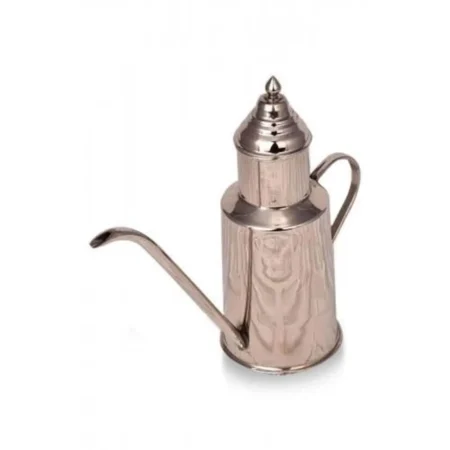
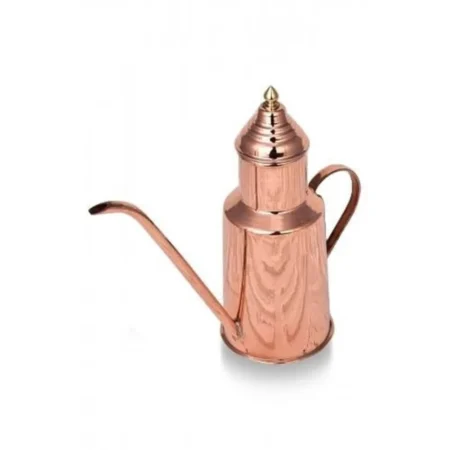
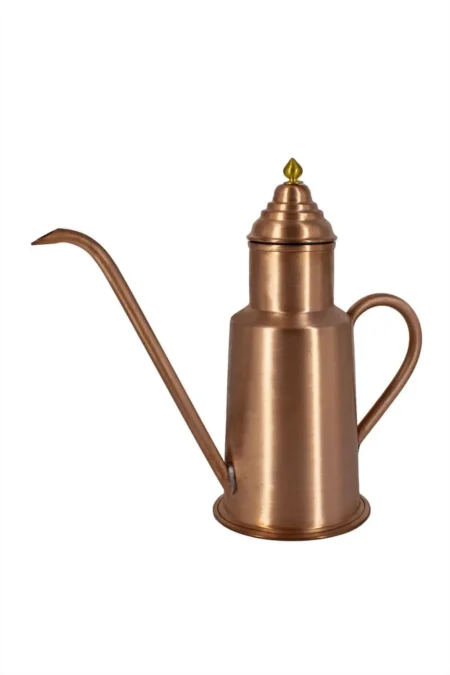
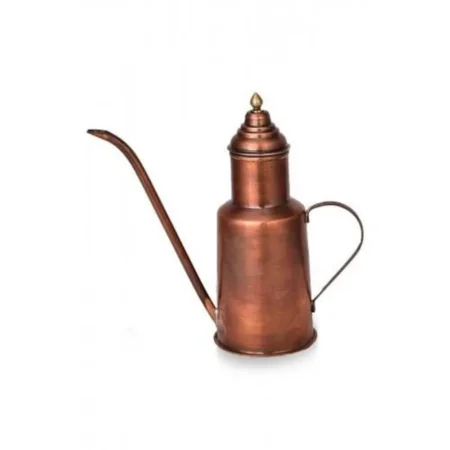
4 items in stock right now, all of them 500 ml. Other sizes and finishes are produced to order.
Documents, customs and what we will not claim
BakırBul does not hold a food-contact certificate for copper cruets, and says so before an order rather than at a border. Copper table and kitchen articles of this kind sit under Harmonized System heading 7418, but classification is the importer’s responsibility and their broker’s decision rather than ours.
In the European Union the framework for materials intended to contact food is Regulation (EC) No 1935/2004, with the EDQM guide as the working reference for metals and alloys; in the United States it is the FDA Food Code. No supplier can hand you an approval certificate for a copper cruet, because that document does not exist; what exists is a migration test report against a stated specification. If your market asks for one, say so before the order so the testing is arranged rather than promised. The longer version is on our food contact and compliance page.
Heading 7418 sits in Chapter 74 of the nomenclature maintained by the World Customs Organization; national tariff lines and duty rates sit below that six-digit level and belong to your broker. Export documentation on the Turkish side is prepared here and quoted as a service rather than assumed to be included; we have no contracted forwarder, so carriage is normally left with the buyer; and the destination declaration stays with the importer. The detail is on our importing page.
How we work
BakırBul works through a long-term production partnership rather than a plant of its own. We specify the piece, our partner produces it, and we carry it under our own name, check it in our own warehouse and ship it from there. Cruets outside the standing body are made to drawing rather than substituted.
Copper is selected from the workshops of Kahramanmaraş and other Anatolian copper towns and checked here against the order. Because we specify rather than resell whatever a catalogue happens to contain, a repeat order can be matched against what you received last time; and because checking happens before a shipment leaves, the rejects are ours rather than yours.
Request a quotation
A cruet quotation starts from a capacity, a spout form, a finish, an approximate quantity and a destination country, plus one sentence on what will sit inside — oil alone, or vinegar and dressings as well. There is no published minimum figure, because a single number would be wrong for most of what we carry.
Frequently asked questions
Is copper a good material for an olive oil cruet?
For light, yes, and that is a real advantage rather than a marketing one: an opaque body stops photo-oxidation at the wall. For heat and oxygen the material changes nothing. A cruet kept away from the heat line and refilled often is an excellent vessel; one left half full beside a hob is not.
Does olive oil react with copper?
Copper acts as a catalyst for the oxidation of fats, so prolonged contact between oil and bare copper works against the oil rather than for it. That is why an interior specification is asked for at the quotation stage, and why contents that stand between services sit against tin instead of metal.
Should the inside of a copper oil cruet be tinned?
If it holds oil, vinegar or a made-up dressing, yes. If it is a display piece that never holds anything, no, and paying for a lining nothing needs is waste. Tin is consumable rather than permanent: it wears with use and is re-tinned, which is normal for copper and not a fault.
What capacity should a service cruet be?
Small enough that the oil turns over, large enough that nobody refills mid-shift. The standing body here is a half-litre, which suits a dressed table or a station in most rooms. Back-of-house refill bodies and small counter bodies for a delicatessen are both made to order.
Which finish holds up best in a busy dining room?
Nickel plating and brushed matt, in most rooms. Nickel shows oil marks and fingerprints latest of the four finishes, and brushed matt breaks them up. Antique oxide is already dark, so further darkening blends in. Red copper is the most striking and the most demanding, and it needs a polishing rota.
Are these the same as an Italian self-closing oliera?
No, and the difference is worth confirming before an order. A professional oliera is built around a spring-loaded valve that shuts the spout when the bottle is set down, usually on a stainless body. These are hand-worked copper vessels with a formed lip. If the valve is the requirement, tell us.
Do you have a minimum order?
There is no published figure, and that is deliberate rather than evasive. One capacity in one finish and a mixed list across several categories are different problems, and any single number would be wrong for most of what we carry. Send the list with quantities and a destination country.
Can you engrave or private-label the cruets?
Yes. A house name or crest goes on the shoulder where guests see it, and an inventory code goes on the base where they do not. Hand engraving suits a crest; laser marking suits a fine logo or a run of codes. Send vector artwork and placement is confirmed on a sample.
The 2026 catalogue — the full range with codes, sizes and weights: open or download it here. For trays, plates and pitchers see copper serveware; for a whole property, copper for restaurants and hotels; and drawings, tooling and sampling are on our made-to-drawing page.
Send us your list
A capacity, a spout form, a finish, an approximate quantity, a destination country and one line on what goes inside is enough to start. We come back the same day.
Last updated: 20 September 2026