
Wholesale Copper Mugs and Drinkware
Copper mugs, cups and goblets in bulk
We supply handmade copper drinkware to bars, hotel groups, coffee roasters, promotional agencies and retail brands — plain tumblers, hammered mugs with a handle, stemmed goblets, ladle-handled maşrapa cups and shot cups, tin-lined inside and marked with your logo if you want one. Tell us the shape, the capacity, the finish and roughly how many, and the quotation comes back the same day.
Not sure which body you need? Describe the drink and the service — iced drinks, hot Turkish coffee alongside, water on the table, a gift box — and we will propose the shapes that survive it.
BakırBul supplies handmade Turkish copper drinkware in bulk: hammered mugs with a handle, straight tumblers, ladle-handled maşrapa cups, stemmed goblets and shot cups. Every surface that meets a drink is tin-lined as standard, bodies can be engraved or laser-marked with your logo, and shapes outside the range are made to drawing.
Tin-lined interiors
Every surface that meets a drink is tinned. That is the default, not an upgrade you pay extra for.
Logo and engraving
Hand engraving, laser marking and base stamping are done to order. Send the artwork and we come back with a sample.
Shapes outside the range
If the body you want does not exist yet, new tooling can be commissioned at the workshop we work with.
Tiered pricing
Unit price falls as the quantity of one item rises. The tiers are written into the quotation.
Samples before bulk
You approve a physical piece before the run starts, and the sample cost is deducted from the order.
Export packing
Individually wrapped, cartoned and palletised for freight. Copper dents; the packing assumes it will be handled badly.
The shapes buyers actually order
Wholesale copper drinkware divides into five bodies that behave differently in service: hammered mugs with a handle, straight tumblers, maşrapa ladle cups, stemmed goblets and small shot bodies. Choosing the wrong body for the drink and the service is the most common reason a first bulk order disappoints.
Copper drinkware is not one product. The bodies below behave differently in service, cost differently to make and photograph differently, and choosing the wrong one is the most common reason a first order disappoints. This is what we get asked for, in roughly the order we get asked.
Hammered mugs with a handle
The straight-sided mug with a soldered or riveted handle is the piece most international buyers arrive looking for, usually under the name it took from the cocktail it is served in. In our own catalogue the closest Turkish body is the maşrapa, a ladle-style cup that has been made in Anatolia far longer than that drink has existed. The two are close cousins: same wall behaviour, same thermal trick, different handle geometry. Hand-hammered walls scatter light and hide fingerprints, which matters more on a bar than most buyers expect — a mirror-bright mug looks superb in a photograph and looks filthy after twenty minutes of service.
The handle is the part that fails. Ask any supplier how the handle is attached and treat a vague answer as a warning. A riveted handle survives a dropped tray; a lightly soldered one does not. We state the attachment method in writing because it is the single difference that decides whether you reorder in a year or replace the whole set.
Straight tumblers and water cups
Plain-walled tumblers in the middle capacities are the volume item for hotels and restaurants: they stack better, cost less per piece, and read as tableware rather than as a themed prop. They are also the easiest body to mark, because the wall is uninterrupted. If you are ordering copper for a table rather than for a bar, start here.
Stemmed goblets — kadeh
The stemmed copper goblet is a specifically Turkish and Middle Eastern table piece, and it is the shape that most surprises Western buyers when they see it in use. It carries a table setting visually in a way a tumbler cannot, and it suits gift boxing. The stem is a separate soldered assembly, so the tolerance question is different: ask about wobble on a flat surface, not about wall thickness.
Shot cups, small bodies and gift sets
Small bodies are disproportionately popular as branded giveaways because the metal cost per piece is low while the perceived value stays high. They are also where engraving reads worst — a mark with fine detail does not survive on a small curved wall. If your artwork is complex, put it on a larger body or on the base.
Lining, and the honest version of the safety question
Tin lining is what makes copper drinkware usable, because copper reacts with acid and tin does not. The lining is applied by hand with heat, it wears with use, and it is renewed rather than replaced. Uncoated interiors sold as authenticity are a defect dressed up as tradition.
Copper reacts with acid. That is chemistry, not marketing, and it is the reason the inside of a serious copper vessel is tinned. Tin is a soft, food-appropriate metal that sits between the drink and the copper. It is applied by hand, with heat, and it wears — slowly in a home, faster in a bar that runs the same mugs through service every night.
You will find sellers offering uncoated interiors for acidic drinks and framing it as authenticity. It is not authenticity, and we do not do it. You will also find claims that drinking from copper delivers specific health benefits; those claims are largely a myth built on a real trace-mineral requirement, and there is no evidence that a mug is a sensible way to meet it. We would rather sell you a well-made piece than a story.
What we do state plainly: the tin layer is renewable. When copper starts to show through, the piece is re-tinned rather than binned, and in a commercial setting that is a maintenance line item you should plan for. Our page on living with copper covers how to spot it, and the safety questions are answered in full on their own page.
An exterior lacquer is available on request. It keeps the outside bright for longer and reduces polishing labour, which is why hotel groups often ask for it; it also removes the living patina that some buyers want precisely because it changes. It is a preference, not a quality grade, and we will not pretend otherwise.
Finishes and what they cost you in upkeep
Copper drinkware finishes trade appearance against labour. Red copper is untreated and darkens; oxide is deliberately aged and hides handling; nickel plating reads as silver; scotch-brushed matt resists fingerprints best; matte black and dark brown photograph well against wood. Bright finishes need a polishing rota, aged finishes do not.
The same body is offered in several surface treatments, and the choice changes both the price and the daily labour. Red copper is the untreated warm surface that darkens over time. Oxide is deliberately aged, hiding marks and needing the least attention — the reason it dominates hospitality orders. Nickel-plated exteriors read as silver and suit table settings that already use stainless. Scotch-brushed is a matte, directional finish that resists fingerprints better than anything else on the list. Matte black and dark brown are the newer additions and photograph unusually well against wood.
Sales staff rarely tell buyers the practical part, so here it is: bright finishes need polishing, aged finishes do not. If the pieces will be handled by guests and washed by staff on a rota, an aged or brushed finish will still look intentional after a season. A bright red-copper mug in the same service will look neglected within weeks unless someone is assigned to it.
Hand-hammered, machine-forged, or plain
Three production methods sit behind copper drinkware pricing. Hand-hammered bodies carry irregular marks from a person working the metal and cost the most. Machine-forged bodies carry a regular repeating pattern at a lower cost. Plain bodies have a smooth wall and take an engraved or laser mark most cleanly.
Three production methods sit behind almost every quotation, and the price gap between them is large enough to matter at volume.
Hand-hammered bodies carry irregular marks left by a person working the metal. No two are identical, the surface has depth, and this is what hospitality buyers usually want on a visible table. Machine-forged bodies carry a regular repeating pattern, cost meaningfully less, and are the right answer for back-of-house volume or for a promotional run where the recipient will never compare two pieces side by side. Plain bodies have a smooth wall and are the cleanest canvas for an engraved or laser mark.
We quote more than one method for the same shape so you can see the gap rather than guess at it. A buyer who is told only the hand-hammered price often walks away from a project that would have worked perfectly well machine-forged.
Branding: what works on curved copper
Copper drinkware is branded four ways: hand engraving cuts into the metal and lasts indefinitely, laser marking holds fine detail across a large run, base stamping keeps the mark hidden from the guest, and embossing raises the pattern but needs tooling. Vector artwork is confirmed on a sample before the run.
Marking copper is not marking a ceramic mug, and artwork drawn for print usually needs adapting. The methods available, and their real limits:
Hand engraving cuts into the metal. It is permanent, it survives washing indefinitely, and it looks like craft rather than like a label — but it needs a design with weight. Hairline strokes disappear.
Laser marking holds finer detail and repeats identically across a large run, which is what you want for a corporate mark with tight geometry. It sits on the surface rather than deep in it, so on a heavily used exterior it will soften over years.
Base stamping puts your mark underneath. Buyers who want the piece to look unbranded on the table and traceable in the stockroom choose this, and it is the least intrusive option for retail brands selling into a design-led market.
Embossing and repoussé raise the pattern from behind. It is the most expensive route and it needs tooling, so it makes sense only above a certain run size — we will tell you where that line falls for your specific artwork rather than quoting a general figure.
Send vector artwork where you can. If all you have is a photograph of a logo, say so early; redrawing is routine and cheap at the start of a project and expensive once a sample has been cut wrong. Placement, orientation relative to the handle, and the size of the safe area are all confirmed on the sample before the run.
Sizes outside the range, and new tooling
A capacity or profile that is not in the catalogue can still be quoted. Our partner produces made-to-drawing work, and where the quantity justifies it new tooling is commissioned for a body that has never been made. Two limits stand: no protected design is copied, and no drink surface is left untinned.
If the capacity or the profile you need does not exist in the catalogue, that is not the end of the conversation. Our partner produces made-to-drawing work, and where the quantity justifies it new tooling is commissioned for a shape that has never been made. This is genuinely how a large part of our export work starts: a buyer sends a sketch or a sample of what they have been buying elsewhere, we come back with a drawing and a price, and a physical sample follows.
Two honest limits. We will not copy another company’s protected design, and we will not leave a surface that meets a drink without its tin lining because a drawing omitted it. Everything else is a question of quantity and time. Full detail is on the custom production page.
Sampling, approval and the first order
The sequence that avoids surprises runs: enquiry with shape, capacity, finish, marking and quantity; a written specification and tiered price; a physical sample in your hands; then the run made against that approved sample and checked in our warehouse for dimensions and tin coverage before packing.
The sequence that avoids expensive surprises looks like this. You send the shape, the capacity, the finish, the marking and the approximate quantity. We come back with a written specification and a price, including the tiers. You approve a sample — physical, in your hands, not a rendering. The run is made against that approved sample, checked in our own warehouse for dimensions and tin coverage, then packed and shipped.
The step buyers most often want to skip is the physical sample, and it is the one that pays for itself. Copper colour reads differently in a photograph than under your own lighting; hammering density is impossible to judge on a screen; and a mark that looked balanced in a vector file can sit wrong against a handle. The sample cost comes off the order when you place it, so skipping it saves nothing.
Packing, freight and what actually arrives
Copper is soft, so export packing decides what arrives. Pieces are wrapped individually, cartoned with separation and palletised, and stemmed bodies are packed differently again. Carton dimensions and gross weights go out with the quotation, because copper is dense enough to reach a weight limit before it fills the space.
Copper is soft. A mug that leaves in perfect condition and arrives dented has usually been packed to a domestic standard and freighted to an international one. Pieces are wrapped individually, cartoned with separation, and palletised. For fragile stemmed bodies the packing is different again, and the quotation says so.
Weight and volume both matter on an export line, and copper is dense enough that a pallet of small mugs can reach a weight limit before it fills the space. We give you the carton dimensions and gross weights with the quotation so your forwarder can price it properly rather than estimating. Customs classification, documents and the division of responsibility between us and you are covered on the importing page.
Goods-in: what to check when the pallet arrives
A goods-in check on copper drinkware takes four passes: count and condition against the packing list, tin coverage inside every sampled body, handle attachment under load, and marking placement against the approved sample. Anything found in the first week is a supplier conversation; anything found in month three is your problem.
Copper arrives from an export line having been lifted, stacked and driven a long way, and the checks that catch a problem are worth doing in the first week rather than at the first complaint. Open a carton from more than one layer of the pallet rather than only the top one, because handling damage concentrates at the edges and at the base.
Count and condition come first, against the packing list and the carton dimensions written into the quotation. Dents in a soft metal are a freight question before they are a production question, and a photograph taken at goods-in settles that conversation in a way a photograph taken a month later never does.
Then look inside. Tin coverage is easiest to judge under a raking light rather than a ceiling light: tilt the body so the light runs along the interior wall, and a thin or missed area shows as a change of shade rather than as an obvious hole. Sample across the run instead of from one carton, because coverage varies by tinning batch rather than randomly.
Handles come next, and they are judged under load rather than by eye. Fill a body with water, lift it by the handle and hold it; a joint that is going to fail in service usually announces itself here. Finally, compare marking placement and depth against the approved sample, and keep that sample in the stockroom for the life of the line. A retained sample turns a disagreement about a repeat order into a two-minute comparison.
Food-contact rules for copper drinkware, market by market
Copper drinkware sold in the European Union sits under the framework regulation on food-contact materials, with the Council of Europe metals and alloys guide as the working reference. In the United States the retail food code restricts bare copper against acidic drinks. A tinned interior is what satisfies both.
Copper drinkware entering the European Union falls under Regulation (EC) No 1935/2004, the framework rule for materials intended to come into contact with food. Metals and alloys have no dedicated EU measure of their own, so the working reference across most member states is the Council of Europe technical guide published through the EDQM, which sets release limits for copper and for tin.
In the United States the text that matters to anyone serving drinks commercially is the FDA Food Code, which restricts bare copper from contact with food and drink below a stated acidity. A tin lining is precisely what takes a copper mug out of that restriction, which is why the lining is a specification question rather than a decorative preference — and why a seller offering an uncoated interior for a citrus or vinegar-based drink is describing a compliance problem as a style.
Two honest notes for an importer. No supplier can hand you an “FDA approved” certificate for a copper mug, because the document does not exist in that form; what exists is migration testing of a specific piece against a specific market’s limits, and arranging it takes time. And rules on marking, labelling and consumer information are national rather than universal, so name the destination country at the quotation stage rather than after production. The market-by-market detail is on our page about food contact and compliance.
Copper, recycling and the working life of a mug
Copper is recyclable repeatedly without losing the properties that make it useful, which is why scrap copper holds real value and why a copper mug is rarely thrown away. For a retail or hospitality buyer that matters twice: the piece is repairable when the tin wears, and it keeps a residual value afterwards.
Copper can be recycled repeatedly without losing the conductivity and workability that make it useful in the first place, which is why scrap copper has a price at all and why copper vessels are handed on rather than discarded. The Copper Development Association and the Royal Society of Chemistry’s element profile for copper both set out the metal’s properties and its recycling behaviour, and neither is a claim we invented for a product page.
For a buyer this shows up in two commercial places. The first is repair: when the tin wears, the body is re-tinned and goes back into service, so the event that ends a coated pan’s life is a maintenance item here. The second is residual value at the end of that life, which is not true of most tableware made from anything else.
It also changes how a retail buyer can talk about the product without overstating it. A copper mug is a durable, repairable object made from a metal that is recycled at scale. That is checkable, it survives a sceptical customer, and it is a stronger story than the health claims some sellers still reach for. If you are quoting a mixed drinkware and cookware list, the wider range is on wholesale copper utensils, and the bar-focused body is covered on Moscow Mule mugs in bulk.
Drinkware groups in the catalogue
Photographs, capacities and finishes sit on every product page. The catalogue is in Turkish; ask us about anything you cannot read.
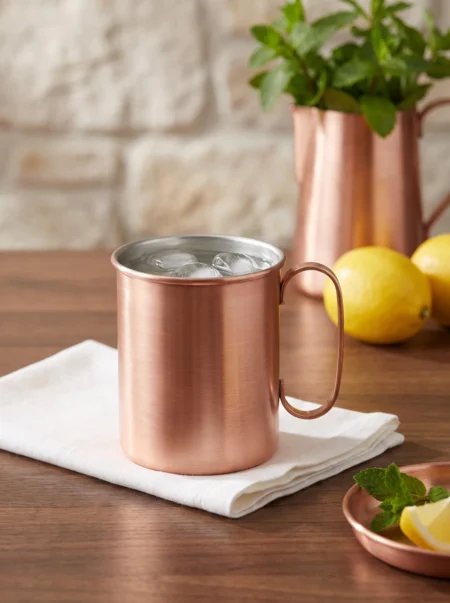 Tumblers and cupsStraight and hammered bodies across the everyday capacities.See the range
 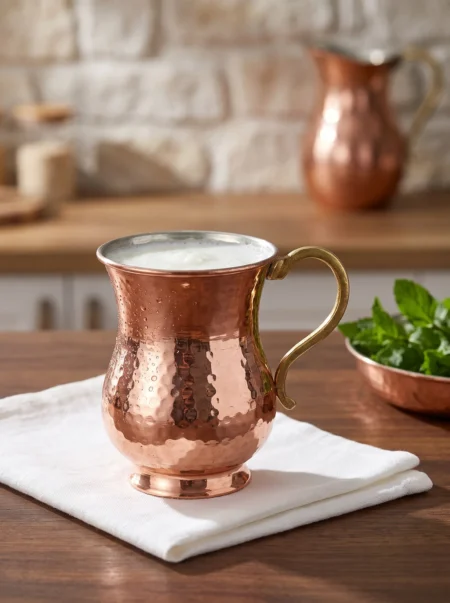 Maşrapa — mugs with a handleThe Anatolian ladle cup, the closest body to a hammered mule mug.See the range
  Stemmed gobletsKadeh bodies for table settings and gift boxing.See the range
 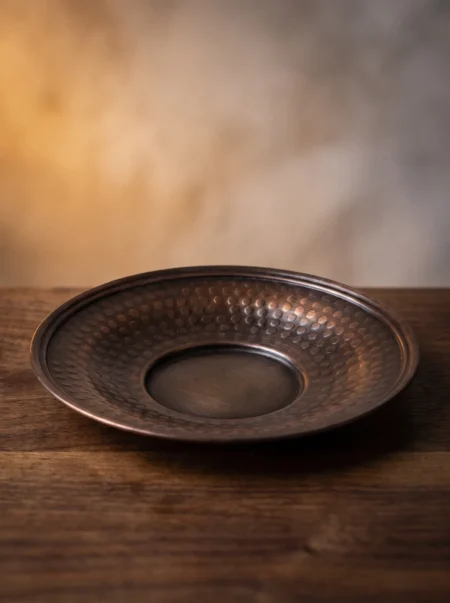 Serveware to matchTrays, pitchers, bowls and serving plates in the same finishes.See the range
 How we work
BakırBul works through a long-term production partnership: we write the specification, our partner produces the piece, and it is carried under our own name. Copper is selected from the workshops of Kahramanmaraş and other Anatolian copper towns, brought into our warehouse, checked against the order and shipped.
We work through a long-term production partnership — we specify the piece, our partner produces it, and we carry it under our own name. That is why a shape that does not exist yet can still be quoted, and why responsibility for what arrives sits with one party rather than being passed along a chain.
Copper is selected from the workshops of Kahramanmaraş and other Anatolian copper towns, brought into our own warehouse, checked against the order and shipped.
Request a quotation
A drinkware quotation needs six things: the body shape, the capacity, the finish, whether the pieces carry a mark, an approximate quantity per line and the destination country. With those, a written price and a realistic lead time come back the same day, tiers included.
Tell us the shape, the capacity, the finish, whether you want marking, roughly how many, and the destination country. We answer with a price and a realistic lead time. If a conversation is easier, WhatsApp works just as well.
What drinkware buyers ask
Are the mugs lined inside?
Yes. Every surface that meets a drink is tin-lined, on every body we quote. Tin wears with use and is renewed when copper begins to show through — expect that sooner in nightly bar service than in a home.
Can we put our logo on them?
Yes. Hand engraving, laser marking and base stamping are all available, and embossing where the run size justifies tooling. Send vector artwork if you have it; if you only have an image of your logo, tell us at the start so it can be redrawn before a sample is cut.
What is the minimum order?
There is no published figure, because it depends on what you are asking for. A single tumbler shape in one finish and a mixed order of engraved stemmed goblets are not the same problem. Send your list and we will tell you straight away whether it works.
Are copper mugs dishwasher safe?
We do not make that claim. Machine washing dulls the exterior, attacks the tin over time, and the heat cycle is hard on soldered handles. Hand washing with a soft cloth is what we recommend, and it is what we tell hospitality buyers even when a competitor is promising otherwise.
Do copper mugs have health benefits?
The strong versions of that claim are a myth, and there is no evidence that drinking from a copper vessel is a sensible way to change anything about your health. Copper drinkware is bought for how it looks, how it holds cold, and how long it lasts. Those reasons are good enough.
Will the mugs keep a drink cold?
Copper conducts heat quickly, so a chilled drink in a chilled mug frosts the outside fast and feels colder in the hand. It is a real effect, not insulation — the same conductivity means the drink also warms quickly once it sits. Bars that care about it pre-chill the mugs.
Hand-hammered or machine-forged for a bar?
Hand-hammered if guests will hold it and photograph it, machine-forged if it is back-of-house or a large promotional run where nobody will compare two pieces. We quote both so the difference is a decision rather than an assumption.
Can you make a shape we designed?
Yes, made-to-drawing work is routine, and where the quantity justifies it new tooling is commissioned for a shape that has never been made. We will not copy another company’s protected design.
How is the handle attached?
It depends on the body, and we state it in the quotation rather than leaving it vague. Riveted attachment survives commercial handling better than a light solder joint, and on a mug destined for service that difference decides the reorder.
Do you sell under our own brand?
Yes. Marking and packaging can carry your label rather than ours, and work made to your drawing goes out under your mark.
How long does an order take?
It depends on the shape, the finish and whether tooling or engraving is involved. We give a lead time with the quotation, and we would rather give you a realistic one than a flattering one that slips.
The 2026 catalogue — the full range with codes, sizes and weights: open or download it here. For the wider wholesale terms, see wholesale and export.
Send us your list
Shape, capacity, finish and an approximate quantity is enough to start. We come back the same day.
Last updated: 11 September 2026