
Copper Cookware from Türkiye
Copper pots, pans and oven trays
Hand-hammered Turkish copper cookware from Kahramanmaraş — pots, frying pans, sahan, roasting plates and oven trays, every one tin-lined on the inside. We select the work, check dimensions and tin coverage in our own warehouse, and ship it.
Tell us the pieces and roughly how many, and we come back the same day with a quotation.
Copper cookware from BakırBul covers pots, frying pans, sahan, roasting dishes and oven trays, hand-hammered or machine-forged in Kahramanmaraş and tin-lined on every surface that meets food. Bodies are supplied in two sheet gauges, several diameters and four finishes, with sizes outside the range made to order.
Two gauges, two jobs
Thin gauge heats fast and stays light — short cooking and service. Heavy gauge holds heat, so the temperature does not collapse when cold food goes in.
Tin-lined interiors
Every surface that meets food is tinned. Tin wears with use and is renewed when the copper starts to show through.
Checked before dispatch
Dimensions and tin coverage are inspected before anything leaves the warehouse. Items are packed individually.
Made to your size
Sizes outside the range, changed forms, different finishes and logo engraving are produced to order at a contracted workshop.
What is in stock right now
Stock on this page is read live from the warehouse rather than from a catalogue export, so a piece shown is a piece on the shelf. Items sell and return, so the grid changes through the week. Anything missing can still be quoted, because sizes outside the range are made to order.
The grid below is read live from the warehouse — it shows pieces that are on the shelf today, not a catalogue photo set.
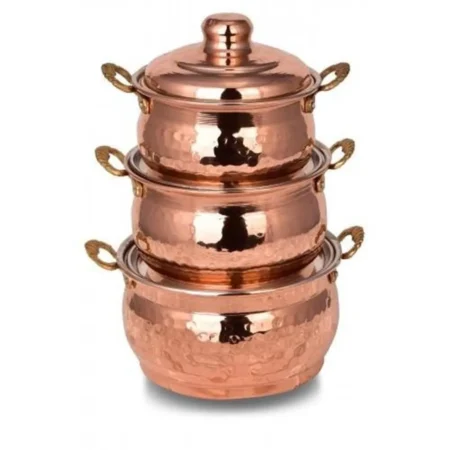

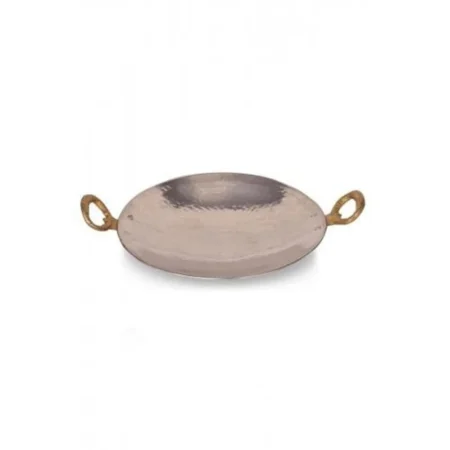
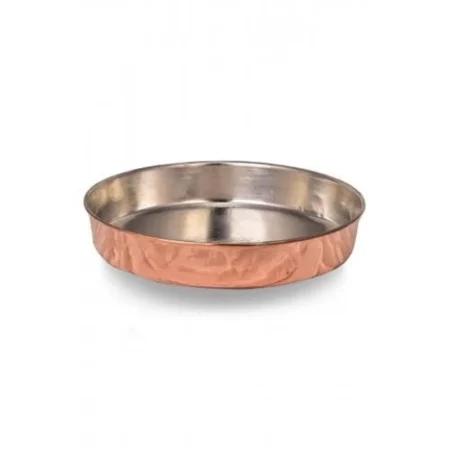
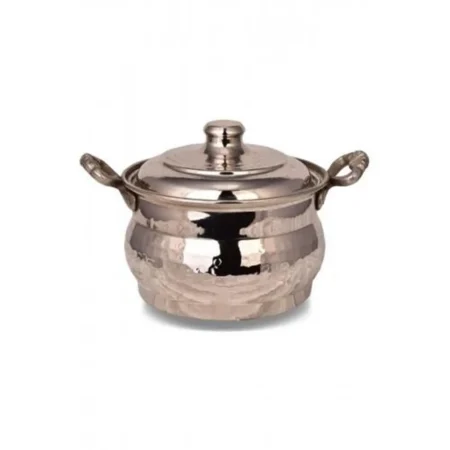
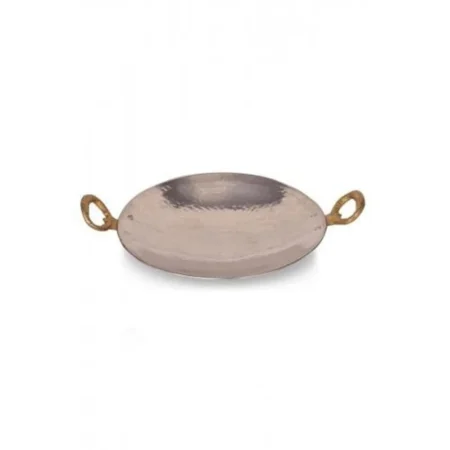
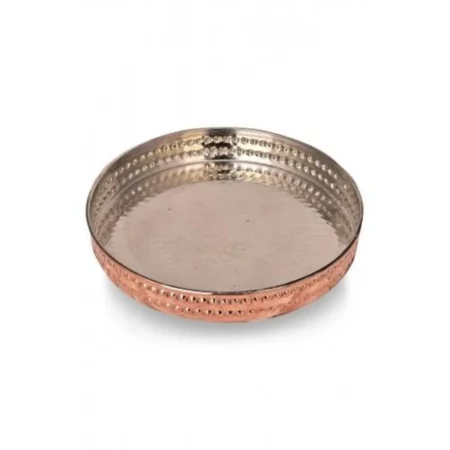
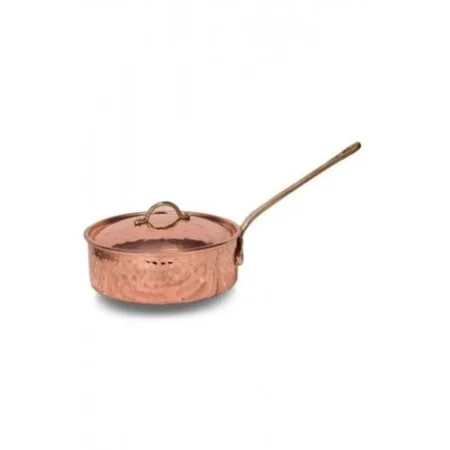
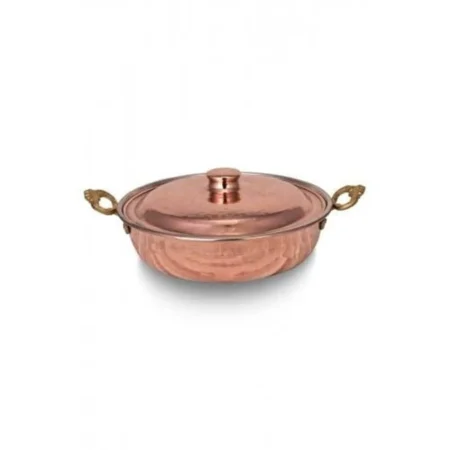
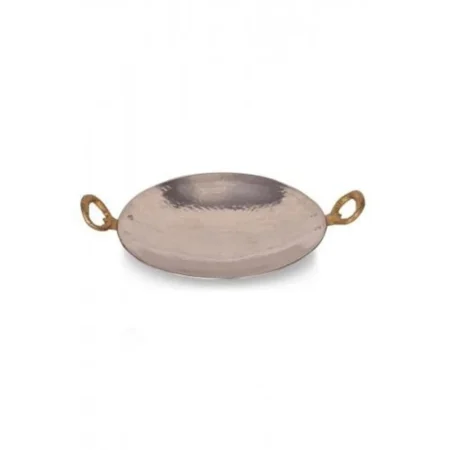
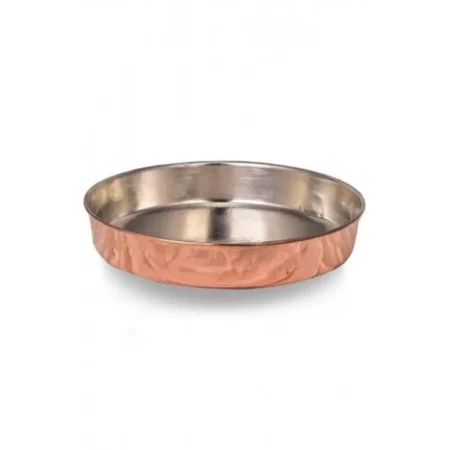
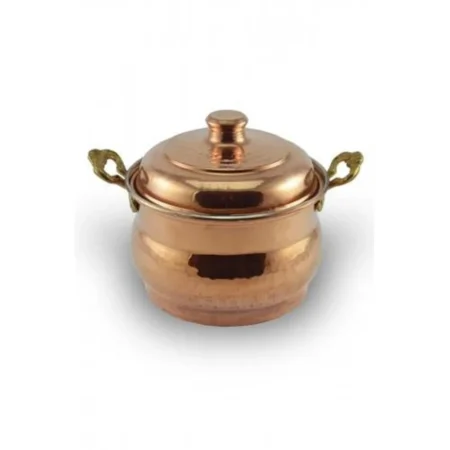
134 items in stock right now, from 12 cm to 36 cm. Other sizes and finishes are produced to order.
Why copper cooks differently
Copper conducts heat more than twenty times faster than stainless steel, so a flame under one point of the base spreads across the whole surface within seconds. Scorching and hot spots become unlikely, and the pan cools as quickly as it heats, which is why a copper kitchen cooks one hob setting lower.
Copper conducts heat far faster and far more evenly than stainless steel or cast iron. A flame hitting one point of the base spreads across the whole surface within seconds, so hot spots and scorching are much less likely — which is why milk puddings, sauces, jams and Turkish coffee have been cooked in copper for centuries.
The same property works in reverse: taken off the heat, copper releases it quickly, so cooking actually stops when you want it to. In practice this means a kitchen used to steel will usually cook one hob setting lower in copper.
Choosing gauge and size
Gauge and diameter carry the decision. Thin sheet heats fast and stays light, which suits short cooking and service pieces; heavy sheet stores heat and holds temperature when cold food goes in. Diameter follows covers served rather than the recipe, and commercial use normally moves one gauge step above domestic.
Two decisions carry most of the weight. Gauge is the thickness of the sheet: thin bodies heat quickly and are easy to lift, heavy bodies store heat and hold their temperature when a cold ingredient goes in. In commercial service the choice usually moves one step up from domestic use, because the same pan is worked harder.
Diameter follows the covers you serve rather than the recipe. If you are unsure, describe the use — covers per service, cups per pot, how often the piece goes on the hob — and we will propose sizes with the quotation.
Tin, cleaning and hob compatibility
Tin lining, hand washing and hob type are the three constraints on a copper pan. Tin separates acidic food from copper and is renewed when the copper shows through. Washing is by hand and drying is immediate. Copper is not magnetic, so gas, electric and open fire work while induction does not.
The interior is tinned, and that layer is what keeps acidic food from sitting directly against copper. It wears; when the reddish copper starts to show through, the piece is re-tinned rather than replaced. Copper is not magnetic, so these pieces work on gas and electric hobs and over open fire, but an induction hob will not detect them. Fuller guidance is on our copper care page.
Sheet gauge, and what the numbers mean
Sheet gauge is the thickness of the copper before a body is raised, measured in millimetres, and it is the single number that separates cookware from decoration. Light sheet suits service pieces and short cooking. Heavy sheet holds temperature under load and is what a working kitchen should specify.
Hammering thins a sheet unevenly, so the figure quoted for a finished body is the starting thickness rather than a measurement taken at one point on the wall. That is normal practice across the trade, and worth knowing when you set two quotations side by side.
What the thickness actually buys is thermal mass. A light body reaches temperature almost immediately and loses it just as fast, which is exactly right for a sahan carried to a table or a pan that fries for two minutes. A heavy body takes longer to come up and then refuses to drop when a cold ingredient lands in it — the behaviour a busy kitchen is paying for, and the reason a thin pan disappoints under service even though it cooks perfectly at home.
Weight is the honest proxy. Two pans of the same diameter that differ noticeably in the hand differ in sheet, whatever the listing says. This is also where the cheapest quotation in any market comes from: thinning the sheet is invisible in a photograph and obvious in a kitchen.
We publish diameter, height and weight for catalogue items, and we state the sheet used on a quotation for anything made to order. If a supplier anywhere will not put those figures in writing, that silence is your answer. The wider sourcing test is on sourcing copper cookware.
Which hobs and heat sources work
Copper cookware works on gas, radiant electric, ceramic and halogen hobs, in an oven where the handle allows it, and over charcoal or wood. Copper is not ferromagnetic, so an induction hob cannot detect it and will not fire at all. Nothing is damaged; nothing heats either.
| Heat source | Works | What to watch |
|---|---|---|
| Gas | Yes | Keep the flame under the base. Flames licking up the side char wooden handles. |
| Radiant electric, solid plate | Yes | A flat base transfers heat far better than a hammered one. |
| Ceramic and halogen | Yes | Lift rather than drag; a hammered base scratches glass. |
| Induction | No | Copper is not ferromagnetic. The hob does not detect the pan and the ring never fires. |
| Oven | Body yes, handle decides | Wooden handles and knobs do not tolerate oven heat. Order without wood. |
| Charcoal, wood, open fire | Yes | The traditional use. Expect the exterior to darken permanently. |
| Hot sand (cezve) | Yes | Handle length decides comfort more than the body does. |
An interface disc — a magnetic steel plate placed between the hob and the pan — makes a copper body usable on an induction ring. It works, and it removes most of what copper is bought for, because heat now arrives through a second layer of steel with a lag of its own.
If a kitchen is induction throughout, the better answer is normally to buy copper for the table rather than for the hob: trays, serving plates, pitchers, drinkware and coffee service are unaffected, and that is where most of the visual value sits anyway. The full argument, including what clad copper is and is not, is on copper and induction hobs.
The first month with a copper pan
A new copper pan needs washing, drying and a first cook at moderate heat rather than seasoning. Tin does not require breaking in. The habits that matter from the first day are heating with fat or liquid already in the pan, using wood or silicone, and drying immediately after washing.
Unwrap, wash in warm soapy water, rinse and dry. Nothing else is needed. Copper is not cast iron: there is no seasoning layer to build and no oil to bake on, and attempting either on a tinned interior does harm rather than good.
The first cook is where habits form. Put the pan on a moderate flame with fat or liquid already in it, and notice how quickly it responds — most cooks coming from stainless steel overshoot on the first two or three dishes and then settle a setting lower for good. That adjustment is the whole learning curve.
Three things to keep off the lining from day one: metal utensils, abrasive pads and the dishwasher. Wood and silicone cost nothing and remove the only realistic way an owner damages the interior by accident.
Expect the outside to change. A new pan is bright; after a month of use it is slightly deeper in colour, and after a year it has a patina. That is the material behaving normally, not a fault, and whether you polish it back is a matter of taste rather than of care. The routine is set out on living with copper.
What not to cook in copper, and why
Long-simmered acidic dishes left standing, food stored in the pan after cooking, and empty preheating are the three uses that shorten a copper pan’s life. Cooking acid is fine; storing it is not. Sugar work and deep frying are fine in a tinned body while the heat stays below the melting point of tin.
The distinction that matters is cooking against standing. A tomato sauce simmered in a tinned copper pan is unremarkable — that is what these pans have always been for. The same sauce left in the pan overnight is a different matter, because time and acid together work on any thin spot in the lining. Empty the pan into a bowl and the problem disappears.
Empty preheating is the one genuine hazard, and it is worth repeating because it is the fastest way to destroy a lining. Tin melts at a temperature a dry pan on a strong flame reaches within a couple of minutes. Liquid or fat in the pan holds the interior below that point.
Sugar work is traditional in copper and stays safe in a tinned body as long as the syrup is watched; classic uncoated copper sugar pans exist precisely because they are never intended to hold food afterwards, and ours are not those. Deep frying is fine at ordinary frying temperatures.
Two habits worth adding: no ice water into a hot pan, because thermal shock loosens soldered joints, and no salt sitting undissolved on a dry interior. Tin melts at 231.9 °C according to the Royal Society of Chemistry, which is the number behind the empty-pan warning, and the migration limits a lining is measured against sit in the Council of Europe metals and alloys guide published by the EDQM. The safety background is on is copper cookware safe.
Copper against steel, cast iron and aluminium
Copper leads every common cookware metal on thermal conductivity, at roughly four hundred watts per metre-kelvin against about sixteen for stainless steel. Cast iron wins on heat retention and on cost; aluminium wins on weight. Copper wins on control, which is the property that matters in sauces, sugar work and coffee.
| Metal | Thermal conductivity (W/m·K) | Response to a heat change | Detected by induction |
|---|---|---|---|
| Copper | around 400 | Immediate | No — not ferromagnetic |
| Aluminium | around 235 | Fast | No, unless a steel base is bonded on |
| Cast iron | around 50 | Slow, holds heat longest | Yes |
| Stainless steel (304) | around 16 | Slow and uneven without a bonded base | Depends on grade |
Conductivity figures are standard materials data; the Copper Development Association publishes them for copper and its alloys. The practical reading of the table is that copper is not “better” in general — it is better at one thing, which is following the cook.
Where each metal genuinely wins: cast iron for a steak, because mass beats conductivity when a cold piece of meat hits the pan. Aluminium for a pan that will be lifted a hundred times a shift. Stainless steel for anything that will be abused, put in a dishwasher and forgotten. Copper for sauces that break, sugar that burns, milk that catches, and coffee that has to come off the heat at a specific second.
A serious kitchen usually runs more than one metal, and the copper is bought for a defined set of jobs rather than to replace the batterie. That is also the cheapest way to introduce it — the venue argument is on copper for restaurants and hotels.
Questions buyers ask about copper cookware
Buyers ask five questions before ordering copper cookware: whether it is safe to cook in, whether it works on an induction hob, how hand-hammered differs from machine-forged, whether a dishwasher is acceptable, and whether restaurants are supplied. Copper does not work on induction; the other four answers are below.
Is copper cookware safe to cook in?
Yes, when the interior is lined — and ours is. The tin layer separates food from the copper. What matters in practice is watching that layer: once the copper shows through, the piece should be re-tinned before it goes back into service.
Can I use it on an induction hob?
No. Copper is not magnetic, so an induction hob will not detect the body. These pieces are for gas and electric hobs, for open fire, and for oven use where the handle allows it.
Hand-hammered or machine-forged?
Hand-hammered bodies carry visible hammer marks and no two are identical, which is what most hospitality buyers want on the table. Machine-forged gives a more regular pattern at a lower price and suits back-of-house volume. We quote both so you can compare.
Is it dishwasher safe?
No. Machine detergent and heat damage both the tin lining and the outside surface. Wash by hand with warm water and a soft sponge, and dry without leaving it to stand.
Do you supply restaurants and hotels?
Yes — that is most of what we do. Tell us the pieces, the quantity and the destination; unit price steps down with quantity and the terms are written into the quotation.
Which body does which job
Turkish copper cookware is organised by dish rather than by pan hierarchy. Sahan is the shallow lidded body that goes from heat to table, tencere the deeper pot, tava the frying body, and oven or fire bodies are trays and deep dishes built for high heat. Ordering by job beats ordering by name.
Turkish copper cookware is organised around dishes rather than around a Western pan hierarchy, and buyers get better results when they order by job.
Sahan. Shallow, often lidded, made to go from the heat straight to the table still sizzling. It is a cooking vessel and a serving vessel at once, which is why it is the piece that most changes how a dish arrives in front of a guest.
Tencere. The deeper pot, from single-portion bodies up to large diameters for volume cooking. Depth and diameter matter more than capacity on paper: a wide shallow body reduces liquid fast, a narrow deep one holds it.
Tava. The frying body, with and without a lid, in plain, machine-forged and hand-hammered walls. The thinner gauges heat faster and dent more easily; the heavier ones are what a busy kitchen should be ordering.
Oven and fire bodies. Trays and deep dishes made to go into an oven or over charcoal. Handle material decides what is possible here, so tell us where the piece will sit before you choose it.
What we would not sell you
Decorative copper photographed as cookware is the most common trap in this trade: thin walls, no published gauge, an unnamed interior coating and a lightly attached handle. BakırBul quotes decorative bodies as decorative and publishes gauge, lining and handle attachment for anything sold as cookware.
A large amount of copper on the market is decorative work photographed as cookware — thin walls, no published gauge, an unnamed interior coating, and a handle attached lightly enough to look right in a photograph. It is not a scandal and it is not always dishonest; decorative copper is a real product with a real purpose. It just is not a pan.
Our rule is simple. If a body is decorative, it is quoted as decorative. If it is cookware, the gauge and the lining are published and the handle attachment is stated in writing. When a buyer asks us for a price that only a decorative body can meet, we say so rather than quietly supplying one. The wider version of this test — and how to apply it to any supplier, in any country — is on sourcing copper cookware.
Cooking with it, without ruining it
Three habits protect a copper pan: never heat it empty, keep steel utensils off the tin, and wash it by hand while still warm before drying it immediately. Copper colour appearing across the working surface signals re-tinning, which is scheduled maintenance rather than failure.
Copper heats far faster than stainless steel, and the single most common way a new owner damages a pan is heating it empty. Put the fat or the liquid in first. Keep steel utensils off the lining; wood and silicone cost nothing. Wash by hand while the pan is still warm and dry it immediately.
Watch the inside over the years for copper colour appearing through the silver-grey tin. Isolated pinpoints are not urgent; copper visible across a meaningful part of the cooking surface means the piece should stop meeting acidic food and go for re-tinning. That is maintenance rather than failure, and it is the reason a copper pan can outlast the kitchen it was bought for. Full detail on copper and food safety and the day-to-day routine on living with copper.
Ordering for a venue
Venue orders differ from domestic ones in three ways: heavier gauges, riveted handles, and aged or brushed finishes that need no polishing rota. Splitting an order — hand-hammered where guests see it, machine-forged where they do not — is usually what makes a copper project affordable for a kitchen.
Kitchens buy differently from homes. Heavier gauges, riveted handles and aged or brushed finishes are the specification that survives a service, and splitting the order — hand-hammered where guests see it, machine-forged where they do not — is usually what makes a copper project affordable. If you are furnishing a venue, start on copper for restaurants and hotels, and tell us your hob type in the first message.
Send us your list
Product group and an approximate quantity is enough to start. We reply in English, the same day.
Last updated: 11 September 2026