
Copper Cezve — Turkish Coffee Pots
Copper cezve — the Turkish coffee pot
The cezve is the pot Turkish coffee is made in: a narrow copper body that widens at the base, a long handle, a pouring lip. Ours are hand-worked in Kahramanmaraş and tin-lined inside.
Cafés: tell us how many cups you pull at peak and we will propose the sizes and the quantity.
A cezve is the long-handled copper pot Turkish coffee is brewed in: a wide base, a narrowing neck that holds the foam, and a pouring lip. BakırBul supplies hand-worked tin-lined cezve from Kahramanmaraş, in single bodies and graduated sets, with wooden or brass handles and engraving to order.
Sized by cups, not litres
A cezve is never filled to the rim — the foam needs room. What matters is how many cups it pours comfortably.
Wood or brass handles
Wooden handles stay cool on the hob and can be held directly. Brass looks traditional but heats, so it wants a cloth.
Tin-lined
Coffee is acidic, so the lining matters here more than almost anywhere else in the range.
Sets as well as singles
Bodies are also sold as graduated sets, which is how most cafés and gift buyers order them.
What is in stock right now
Stock on this page is read live from the warehouse, so the volumes shown are the bodies on the shelf today rather than a catalogue selection. Sets and singles move at different speeds through the week. Sizes outside the range are made to order at the partner workshop.
Read live from the warehouse — the volumes on the shelf today.
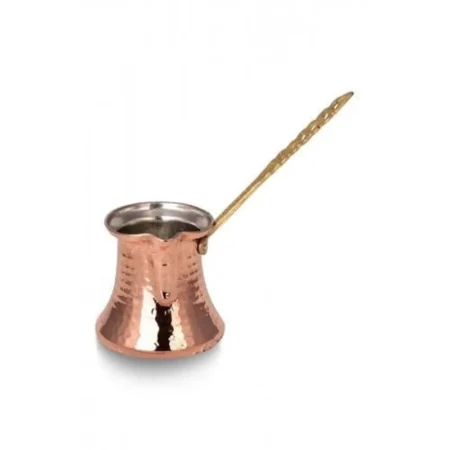
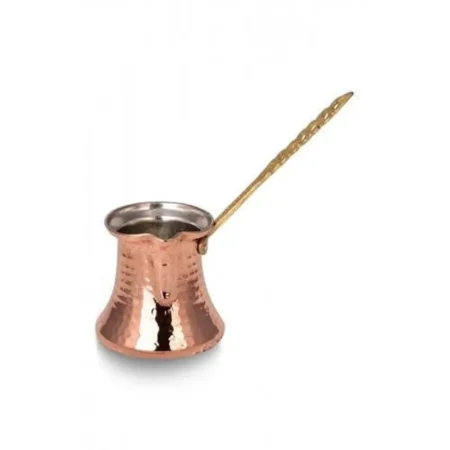
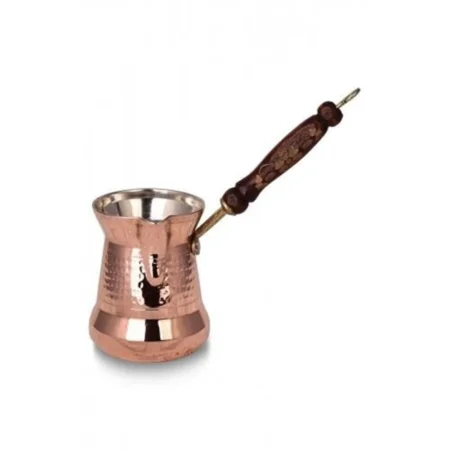
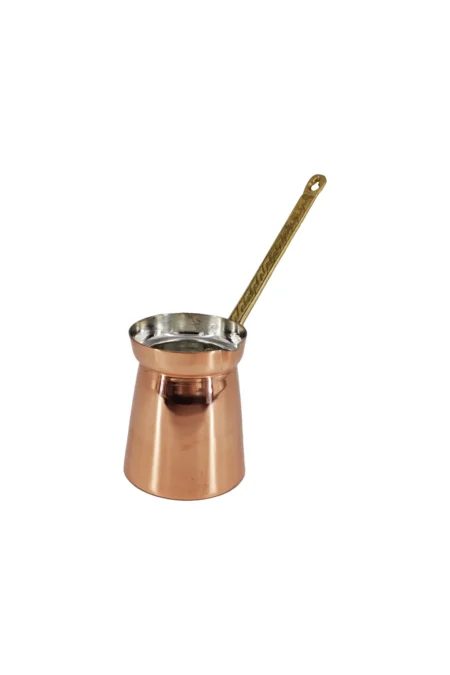
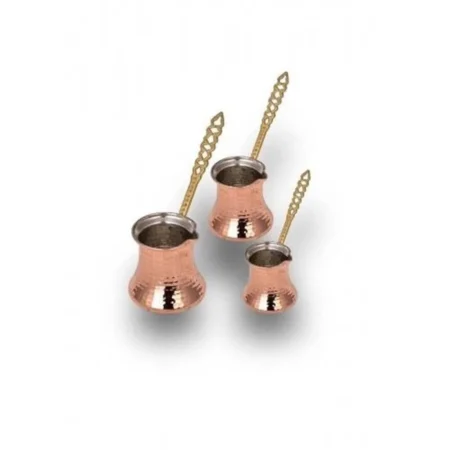
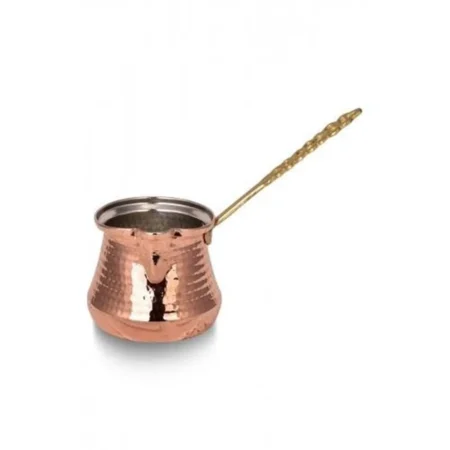
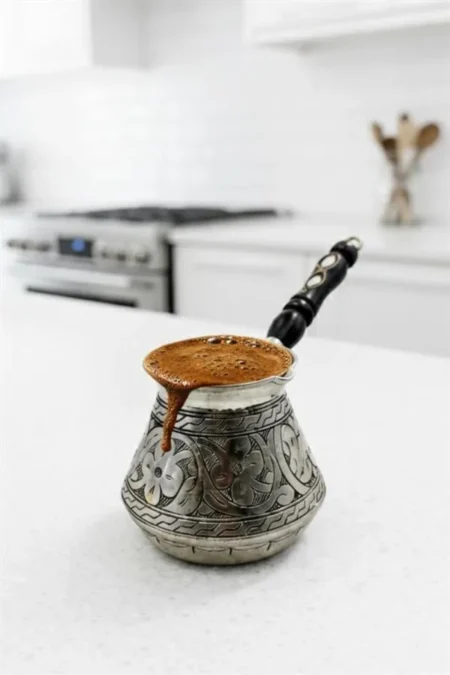
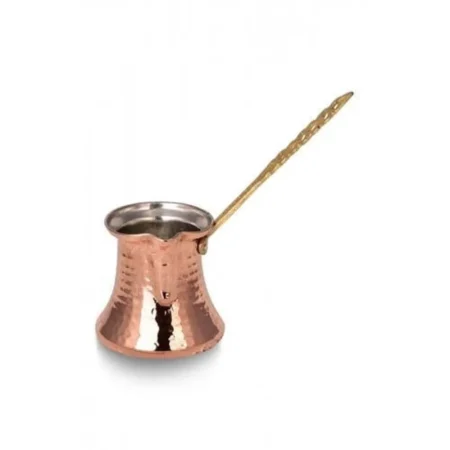
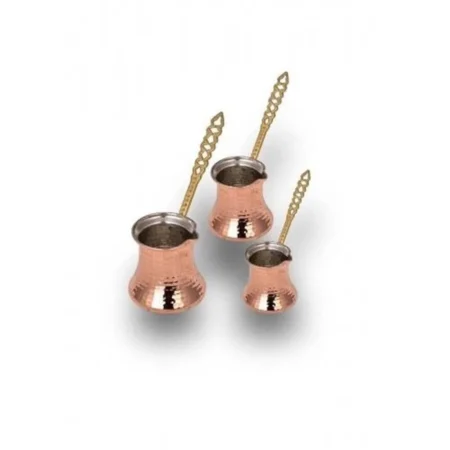
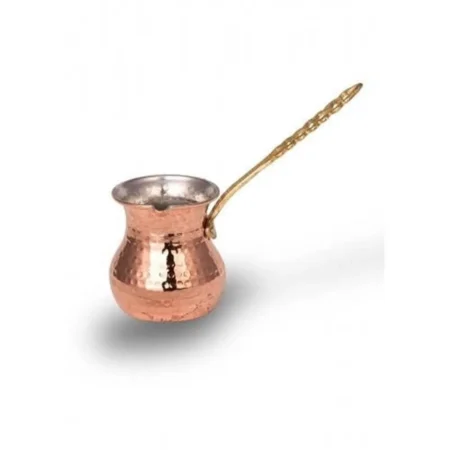
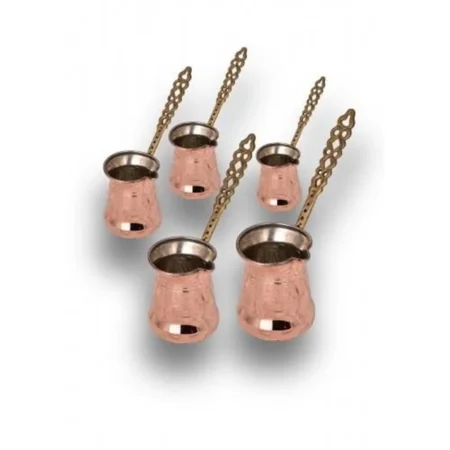
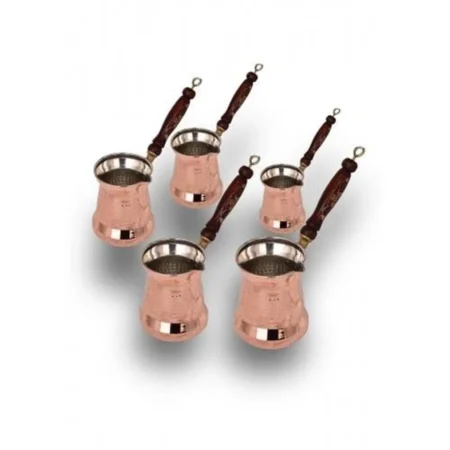
56 items in stock right now, from 90 ml to 1120 ml. Other sizes and finishes are produced to order.
How the size is chosen
Cezve size is chosen in cups rather than in millilitres, because the pot is never filled to the rim — foam needs the space. A single-cup body serves one person, two to three cups covers most households, and four or more suits a table with guests. Cafés take several small bodies instead.
Turkish coffee is measured in cups, and a cezve is chosen the same way. A single-cup body is for one person in the morning; two to three cups covers most domestic use; four and above is for a table with guests. Because the foam has to rise, the pot is never filled to the top — which is why the useful figure is cups poured, not the volume stamped on the body.
In a café the calculation is different again: the same pot goes back on the heat many times an hour, so buyers usually take several small bodies rather than one large one.
How it is used
Turkish coffee starts in cold water measured with the serving cup. Ground coffee and sugar go in, the mixture is stirred before heating, and the pot sits on a low flame. When foam rises at the rim the pot comes off, foam is shared between cups, and the rest is poured after a brief return.
Coffee starts in cold water. Water is measured with the cup it will be served in, the ground coffee and any sugar go in, and the mixture is stirred before it meets the heat. The hob stays low: heating slowly is what keeps the coffee from turning bitter.
Foam rises at the rim first. At that point the pot comes off, the foam is shared between the cups, and the pot goes back briefly before the rest is poured. Copper helps twice here — it spreads the heat so the bottom does not scorch, and it lets go of the heat quickly when the pot is lifted.
Anatomy of a cezve
A cezve has five parts that decide how it pours: a wide base for heat, a narrowing neck that holds the foam, a flared rim, a pouring lip cut into that rim, and a long handle set high on the body. Capacity is quoted in millilitres but chosen in cups.
The base is the widest part and it is deliberately so. Heat enters across a large surface, spreads through the copper almost instantly, and brings the whole body of liquid up together rather than boiling it from one point. A cezve with a narrow base is a decorative object.
The neck narrows above it. That taper is what makes the foam: as the brew rises it is funnelled into a smaller cross-section, so it builds a thick head instead of spreading and collapsing. It also slows the rise, which buys the person watching the pot the two or three seconds they need.
The rim flares back out and carries the pouring lip. A well-cut lip lets a thin stream go into a small cup without dripping down the outside — a detail that separates a working pot from a souvenir, and one worth checking on a sample.
The handle sits high, angled away from the heat. Length matters more than material for safety: a short handle over sand or a strong flame puts a hand where it should not be. Wooden handles stay cool and are traditional; brass and copper handles look right on a counter and need a cloth.
Wall thickness is the fifth variable and the least visible. A thin body responds fastest, which is what a skilled hand wants; a slightly heavier one is more forgiving in a busy service.
Cezve, ibrik and dallah are three different pots
Cezve, ibrik and dallah name three separate vessels. The cezve is the Turkish coffee pot with a straight long handle. Ibrik is a general Turkish word for a spouted jug or ewer. The Gulf dallah is a tall coffee server with a curved beak, used for a different drink entirely.
The confusion is worth clearing up before an order, because the three are sold under overlapping names online and a buyer expecting one can receive another.
Cezve is the Turkish word and the correct one for the brewing pot. In Greek the same vessel is a briki, in Arabic a rakwa, in Bosnian a džezva. All describe the same object: wide base, narrow neck, long side handle, no lid.
Ibrik in Turkish simply means a spouted jug — a water ewer, a washing vessel, sometimes a decorative piece. English-language coffee writing has borrowed it as a synonym for cezve, which is why the word appears on so many product listings, but in Turkish a shopkeeper hearing “ibrik” will not reach for a coffee pot.
The dallah is a different tradition altogether. It is the tall lidded server of the Gulf, with a long curved beak, made for Arabic coffee — a lighter, often cardamom-spiced drink brewed and then held warm in the pot. A dallah is a serving vessel; a cezve is a brewing vessel. We supply the cezve, and we say so rather than letting a buyer discover the difference on arrival.
If your market expects a dallah, we are the wrong supplier for that item, and it is cheaper for both of us to establish it in the first email.
Sand brewing, and why counters use it
Sand brewing sets the cezve into a tray of heated sand rather than onto a burner. Heat surrounds the lower body evenly, the operator controls temperature by how deep the pot is pushed instead of by a dial, and several pots run at once. Most Turkish coffee counters brew this way in front of guests.
The mechanism is simple and the result is hard to match on a hob. Sand heated from below holds a stable temperature gradient: hotter at the bottom of the tray, cooler near the surface. Pushing the pot deeper raises the heat; lifting it slightly lowers it. A skilled operator adjusts continuously without ever touching a control.
Even heating around the lower body also removes the single point of contact a burner creates, so the coffee rises uniformly and the foam builds more reliably. And because the sand holds heat, a counter can brew four or five pots simultaneously without any of them waiting for a ring.
It is also theatre, which matters commercially. A sand brewer working in view of a queue is the reason many cafés carry Turkish coffee at all.
For sand service the handle specification changes. It needs length, because the hand works close to hot sand, and it should be secure rather than decorative. Tell us the brewing method when you order and we will point you at the right handle rather than the prettiest one. The rest of a counter order — trays, cups, sugar bowls — is on copper trays, plates and pitchers.
Grind, water and ratio: what the pot cannot fix
Turkish coffee needs a powder grind finer than espresso, cold water measured with the serving cup, and gentle heat. A copper cezve controls the heat superbly and cannot correct a coarse grind. Grind fineness is the single variable that separates good Turkish coffee from gritty coffee.
The grind has to be close to flour. Espresso grind is too coarse: it stays suspended, settles slowly and produces a cup with a texture people describe as gritty. This is the most common reason a new cezve disappoints, and no pot on earth compensates for it. A dedicated Turkish coffee grinder or a burr grinder set to its finest position is the fix.
Water is measured with the cup that will be served, not with a jug, and it goes into the pot cold. The coffee and any sugar are stirred in before the heat rather than after, because stirring later collapses the foam.
Heat stays low. Slow extraction is what keeps the cup from turning bitter, and it is also what gives the foam time to build. A cezve on a high flame produces a fast boil and a thin head, which is the second most common mistake after the grind.
The pot’s contribution is control. Copper responds to a change in flame immediately and releases heat the moment it is lifted, so the person brewing decides when extraction stops. Copper’s conductivity — roughly four hundred watts per metre-kelvin against about sixteen for stainless steel, in the materials data published by the Copper Development Association — is what makes that control possible. It is a real advantage over steel, and it is the whole reason the tradition settled on copper — but it is an advantage on top of a correct grind, not a substitute for one.
Turkish coffee as registered heritage
Turkish coffee culture and tradition was inscribed on the UNESCO Representative List of the Intangible Cultural Heritage of Humanity in 2013, and Kahramanmaraş coppersmithing carries a Turkish geographical indication. Both sit behind the cezve as a product: the pot belongs to a documented tradition rather than to a styling exercise.
The UNESCO inscription covers the preparation and the social ritual around it — the brewing method, the serving with water and something sweet, the role of the coffee house, the readings of the grounds afterwards. The listing is public and can be read on the UNESCO intangible heritage site.
The copperwork has its own protection. Kahramanmaraş coppersmithing is registered as a geographical indication with the Turkish Patent and Trademark Office, the same instrument that protects a regional cheese or a wine. It records a craft tied to a place rather than a brand.
This matters commercially for one reason: it is verifiable. A retailer telling a customer that a cezve comes from a registered Turkish coppersmithing tradition is stating something on a public register, not repeating a supplier’s adjective. Origin claims that cannot be checked are worth nothing on a shelf, and we would rather point at the register than at ourselves.
What it does not do is certify any individual pot. A geographical indication protects the craft and its name; the quality of a specific piece is still decided by the sheet, the tinning and the finishing. That is what a sample is for.
Buying cezve as a gift line or a retail range
Cezve sells abroad mainly as a gift and as an entry-level retail line, because it is light, photographs well and posts cheaply. Graduated sets, matching cups and a printed brewing card raise the basket value. Engraving and private-label boxing are quoted on the order rather than added afterwards.
The commercial shape of this product is different from cookware. A cezve is inexpensive, it explains itself in a photograph, and it carries a story a shop assistant can tell in one sentence. That combination makes it the piece most likely to bring a new customer into a copper range.
Three things reliably lift the value of a cezve order. A graduated set of two or three sizes sells better than a single pot, because it looks like a collection. Matching cups turn a pot into a service. And a short printed brewing card — grind, cold water, low heat, lift at the foam — prevents the disappointed first attempt that stops a customer from ever using the pot again.
For a retail range, order across finishes rather than depth in one. Bright red copper photographs strongest online, oxidised sells better in a physical shop where customers pick pieces up, and nickel-plated bodies suit a modern homeware setting.
Marking is available on the body or on the base, and packaging can carry your label rather than ours. Send the list, the finish and an approximate quantity, and the quotation comes back with quantity tiers and a lead time — the bulk drinkware side is on mugs, cups and goblets in bulk.
Questions buyers ask about the cezve
Buyers ask five questions about the cezve: what size to order, how it differs from an ibrik or a dallah, whether it works on induction, how often the tin needs renewing, and whether cafés are supplied. Copper does not work on induction; the remaining answers follow below.
What size cezve should I order?
For a household, a body that pours two to three cups covers most days. For a table with guests, four to five. For a café, several smaller bodies work better than one large one.
Is a cezve the same as an ibrik or a dallah?
No, and the difference matters when you are ordering. A cezve is the narrow, long-handled pot for Turkish coffee. The Gulf dallah is a different vessel with a curved spout, made for Arabic coffee. We supply the cezve.
Can it be used on induction?
No — copper is not magnetic. A cezve works on gas and electric hobs and over an open flame or hot sand.
How often does the tin need renewing?
In daily domestic use, roughly every year or two. In a café it comes sooner, because the pot is heated many times a day. The signal is the reddish copper starting to show through the silver.
Do you supply cafés and roasters?
Yes. Tell us the sizes, the quantity and the destination and we will quote; engraving a logo on the body is done to order.
Why the shape does the work
Cezve geometry does the brewing. The wide base spreads heat so the coffee rises slowly, and the narrow neck concentrates the foam and holds it while the pot is lifted. The same grounds brewed in a straight-sided pan lose the foam, which is why the shape has survived unchanged for centuries.
A cezve is not a small saucepan with a long handle. The narrow neck and wide base are doing something specific: the base spreads heat across a large surface so the coffee comes up slowly, and the neck concentrates the foam and holds it while the pot is lifted. Brew the same grounds in a straight-sided pan and the foam collapses, which is why the shape has survived several centuries without needing improvement.
Copper matters here more than in almost any other piece we make. The brew depends on gentle, even, controllable heat and on being taken off at the right second. Copper responds instantly; a thick steel body does not, and the coffee boils over before the person holding it can react.
Handles, heat and the counter
Handle material decides where a cezve can be used. Wooden handles stay cool in the hand but must not sit over a flame that licks up the side or go into an oven. Brass and copper handles tolerate more heat and get hot, so a counter brewing continuously keeps a cloth beside them.
Handle material decides where the pot can be used. Wooden handles stay cool in the hand and are the traditional choice, but they should not go into an oven or sit over a flame that licks up the side. Brass and copper handles tolerate more heat and get hot, which is why counters that brew continuously often prefer them with a cloth.
For sand brewing — the method that produces the best result and the best show — the handle also has to be long enough to keep a hand clear of the hot sand. Tell us the method when you order and we will point you at the right handle rather than the prettiest one.
Cafés and roasters: what a service order looks like
A service order for Turkish coffee is a range rather than a pot: several sizes so a single order and a table of four both brew correctly, spares because pots in constant service are consumables, and matching trays, sugar bowls and plates so the arrival reads as one thing.
A counter serving Turkish coffee properly does not buy one pot. It buys a small range of sizes so a single order and a table of four are both brewed correctly, spares because a pot in constant service is a consumable, and the surrounding service — tray, sugar bowl, small plates — in a matching finish so the whole arrival reads as one thing.
Two practical notes for volume service. Aged and brushed finishes hide handling marks and need no polishing rota, which matters when the pots are handled a hundred times a shift. And tin in constant commercial use wears faster than a domestic owner would ever see, so build re-tinning into the maintenance plan rather than treating it as a fault. The service side is covered in full on copper for restaurants and hotels, and the matching pieces are on copper trays, plates and pitchers.
Care, briefly
Cezve care is three rules: never heat the pot empty, wash by hand while warm and dry immediately, and keep it out of the dishwasher. Copper colour appearing through the silver-grey tin is the signal to have the pot re-lined, which is routine maintenance rather than a fault.
Never heat a cezve empty — copper reaches damaging temperatures faster than people expect, and an empty pot on a strong flame is the most common way a lining is ruined. Wash by hand while warm, dry immediately, and keep it out of the dishwasher. Watch the inside for copper colour showing through the silver-grey tin, and have the pot re-lined when it does. The full routine is on living with copper and the safety background on is copper cookware safe.
Order cezve for your café or shop
Sizes and quantity is enough to start. We reply in English, the same day.
Last updated: 11 September 2026