
Wholesale Copper Goblets and Wine Cups
Copper goblets and wine cups, bought in quantity
A goblet is a cup that has been lifted onto a foot, and everything difficult about it follows from that: what you are allowed to pour into it, and whether it stays upright when somebody sets it down badly. We supply tin-lined copper goblets — wine bowls, martini forms and straight cups on a raised base, in red copper, antique oxide, brushed matt and nickel — to hospitality buyers, event and rental companies, homeware retailers and gift importers.
Tell us what will be poured into them before you tell us the size. Wine, spirits, juice, water and a purely decorative display each lead to a different specification, and the difference is on the inside of the cup.
Copper goblets are stemmed or footed copper drinking cups, supplied with a tin lining on every interior surface. The lining is the central specification rather than a finish detail, because acidic and alcoholic drinks react with bare copper, and the raised foot that defines the shape also decides how stable the cup is on a table.
Tinned on every inside surface
Wine, juice and cocktails are acidic. The lining is what keeps them off the copper, and it is not left out to save money.
Footed, not just a cup
Base diameter, stem height and the weight of the bowl decide whether a full goblet survives a crowded table or tips.
240 ml to 500 ml
Measured across what is on the shelf: from a martini-sized bowl to a full wine goblet, standing roughly 13.6 cm to 21 cm tall.
Four finishes, four upkeep levels
Red copper, antique oxide, brushed matt and nickel. Each one asks a different amount of work from whoever polishes the back bar.
Documents, stated honestly
We do not hold a food-contact test report for these bodies. If your market requires one, say so before the order so testing can be arranged.
Engraving and made to drawing
Bowls, stems and base diameters outside the range are produced at the workshop we work with, and a sample is approved first.
What a copper goblet is, and how it differs from a mug or a tumbler
Copper goblets are drinking vessels whose bowl sits on a raised foot or a short stem, which separates them from mugs and tumblers that stand directly on their own base. That raised foot changes the balance, the hand position, how the drink warms, and what a buyer has to check before ordering in quantity.
The Turkish word is kadeh, and it covers the whole footed family: a rounded wine bowl, a conical martini form, and a straight-sided cup lifted onto a plinth. What all of them share is that the hand holds the stem or the foot rather than the bowl, which is exactly the point. A hand wrapped around a copper bowl warms whatever is inside it quickly, because copper conducts heat roughly twenty times faster than stainless steel. Lift the bowl away from the hand and that transfer slows down. A goblet is, functionally, a mug with the thermal problem engineered out of it.
It is worth being clear about what this page does not cover, because the neighbouring shapes are easy to confuse and they sell to different buyers. Straight copper cups and tumblers, including the half-litre bodies used for a well-known cocktail, are handled on our wholesale copper drinkware page and in more detail on the mug page, where the decisions are about capacity bands and handle construction. The maşrapa, the handled Turkish water cup, is on the same pages. A goblet has no handle and is not chosen by capacity first; it is chosen by what goes into it and how it stands up.
The market vocabulary is loose in English. Buyers write asking for copper wine cups, copper goblet glasses, chalices, and copper wine goblet sets, and they usually mean the same family. Where it stops being loose is the moment somebody sends a photograph of a bare, unlined interior and calls it the same product. That is a different specification with different consequences, and it is what the next section is about.
What goes inside the cup: acid, alcohol and why the lining decides it
Wine, cocktails, fruit juice and anything else below roughly pH 6 react with bare copper and dissolve a small amount of it into the drink. Copper goblets intended for those drinks are lined with tin on every interior surface, which is why the inside of a properly specified goblet is silver rather than red.
This is the most important paragraph on the page, so it is worth stating without decoration. Copper is chemically active. Put an acidic liquid in contact with it and copper migrates into the liquid; the more acidic the drink and the longer it sits, the more migrates. Regulators in different jurisdictions have reached the same conclusion by different routes, and the rules are public.
In the United States, the FDA Food Code addresses this directly in section 4-101.14: copper and copper alloys such as brass may not be used in contact with food that has a pH below 6, and the examples it gives are vinegar, fruit juice and wine. That is not an obscure footnote; wine is named in the text. A bare copper goblet used for wine in a regulated food-service setting in the United States is not a grey area, and a supplier who sells one into that market without saying so is handing the problem to the buyer.
In the European Union the route is different and the destination is similar. Regulation (EC) No 1935/2004 sets the framework principle — a material in contact with food must not transfer its constituents in quantities that could endanger health or unacceptably change the food — but there is no EU-wide specific measure for metals and alloys. The practical reference most national authorities use is the technical guide published by the EDQM at the Council of Europe, which sets release limits for metals including copper. The whole framework, and which certificates genuinely exist and which do not, is set out on our food contact compliance page.
The dose question is the one buyers ask next, and the honest answer has a number behind it. Copper is an essential nutrient, and the US National Institutes of Health Office of Dietary Supplements sets a tolerable upper intake level for adults of 10 milligrams a day, with acute gastrointestinal effects reported above that. Nobody is claiming that one glass of wine in a bare copper cup is dangerous. What we are saying is that the specification exists for a reason, that a busy venue serving hundreds of acidic drinks is a different case from one glass at home, and that we are not prepared to supply an unlined goblet and let the buyer find the rule out from an inspector.
So the working rule for a copper goblet is short. Tinned interior: wine, cocktails, juice, water, anything. Unlined interior: display only, and it should be sold as a decorative object with that stated on the packaging. We supply the first and will quote the second only where the buyer states in writing that it is decorative.
Tin lining: how to recognise it and when it needs renewing
Tin lining is a thin layer of pure tin wiped onto the inside of a copper vessel while it is hot, leaving a soft silver-grey surface with a slightly mottled, cloudy appearance. It wears with use rather than failing suddenly, and it is renewed when copper begins to show through across a broad area.
Recognising a real tin lining matters because two other silver interiors circulate in this trade and neither behaves the same way. Hand-wiped tin is dull, faintly cloudy and often shows soft brush strokes; it is not mirror-bright and it should not be. A stainless steel liner, found in factory-made hybrid cups, is hard, bright, perfectly even and usually reveals itself as a separate shell at the rim. Nickel plating, which is sometimes used on the outside of our own pieces, is bright, hard and uniform. If a supplier’s photograph shows a flawless mirror interior and the invoice says tin, ask again.
Tin is soft and it has a low melting point, around 232 degrees Celsius according to the Royal Society of Chemistry. For a drinking vessel that is irrelevant in service and highly relevant in the dishwasher and in storage: heat, harsh detergent and abrasive scouring are the three things that shorten a lining’s life. In a goblet used for cold drinks and washed by hand, a lining lasts for years. In a venue that racks them through a commercial machine on a hot cycle, it will not.
Renewal is a real service that exists in most countries with a metalworking trade, and we say plainly that we do not arrange it on your behalf in your market. What we do is specify a lining that can be renewed, tell you the signs to look for — broad patches of red showing through the base and the lower wall, rather than a small mark at the rim — and keep the original specification on file so a replacement batch matches what you already own. The arithmetic behind the decision to re-tin, rotate or replace is worked through on our copper lifespan page.
The foot and the stem: balance on a working table
A copper goblet stands or falls on the relationship between base diameter, stem height and the weight of the full bowl. A narrow base under a tall bowl tips when a tablecloth is pulled or a sleeve catches it, and in a venue that is not a rare accident but a weekly cost.
The physics is not complicated and it is routinely ignored in listings. Fill a goblet and most of the mass sits at the top, which raises the centre of gravity; the taller the stem, the higher it goes. What resists tipping is the footprint on the table and the weight in the base. A design that looks elegant in a product photograph — long slim stem, wide shallow bowl, small foot — is the least stable combination that exists, and it is the one that gets ordered on appearance.
There are three practical answers and the right one depends on the room. A broad, slightly weighted base with a short stem is the workhorse: it looks solid rather than delicate, it survives a banqueting table, and it is what we would put in front of a hotel or a rental company. A medium stem with a rounded bowl is the compromise and the most common shape in what we carry. A tall slim form belongs on a display shelf, a styled table or a photograph, and we will say so rather than let you find out during a wedding service.
Copper has a quiet advantage here over glass and it is worth naming. When a copper goblet does go over, it does not shatter, it does not send fragments across a dance floor, and it does not close the service area for ten minutes. It dents. A dent can usually be worked out or lived with, and the cup stays in the rotation. For event and rental companies that difference in breakage cost is often the entire reason they are reading this page.
The other half of the handling question is the rim. A rolled or beaded rim is stiffer, more comfortable against the lip and far less likely to deform in a crate; a thin cut edge is cheaper and feels sharper. The sheet in this range runs from roughly 0.6 mm up to 1.3 mm, and the heavier gauges are not there for heat performance, which a cold cup does not need, but for exactly this: a rim and a bowl that keep their shape through a season of handling. If you are comparing quotations, ask which gauge and which rim each one is based on, because that is the easiest place for a price to be quietly shaved.
Temperature: what copper does to a cold drink, and what it does not
Copper conducts heat extremely fast, so a chilled drink in a copper goblet feels colder at first touch than the same drink in glass and then warms more quickly unless the cup is pre-chilled. The metal does not cool anything by itself; it only moves heat, and it moves it in both directions.
The first sensation is real and it is the reason copper drinkware sells. A metal cup at room temperature drawing heat away from your fingertips registers as cold, and a cup that has been chilled registers as very cold indeed. That is conduction doing its job, and the reference figures sit on the Copper Development Association pages alongside the cookware data.
The second half of the sentence is the part that listings leave out. Conduction has no preferred direction. The same property that makes a cup feel icy in the first ten seconds lets room-temperature air and a warm hand push heat back into the drink faster than glass would. A goblet held by the stem slows that considerably, which is one of the practical arguments for the shape, but it does not abolish it. If the drink is meant to stay cold for half an hour, the cup goes in a chiller or a fridge before service, and that is a workflow decision your bar needs to make before the order arrives rather than after.
We would rather put that plainly than sell the more attractive version. Copper is not insulation. A double-walled vacuum vessel is insulation. Copper gives an immediate, very convincing cold sensation and a beautiful surface, and it asks for a small amount of preparation in exchange.
Capacity and height: reading the bands
Copper goblets in the current range hold between 240 ml and 500 ml and stand roughly 13.6 cm to 21 cm tall, weighing about 190 to 290 grams. The smaller bowls suit spirits, aperitifs and a martini-style service; the larger ones are wine and mixed-drink bodies.
Around 240 to 250 ml is the aperitif and cocktail band. It is the size of a conical martini bowl or a small rounded cup, it pours a short measure and leaves the drink looking generous rather than lost, and it is the easiest size to sell as a boxed pair or a gift set. Around 400 ml is the wine and all-purpose band, which is where most hospitality orders land, because it takes a normal pour with room above it and still reads as a proper goblet rather than a bucket. Up to 500 ml is the generous end, suitable for long mixed drinks, punches, iced tea and service where refills are inconvenient.
Height matters separately from capacity and buyers often forget it until the crate arrives. A 21 cm goblet does not fit on a standard bar shelf, does not rack the way a 14 cm one does, and changes the look of a laid table entirely. If the pieces will live on open shelving or in a rental crate, measure the space first and tell us the constraint; it is a cheaper conversation now than after the first pallet.
Weight in the 190 to 290 gram band is deliberate. Light enough to hold comfortably through a long dinner, heavy enough that the cup feels like metal rather than foil and that the base contributes something to stability. If a quotation from anywhere comes in dramatically lighter for the same dimensions, the sheet is thinner, and you will meet that decision again as dented rims.
The grid below is read live from the warehouse. It shows the volumes and finishes on the shelf today rather than a catalogue photo set, and anything absent can still be quoted, because bodies outside the standard range are made to order.
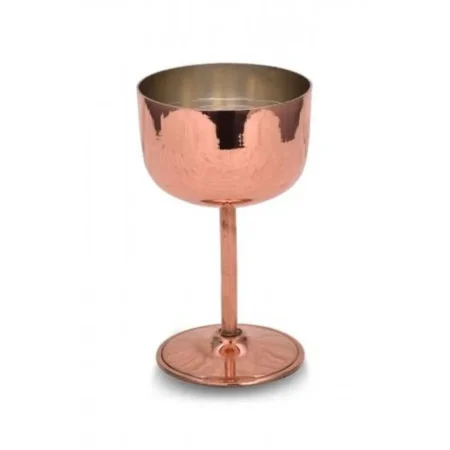
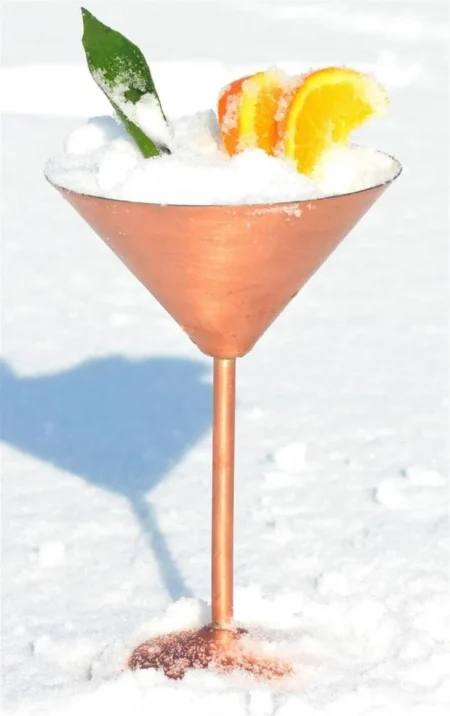
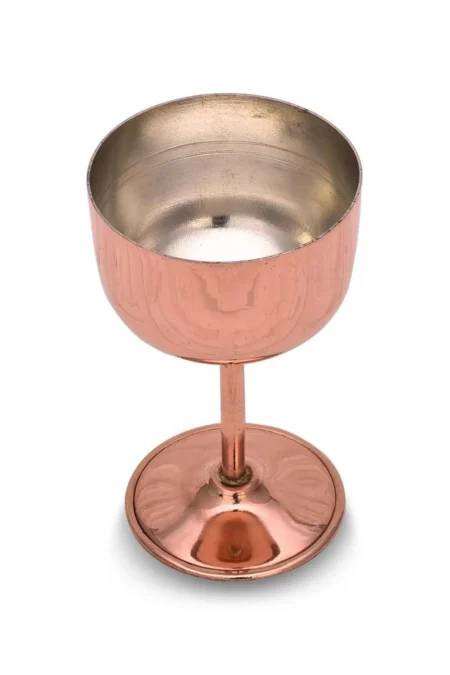
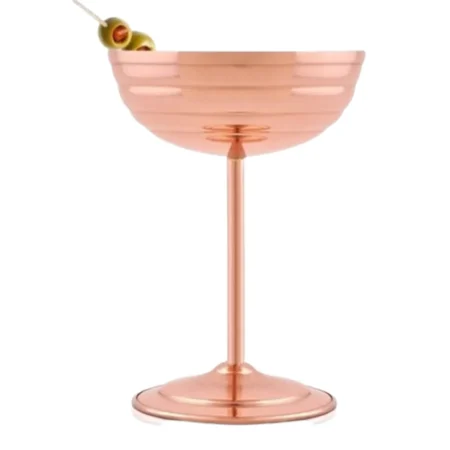
21 items in stock right now, from 240 ml to 500 ml. Other sizes and finishes are produced to order.
Finishes, and what each one costs in upkeep
Copper goblets are supplied in red copper, antique oxide, brushed matt and nickel-plated finishes. All four are exterior decisions, because the interior is tinned regardless, and the choice is mostly a question of how much polishing the room can realistically absorb.
Bright red copper is the finish people picture and the one that asks most of a venue. Copper reacts with air and darkens on its own; hands, moisture and acidic splashes accelerate it unevenly. In a domestic setting that patina is usually welcome. Behind a bar where every cup should match, somebody has to be assigned to polishing, and if nobody is, the set will drift into a mottled mixture within a season.
Antique oxide is a chemical patina applied to the piece when it is new, producing a deep brown-black surface with the highlights rubbed back. It is the practical choice for anything heavily handled, because further darkening simply blends in. It is worth being precise about what it is: oxide is a finish, not age. We do not sell antiques, and we do not describe a new goblet as vintage because it has been darkened. Buyers searching for vintage copper goblets are usually after that look, and this is the honest way to give it to them.
Brushed matt, skoç in Turkish, is a fine directional grain that diffuses reflection and hides fingerprints. It photographs well, it sits comfortably in a contemporary room, and it needs the least attention of the bare-copper finishes. Nickel plating is the fourth option: bright, silver in appearance, far slower to tarnish, and the right answer where a venue wants metal cups that keep a uniform look with minimal work. It is a plated surface, so it is treated gently and never scoured.
One practical note for mixed orders. If you are buying several shapes to be used together, specify the finish once across the whole list rather than per line. Finishes from different production runs can vary slightly, and matching them is far easier at the quotation stage than a year later.
The purity question, and what a copper label can promise
Goblets are widely advertised as “pure copper”, and there is no purity certificate behind that phrase in the homeware trade. What can be stated is that the body is solid copper sheet rather than plated steel or a copper-coloured alloy, and that the interior carries a deliberate tin lining.
The phrase does real work in listings and very little work in fact. In an industrial context copper is sold to defined grades and a mill certificate travels with the coil; in the finished-homeware trade that paperwork almost never follows a hand-worked cup, and we do not claim that it does. Anyone offering you a purity certificate for a decorative drinking vessel is describing something else.
There is also a contradiction hiding inside the phrase when it is applied to drinkware, and it is worth pointing out because it protects the buyer. A cup that is genuinely bare copper on the inside is the cup you should not be pouring wine into. The correct specification for a wine goblet is a copper body with a tin lining, which means the surface touching the drink is deliberately not copper. A listing that boasts about purity and shows a red interior is advertising the wrong thing confidently.
What to check instead is simple and physical. Scratch a hidden spot on a sample and look at the colour underneath; a plated body shows a pale core. Weigh the piece against its stated dimensions. Look into the bowl and confirm the interior is the soft cloudy silver of wiped tin rather than a mirror. We are happy for a buyer to do all three to a sample before committing to anything.
Documents: what we hold, and what we do not
BakırBul does not hold a food-contact test report or a laboratory certificate for these goblet bodies, and says so before the order rather than at the border. Where a market or a customer requires documentation, testing has to be arranged in advance, and it affects both the specification and the timetable.
Procurement departments ask for paperwork, and the honest answer is more useful to them than an impressive one. There is no such thing as an “FDA approved” certificate for a copper drinking vessel, because the agency does not approve articles of that kind; what exists in the United States is the Food Code rule described above, adopted and enforced at state and local level. In the European Union there is no specific measure for metals, so what a buyer can reasonably be given is a declaration referencing the framework regulation and, where required, a migration test report from an accredited laboratory on the actual material and lining.
That test is a real, arrangeable thing rather than a stock document. It costs money, it takes time, and it is done on the specific body and lining you intend to buy. If your market requires it, tell us at the enquiry stage and it becomes part of the project. If you discover the requirement after the goods have shipped, the options are much worse and much more expensive, which is the whole reason this section exists rather than sitting quietly in a footnote.
For decorative-only goods the framework is different again, because a piece sold and labelled as decorative sits outside food-contact rules in most jurisdictions. We will supply on that basis where a buyer states it in writing, and the packaging has to carry it. What we will not do is supply a drinking vessel for food use and stay silent about what is not in the file.
Buying in quantity: engraving, boxing and what arrives
Wholesale goblet orders are usually a mixed list of shapes and capacities in one finish, packed either loose for a warehouse or individually boxed for retail and gifting. There is no published minimum figure, and the practical route is to send the list with quantities and a destination country.
We do not publish a minimum order quantity, and that is a decision rather than an evasion. One shape in one finish and a mixed set for a hotel group are different problems for a workshop, and any single number printed on a page would be wrong for most of what we carry. Send the list you actually want with quantities and a destination country and we will tell you immediately whether it works as an export shipment.
Engraving is where this category earns its margin, and copper takes it beautifully. A crest, a house name, a wedding date or a table number goes on the outside of the bowl; an inventory code goes on the underside of the foot where a guest never sees it. Hand engraving is deep and traditional and suits a crest; laser marking is precise, repeatable and suits a fine logo or a run of sequential codes. Send vector artwork, and placement is confirmed on a sample before a run begins. Weddings, corporate gifting and hotel groups are the three orders where personalisation is most often the point of the purchase rather than an extra.
Packing decides what arrives in a category this vulnerable. Footed pieces do not nest, they are top-heavy in a carton, and a stem that takes a knock in transit arrives out of true in a way that is immediately visible on a flat table. Goblets travel upright, separated by inserts, in cartons at stack heights one person can lift, with rigid inserts in any retail box, because a cup that moves inside its own packaging arrives dented regardless of how good the outer carton is. Carton dimensions and gross weights go out with the quotation so your forwarder can quote against real figures. Shapes that do not exist in the range are made to drawing at the workshop we work with when the quantity justifies it; the process is on our custom manufacturing page, and we will not copy a design that belongs to somebody else.
Care and washing
Copper goblets are washed by hand in warm water with a mild detergent, dried immediately, and never scoured or put through a commercial dishwasher. The tin lining and the exterior finish both suffer from machine detergent and hot drying cycles, and the water marks left by air-drying are harder to remove than the original soiling.
The routine takes seconds per cup and it is the whole of the maintenance story. Rinse soon after service rather than leaving wine or juice standing in the bowl overnight, because a long soak in an acidic liquid is exactly the condition the lining exists to handle and there is no reason to test it. Wash by hand, dry at once with a soft cloth, and store upright rather than inverted on a damp surface.
We do not recommend dishwashers and we do not claim the pieces survive them. Machine detergent is alkaline and aggressive towards both tin and copper, the hot cycle is unkind to a soft lining, and the drying phase spots the exterior. For a venue that racks everything by reflex, this is a genuine operational decision to make before ordering, not afterwards. If nobody can commit to hand washing, nickel-plated exteriors and a robust programme of replacement are a more honest plan than hoping.
Darkening on the outside is not damage and does not need to be prevented, only decided about. Either polish on a schedule and accept that the set will look uniform, or choose oxide or brushed matt and let the surface age evenly. The mistake is choosing bright red copper and then polishing sporadically, which produces a set where no two cups match. The full routine, including what a copper polish does and what the traditional lemon-and-salt method is good for, is on our copper care page.
How we work
BakırBul works through a long-term production partnership rather than a plant of its own. We specify the piece, our partner produces it, and we carry it under our own name, check it in our own warehouse and ship it from there. Shapes outside the standard range are made to drawing.
Copper is selected from the workshops of Kahramanmaraş and other Anatolian copper towns, brought into our own warehouse, checked against the order and shipped from there. Two things follow from that arrangement and both favour the buyer. Because we specify rather than resell whatever a catalogue happens to contain, a repeat order can be matched against what you received last time, which in a stemmed product with an engraved crest is not a small thing. And because checking happens in our own warehouse before a shipment leaves, the rejects are ours rather than yours.
On lining we have one rule and it does not move. Any surface intended to meet food or drink is tinned rather than left bare, whatever a buyer asks for and whatever a competitor quotes. A cheaper unlined goblet exists in this market and we are not going to supply it as a drinking vessel. Where the piece is genuinely decorative and will be sold and labelled as such, that is a different conversation and we will have it in writing.
Where a shape does not exist at all, new tooling is made at the workshop we work with when the quantity justifies it, and that is how most of the non-standard bodies we carry began. Export documentation on the Turkish side is prepared here and quoted as a service rather than assumed to be included; there is no forwarder contracted on our side, and the customs declaration in the destination country stays with the importer because only a party established there can make it. The detail is on our importing page.
Request a quotation
Send the capacities, the shapes, a finish, an approximate quantity and a destination country, and say what will be poured into the cups and in what kind of room. That is enough for a price and a realistic timetable. If your market requires a migration test report, say so now rather than later.
Frequently Asked Questions
Can you drink wine from a copper goblet?
From a tin-lined one, yes; from a bare copper one, you should not. Wine is acidic, and the FDA Food Code names wine explicitly when it prohibits copper in contact with food below pH 6 in regulated food-service settings. The lining is what makes the cup suitable, because the surface touching the wine is then tin rather than copper. Every goblet we supply as a drinking vessel is tinned on every interior surface.
How do I know whether a goblet is lined?
Look into the bowl in good light. A hand-wiped tin lining is a soft, slightly cloudy silver-grey, often with faint brush strokes, and it is not mirror-bright. A mirror-perfect silver interior usually means a stainless steel liner or plating, which is a different product. A red interior means no lining at all, and that cup is a decorative object rather than a wine glass whatever the listing says.
Are copper goblets dishwasher safe?
We do not recommend it and we do not claim it. Machine detergent is alkaline and aggressive towards both the tin lining and the copper exterior, the hot cycle is unkind to a soft lining, and the drying phase leaves water marks that are harder to shift than the original soiling. Warm water, a mild detergent, a soft cloth and immediate drying is the whole method and takes seconds per cup.
What is the difference between a copper goblet and a copper mug?
The foot. A goblet’s bowl sits on a raised base or a short stem, so the hand holds the stem rather than the bowl, which slows the drink warming up and changes how the cup balances on a table. A mug or tumbler stands directly on its own base and usually has a handle. Capacity bands, handle construction and the cocktail bodies are covered on our drinkware pages instead.
Do copper goblets keep drinks cold?
They feel very cold immediately and they are not insulation. Copper conducts heat about twenty times faster than stainless steel, which is why the first touch is convincing, but conduction works in both directions and a warm room pushes heat back into the drink faster than glass would. Holding the stem helps. If the drink has to stay cold for a long service, chill the goblets before use.
Will the goblets tarnish?
Bare copper finishes will, because copper reacts with air; that is chemistry rather than a fault. Decide which way you want to go before ordering. Polish bright red copper on a schedule and it stays uniform. Choose antique oxide or brushed matt and the surface ages evenly with almost no attention. Nickel plating holds a bright silver look far longer. The mistake is bright copper polished occasionally, which gives you a mismatched set.
Are these vintage or antique goblets?
No. They are new production, and antique oxide is a chemical patina applied to a new piece rather than evidence of age. We would rather say that than let the finish imply something it is not. If you want the aged look, oxide is exactly the right specification and it is honest about what it is; if you are sourcing genuine period pieces, we are not the supplier for that.
Can you engrave a logo or a wedding date?
Yes. A crest, a house name or a date goes on the outside of the bowl where it is seen; an inventory code goes under the foot where it is not. Hand engraving is deep and traditional and suits a crest; laser marking is precise and repeatable and suits a fine logo or sequential codes. Send vector artwork and placement is confirmed on a sample before a run starts.
Do you have a minimum order?
There is no published figure, and that is deliberate rather than evasive. One shape in one finish and a mixed list for a hotel group are different problems for a workshop, and any single number would be wrong for most of what we carry. Send the list with quantities and a destination country and we will tell you straight away whether it works as an export shipment.
Can you supply a food-contact certificate?
Not from stock, and we will not pretend otherwise. We do not hold a laboratory test report for these bodies, and there is no such thing as an approval certificate for a copper drinking cup from the US agency people usually name. What can be done is a migration test at an accredited laboratory on the actual body and lining, arranged in advance as part of the project. Tell us before the order, not at the border.
The 2026 catalogue — the full range with codes, sizes and weights: open or download it here. For mugs, tumblers and the cocktail bodies see wholesale copper drinkware, for trays, plates and pitchers see copper serveware, and if you are furnishing a property see copper for restaurants and hotels. More background reading sits in our resource library.
Send us your list
Capacities, shapes, a finish, an approximate quantity and a destination country is enough to start. Tell us what goes in the cup and we will match the lining and the base to it.
Last updated: 20 September 2026