
Copper Cookware Manufacturers and Sourcing
Sourcing copper cookware: how to compare makers and origins
Most buyers searching for copper cookware manufacturers are trying to answer three questions at once: who actually makes it, where should I buy it from, and how do I tell a serious supplier from a convincing website? This page answers all three, including the parts that are not in our favour. We supply handmade Turkish copper, so we have a side — we have tried to give you the checklist rather than the pitch.
Copper cookware is made in workshop networks rather than in single factories: metal is raised or spun in one place, handles and assembly in another, tinning is a specialist trade and finishing a fourth step. The question that predicts quality is not who owns a factory but who is accountable when a piece arrives wrong.
What “manufacturer” means in copper, and why the word misleads
In copper, manufacturer rarely describes a single plant. Sheet is raised, hammered or spun in one workshop, handles are fitted in another, tinning is a trade of its own and finishing is separate again. Buyers should ask who carries the specification and the responsibility, not who owns the machinery.
Buyers arrive asking for a factory because that is how sourcing works in most product categories. Copper cookware is not most categories. Almost everywhere it is made seriously, it is made in workshop networks rather than in a single plant: metal is spun, raised or hammered in one place, handles and assembly happen in another, tinning is a specialist trade of its own, and finishing is a fourth step. A “factory” that owns all of it end to end is the exception, not the standard, and a supplier claiming otherwise is often describing a photograph rather than a process.
This matters to you in a practical way. The question that predicts quality is not “do you own a factory”. It is “who is accountable for the piece when it arrives wrong”. In a workshop network, that answer can be nobody — the trader blames the workshop, the workshop blames the tinner, and you have a container of pans with thin linings and no recourse. Ask the accountability question directly and listen to how comfortable the answer is.
Our own position, stated plainly: we work through a long-term production partnership. We specify the piece, our partner produces it, and we carry it under our own name. That means the specification, the brand and the responsibility for the goods are ours, and the metalwork happens at the partner workshop. You deal with one party from quotation to delivery. We think that is the honest description, and we would rather give it than claim a factory we do not run.
The origins, compared
Türkiye, India, France, Egypt, Mexico, Portugal and Spain supply most of the world’s copper cookware and serveware, and each is strong at something different. Türkiye combines hand-hammering with an unbroken tinning trade and short freight to Europe; India has the deepest volume capacity; France is the premium industrial reference.
Five or six places supply most of the world’s copper cookware and serveware, and they are genuinely good at different things. Choosing between them is a question of what you are buying and for whom, not a question of which country is best.
Türkiye
Anatolia has an unbroken copper tradition and, importantly, an unbroken tinning tradition — the trade that keeps copper usable rather than decorative. Kahramanmaraş and the other copper towns still work by hand at meaningful volume, which is why hand-hammered bodies are ordinary here rather than a luxury line. The coffee and tea culture means the cezve, the teapot, the tray and the serving plate are made as everyday objects at real scale rather than as export curiosities.
Practical advantages for a buyer: short freight distance to Europe and the Middle East, a workforce that can execute made-to-drawing work without industrial tooling, and a cost position between artisanal Western Europe and the highest-volume Asian clusters. Practical limitations, honestly: quantities are workshop quantities, so an order sized for a supermarket promotion is a different conversation from an order sized for a hotel group, and lead times reflect handwork rather than a production line.
India
India has very large metalware clusters with deep capacity and strong price positions, and it is the origin most Western buyers encounter first — particularly for copper drinkware, water bottles and decorative pieces, where the volumes are enormous. If your project is a large promotional run of a simple body, it is a serious option and it would be dishonest of us to pretend otherwise.
What we would tell a buyer to check there, and equally in Türkiye: the interior lining specification in writing, the wall gauge, and whether the piece was designed for cooking or for display. The two markets have different default assumptions about what a copper vessel is for, and a great deal of what is exported from every origin — ours included — is decorative work photographed as cookware.
France
The premium industrial end. French copper cookware is factory-made to tight tolerances with stainless linings and heavy gauges, and it is excellent. It is also priced accordingly, and it is a different product from hand-hammered work: uniform where ours is irregular, engineered where ours is made. If your customer wants a matched professional batterie with identical pieces, that is the reference point, and we will say so rather than pretending we compete on it.
Egypt, Mexico, Portugal and Spain
Each has a living hand-hammered tradition — Egyptian workshop copper, the hammered copper of Santa Clara del Cobre in Mexico, Iberian artisanal work — and each is strong in its own domestic idiom. For a buyer they tend to be regional rather than global supply options: excellent pieces, smaller export infrastructure, and shape ranges built around their own kitchens rather than around yours.
The comparison that actually matters
Origin predicts quality less reliably than four specification points that apply everywhere: the lining and what metal it is, the wall gauge in millimetres, how the handle is attached, and which finish the buyer will have to maintain. Ask for all four in writing before comparing two prices.
Origin is a weaker predictor of quality than most buyers assume. These four specification points predict it far better, and they apply identically wherever you buy.
The lining. Tin is the traditional and appropriate lining for handmade copper. Stainless linings exist and belong to the industrial process. What should worry you is an unlined interior sold as authenticity, or a vague answer about “food-grade coating” that never names a metal. Ask what it is and how it is applied. Our page on copper and food safety explains why this is the first question rather than the fourth.
The gauge. Wall thickness decides whether a pan cooks evenly, whether it warps and whether a dent ends its life. It should be published on the product page, not extracted from a salesperson. Thin copper is cheap for a reason and the reason shows up in the second year.
The handle. Riveted attachment survives commercial handling; a light solder joint does not. This is the most common failure on inexpensive pieces from every origin, and it is the easiest thing to check on a sample.
The finish and its upkeep. Bright surfaces need polishing labour; aged and brushed surfaces do not. This is not a quality grade, but ordering the wrong one for the buyer who will live with it is one of the most common regrets we hear about.
How to check that a supplier is real
A Turkish supplier is checkable through a tax number, a trade registry record and chamber of commerce membership, and a bank or broker can confirm them. Behaviour is more informative than paper: a serious supplier sends a physical sample, takes a video call, writes the specification down and quotes a lead time it expects to keep.
The paperwork test and the behaviour test are both worth running, and the second one is more informative.
On paper, Turkish companies are traceable through a tax number, a trade registry record and a chamber of commerce membership, and your own bank or a broker can verify those without much trouble. Equivalent registries exist wherever you are buying from. Ask for the details and check them rather than accepting a scan.
In behaviour, a serious supplier will do all of the following without complaint: send a physical sample before a bulk order, take a video call and show you the goods, put dimensions, gauge, lining and finish into a written specification, quote a lead time they expect to keep rather than the one you want to hear, and accept payment terms that do not demand everything in advance. A supplier who resists any one of those is telling you something. A supplier who resists the sample is telling you a great deal.
One more, specific to this category: ask what happens when the lining is wrong on arrival. The answer separates a partner from a shipper.
Red flags we would walk away from
Four signals should stop a sourcing conversation: instant certificates produced for any question, photographs published without gauges, capacities or diameters, health claims attached to copper drinkware, and a price quoted without a single question about gauge, finish, marking, quantity or destination. Each says something about the rest of the offer.
Instant certificates for anything you ask about. No supplier can hand you an “FDA approved” certificate for a copper pan, because the document does not exist in that form; a supplier who produces one on request is producing paper. Real compliance work is testing a specific piece to a specific market’s rules, and it takes time — the full explanation is on our food contact and compliance page.
Photographs without dimensions. If a range has no published gauges, capacities or diameters, it is a catalogue of images, and you will find out what you bought when it arrives.
Health claims. Copper drinkware sold on immunity and digestion benefits is being sold on a myth with no evidence behind it. A supplier comfortable making unverifiable claims about your customers’ health is a supplier comfortable making unverifiable claims about wall thickness.
A price with no questions. A quotation produced without asking about gauge, finish, marking, quantity or destination is a number, not an offer.
What actually drives the price
Six factors set the price of a copper pan: metal weight, because copper is a commodity and gauge is bought by the kilo; hand versus machine forming; the quality of the tinning; the finish and its extra process steps; the marking method and run size; and export packing and freight on a dense, dentable metal.
Copper cookware pricing confuses buyers because the same-looking pan can vary enormously. Six factors do most of the work.
Metal weight. Copper is priced as a commodity and a heavier gauge costs proportionally more before any labour is added. This is also why a suspiciously cheap pan is usually a thin pan.
Hand versus machine. Hand-hammered work carries human hours in every piece. Machine-forged bodies carry a regular pattern at a meaningfully lower cost. Neither is a fake; they are different products, and we quote both for the same shape so the gap is visible rather than guessed at.
Tinning. A properly applied lining is skilled work and it is not where a serious supplier saves money.
Finish. Aged, brushed and plated surfaces each add process steps.
Marking. Engraving, laser work and embossing are priced by method and by run size, and embossing needs tooling.
Packing and freight. Copper is dense and dents easily, so export packing is not a rounding error. A pallet of small bodies can reach a weight limit before it fills its space, which changes the freight arithmetic — the importing page covers classification, documents and who does what.
Lead times, and why the honest number is longer
Handwork does not compress the way machine production does. New tooling adds time before anything is made, engraving adds time per piece, and tinning is a separate trade with its own queue. A supplier of hand-hammered goods quoting a factory lead time is usually giving a sales answer rather than a date.
Handwork does not compress the way machine production does. A quoted lead time that sounds like a factory answer, from a supplier selling hand-hammered goods, is usually a sales answer. Tooling for a new shape adds time before anything is made; engraving adds time per piece; tinning is a separate trade with its own queue.
We would rather give you a date we expect to keep. If your deadline is fixed — an opening, a season, a trade show — say so at the start, because there are usually choices that protect the date, such as a machine-forged body for back of house or a simpler finish, and none of them are available once production has started.
Custom work, and what to do when the shape does not exist
When a body, capacity or profile is in no catalogue, a workshop-based origin can still make it. Our partner produces made-to-drawing work, and where the quantity justifies it new tooling is commissioned. A sketch, a dimension or a sample of what you buy elsewhere is enough to start the conversation.
The advantage of a workshop-based origin appears exactly here. If the body, capacity or profile you need is not in anyone’s catalogue, our partner produces made-to-drawing work, and where the quantity justifies it new tooling is commissioned for a shape that has never been made. A sketch, a dimension or a sample of what you have been buying elsewhere is enough to start.
The limits are ones we state in advance. We will not copy another company’s protected design, and we will not leave a food surface unlined because a drawing omitted it. Everything else is quantity and time. Detail on the custom and private label page.
What to put in a copper cookware RFQ
A copper cookware RFQ should state, for every line: the body and its use, diameter and height, wall gauge in millimetres, the lining metal, the exterior finish, handle type and attachment, marking method and artwork format, packing standard, destination country and an approximate quantity. A quotation answering all of those can be compared.
Most quotations that cannot be compared were not comparable when they were requested. A copper enquiry that names only a product and a quantity invites every supplier to answer a slightly different question, and the cheapest reply is usually the one that answered the smallest one. The fields below are what turn a set of numbers into an offer you can lay side by side.
Body and use. Say what the piece is for, not only what it is called. A pan for a home kitchen and a pan for a service line are different specifications wearing the same name. Diameter and height, in millimetres, with the constraint behind them if there is one — a shelf, a burner, a pass.
Wall gauge in millimetres. This is the field most often left blank and the one that explains most price gaps. “Thick” is not a gauge. The Copper Development Association publishes the material terminology if you want the vocabulary before you write the enquiry. Lining metal, named. Tin is the traditional answer for handmade copper; a coating that is never named is not an answer, and it is the point at which a compliance problem enters the order — see Regulation (EC) No 1935/2004 for the European framework.
Exterior finish, and who will maintain it. Handle type and attachment — riveted or soldered, stated rather than implied. Marking method and artwork format, because vector artwork and a photograph of a logo are two different projects. Packing standard, since copper dents and a domestic carton on an export line is a predictable loss. Destination country, which decides the rules that apply; for a buyer serving food commercially in the United States, the FDA Food Code is the operative text. And an approximate quantity per line rather than a total, because tiers are set per item and a total tells a supplier almost nothing.
Pre-shipment inspection and third-party QC
Pre-shipment inspection is a sampled check of finished goods before they leave the country of origin, booked while the run is still in the supplier’s hands. For copper it should cover dimensions and gauge, tin coverage under raking light, handle attachment under load, finish consistency, marking against the approved sample, and packing.
Inspection is cheap relative to freight and very cheap relative to a container you cannot sell, and yet most first-time buyers skip it. The right moment is while the goods are finished but still in the supplier’s hands — after production, before booking the freight. Booked later, an inspection tells you what went wrong rather than preventing it.
What a copper inspection should actually look at is narrower than a generic checklist suggests. Dimensions and wall gauge, measured rather than eyeballed. Tin coverage inside, judged under a raking light across a sample drawn from more than one carton, because coverage varies by tinning batch. Handle attachment tested under load, with a body filled and lifted. Finish consistency across the batch, since two runs of the same finish name can differ. Marking checked against the approved sample rather than against the artwork file. And packing and pallet condition, which is the difference between a shipment that survives and one that arrives dented.
Know what an inspector cannot do. They can confirm that goods match a written specification; they cannot tell you whether the specification was right. That judgement belongs to the physical sample you approved earlier, which is why the sample stage is not a formality and why a retained sample should stay in your stockroom for the life of the line.
Who pays is negotiable and usually the buyer, sometimes shared on a repeat programme. What matters more is the reaction: a supplier who welcomes an inspection is telling you something, and a supplier who resists one is telling you more. If you are also evaluating serveware and drinkware in the same enquiry, the ranges are on wholesale copper utensils and hand hammered copper trays.
What we make and supply
Photographs, gauges, diameters and finishes sit on every product page. The catalogue is in Turkish; ask us about anything you cannot read.
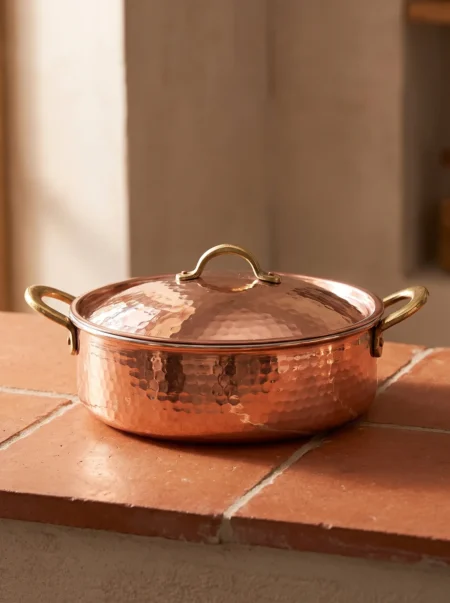 Pots and casserolesSingle-portion bodies through to large-diameter volume cooking.See the range
 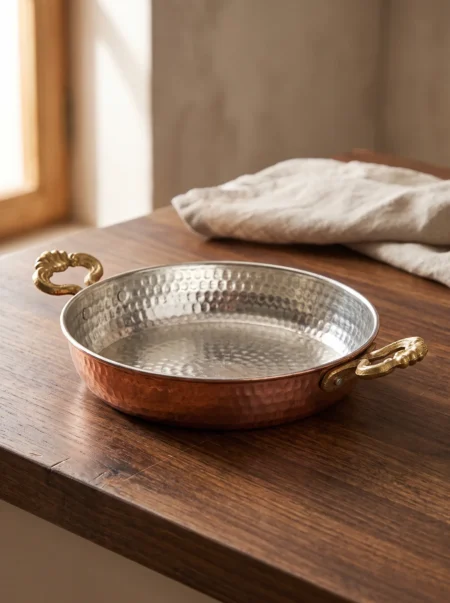 Pans and sahanHand-hammered, machine-forged and plain bodies, lidded and open.See the range
  Turkish coffee potsCezve from single-cup to seven-cup bodies.See the range
 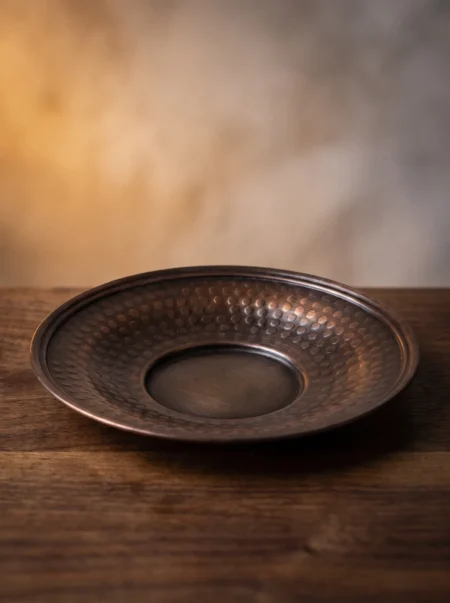 ServewareTrays, serving plates, pitchers and bowls in matched finishes.See the range
 Request a quotation
A sourcing quotation needs the pieces, the sizes, an approximate quantity per line and the destination country. Buyers comparing origins should say so: the specification is then written out in a form that can be placed side by side with a competing offer, which is more useful than a bare number.
Tell us the pieces, the sizes, roughly how many, and the destination country. If you are comparing origins, say so — we will give you the specification in a form you can put side by side with another offer, which is more useful to you than a number on its own.
Sourcing questions we are asked
Are you a manufacturer or a trading company?
Neither label fits cleanly, and the honest answer is more useful than either. We work through a long-term production partnership: the specification, the brand and the responsibility for the goods are ours, and the metalwork happens at the partner workshop. In practice you deal with one party from quotation to delivery, and that party is accountable for what arrives.
Should I source copper cookware from Türkiye or from India?
It depends on what you are buying. For very large runs of simple bodies and for copper drinkware at volume, Indian clusters have deep capacity and strong pricing. For hand-hammered cookware, tinned interiors, cezve and the Turkish coffee and tea service, this is the tradition that produces those pieces as everyday objects, and freight to Europe and the Middle East is short. Compare the specification, not the country.
How do I verify a Turkish supplier?
Tax number, trade registry record and chamber of commerce membership are all checkable, and your bank or broker can confirm them. Beyond the paperwork, ask for a sample, a video call and a written specification. A supplier who resists those is answering your question.
Can you send a sample before a bulk order?
Yes, and we recommend it rather than tolerating it. The sample cost is deducted from the order when you place it, so skipping it saves nothing and risks a container.
What is the minimum order?
There is no published figure, because it depends entirely on what you are ordering. A pallet of one small item and a mixed order of large bodies are not the same problem. Send the list and we will tell you straight away whether it works as an export shipment.
Do you make private label goods?
Yes. Marking and packaging can carry your label rather than ours, and work made to your drawing goes out under your mark.
Which lining should I specify?
Tin for handmade copper. It is the traditional lining, it is renewable when it wears, and it is what a workshop tradition is actually equipped to do well. Be suspicious of unlined interiors sold as authenticity and of coatings that are never named.
Why are two similar-looking pans priced so differently?
Usually gauge and labour. A thinner wall and a machine-formed body cost far less than a heavy hand-hammered one, and both are legitimate — provided you know which you are buying. Ask for the wall thickness in writing before comparing prices.
Can you match a piece I am currently buying elsewhere?
Send it, or send photographs with dimensions. Matching an existing piece is routine, with two exceptions: we will not copy a protected design, and we will not reproduce an unlined food surface.
How long will a first order take?
It depends on the shape, the finish, and whether tooling or engraving is involved. We give a lead time with the quotation and we would rather give you a realistic one than a flattering one that slips. If you have a fixed deadline, tell us at the start, while there are still choices that protect it.
Do you handle export documents?
We prepare the Türkiye-side paperwork, and it is a priced service rather than an assumption. The customs declaration in your country has to be made by a party established there. The split is set out on the importing page.
The 2026 catalogue — the full range with codes, sizes and weights: open or download it here. See also wholesale and export terms, buyers in the UK and buyers in the USA.
Comparing suppliers? Send us your list
We will quote with the specification written out, so you can put it side by side with another offer.
Last updated: 11 September 2026