
Wholesale Copper Griddles (Sac)
Copper griddles, specified by the burner they will sit on
A copper griddle is bought for speed and sold badly when nobody asks what it will be heated by. We supply hand-hammered solid copper griddles — the Turkish sac, a shallow open disc for high-heat sautéing at the table or over a ring burner — to restaurants, kebab houses, hotel banqueting kitchens, catering equipment dealers and homeware buyers, in diameters from small single portions up to banquet sizes.
Tell us the heat source before the size — a gas ring, a domestic four-burner hob, a wood fire, a tabletop burner in a dining room — and we will propose the diameter, the sheet gauge, the depth and the finish that suit it.
A copper griddle, known in Turkish as a sac, is a shallow open disc used for fast, high-heat cooking over a direct flame: meat is cut small, seared hard and served from the pan. Copper is chosen for it because the metal moves heat sideways faster than any other cookware material in ordinary use.
Heat that spreads sideways
Copper carries heat across the face of a disc roughly twenty-five times faster than stainless steel, which is the whole reason a sac is made of it.
Fast, not heavy
A thin disc answers the burner instantly and cools just as fast. It is a responsive pan, not a heat store like cast iron.
Gas and open fire
Flame is the sac’s natural heat source. Contact hobs work with limits, and one hob type does not work at all.
Diameter against burner
The disc is matched to the flame it will sit on, not to the number of covers. An oversized disc heats unevenly at the rim.
Made to size
Diameters, depths and gauges outside the standing range are made to order at the workshop we work with.
Table service
The pan goes to the table over a burner and stays there, which makes the outside face part of the presentation.
What a copper sac is, and what it is actually used for
A sac is a shallow, wide, slightly dished copper disc with small side handles, used for saç kavurma: lamb or beef cut into pieces, thrown onto a very hot surface, moved constantly and finished with peppers, tomatoes and onion. The pan is a cooking surface and a serving dish in the same object.
The form comes from an open fire rather than from a kitchen range. A disc sits over coals or a ring burner, the heat arrives at the centre, and the cook uses the whole face as a temperature map: the middle for searing, the outer ring for holding and for the vegetables that must soften without colouring. That is a technique, not a limitation, and it explains why the pan is shallow and open rather than walled like a sauté pan. Nothing is being contained; everything is being moved.
In service the pan usually arrives at the table on a small burner and stays there, so the food is eaten at the temperature it left the fire at. That changes what a buyer is specifying. A saucepan is judged on what happens inside it; a sac is judged on what the guest sees, which means the outer face, the rim and the handles are part of the purchase and not incidental to it.
It is worth separating this page from general copper cookware at the outset. Pans for sauces, stews and reductions are a different conversation about wall thickness, capacity and lids, and we deal with it on the copper cookware page. Everything below is about a flat, open, direct-flame surface, which behaves according to different rules.
How copper moves heat, and what a thin disc really feels like
Copper conducts heat at roughly four hundred watts per metre-kelvin, about twenty-five times the figure for stainless steel and comfortably ahead of aluminium. On a griddle that matters laterally: a flame touching one part of the base spreads across the whole face in seconds instead of leaving a scorched ring over the burner crown.
Two properties are being confused whenever cookware is discussed, and a griddle is where the difference becomes obvious. Conductivity is how fast heat travels through the metal. Thermal mass is how much heat the pan is holding when you put cold food into it. Copper is exceptional at the first and, in a thin sheet, modest at the second. The Copper Development Association and the Royal Society of Chemistry element profile both give the conductivity figure; nothing gives you mass except thickness.
The standing range here is worked in sheet of roughly 0.8 to 1.0 mm. That is a deliberate choice for this form and it has consequences a buyer should understand before ordering. The pan reaches temperature almost immediately, which is why a sac can be brought up on a tabletop burner in front of guests. It also follows the burner downwards just as fast, so the moment a cold load of meat lands on it the surface temperature dives, and it will not climb back until the burner catches up. The technique that goes with the pan is therefore the right one: small batches, high flame, constant movement, and the pan never crowded.
The comparison customers reach for is cast iron, and it is the wrong comparison in both directions. Cast iron conducts badly and stores enormously; it will hold a sear through a big cold load and it will take ten minutes to change its mind about anything. Thin copper is the mirror image: it is a control instrument. If what a kitchen actually needs is a heat battery for steak service, say so and we will discuss a heavier gauge, because the difference between a responsive pan and a storage pan is millimetres of sheet, not the metal.
Matching the disc to the burner
Griddle diameter should be chosen against the flame that will heat it rather than against the number of covers. Copper spreads heat outwards well enough to forgive a burner smaller than the disc, but the forgiveness has a limit: past roughly three times the diameter of the burner crown, the rim of a thin disc runs cooler than the centre.
This is the single most common specification mistake on this product. A buyer orders the largest disc in the range because the photographs of a banquet sac are impressive, puts it on an ordinary domestic hob with a burner crown the size of a saucer, and discovers a pan with a hot coin in the middle and a warm ring around it. The pan is not faulty. It is simply being asked to do something no sheet of metal of that thickness can do.
The standing range runs from small discs of about 16 cm up to banquet sizes around 36 cm across, and the sizing logic is simple. Small and mid-sized discs work on a normal hob burner and on a tabletop burner, which is what most restaurant service actually uses. The large sizes want a high-output ring burner, a wok ring or an open fire, and that is where they were designed to live: an outdoor kebab setup, a banqueting station, a village fire. If you are equipping dining rooms with tabletop burners, send the burner specification and the proposed diameter will come back adjusted to it.
Handles follow from the same physics and deserve a word. Copper carries heat to the ears of the pan as efficiently as it carries it across the face, so metal handles on a griddle get hot quickly and stay hot. Service staff need a cloth or a mitt, and that is not a defect to be engineered away on a pan of this type; it is the price of the conductivity that made the pan worth buying. Where a piece needs a handle that can be gripped bare, say so at enquiry, because that is a different fitting rather than a coating applied later.
Which hobs a copper griddle works on, and the one it does not
Copper griddles work on gas, on open fire and on solid electric plates, and they work with reservations on radiant ceramic hobs. They do not work on induction: copper is not ferromagnetic, so an induction hob will not sense the pan and will not heat it, and the only workaround removes most of the reason to buy copper.
Gas and open flame. The natural home of this pan. Flame heats a disc by contact and radiation across a broad area, it does not care whether the base is dead flat, and it can be changed instantly — which suits a pan that responds instantly. Ring burners, wok burners, tabletop burners and wood coals are all straightforward.
Solid electric plates. Workable, with two conditions. The plate transfers heat by contact, so the base must sit flat on it, and a hand-hammered base is not a machine-ground one. Plate diameter also becomes a hard ceiling on disc diameter, because nothing beyond the edge of the plate receives any heat directly. For solid-plate kitchens we suggest a flat-bottomed piece in a diameter close to the plate.
Radiant ceramic and halogen. The same contact caveat, plus a cosmetic one: a hammered base and a glass top are not friends. Lift the pan rather than sliding it, and expect the glass to mark over time. If the kitchen is glass-topped throughout, this is a decision to take deliberately rather than by accident.
Induction. Here the answer is no, and we would rather say it before a quotation than after a delivery. An induction hob works by inducing an electrical current directly in a ferromagnetic pan base; copper is not ferromagnetic, as any account of ferromagnetism makes clear, so the hob either refuses to start or reports that no pan is present. An interface disc — a steel plate laid between hob and pan — does make something happen, but what it does is heat a steel plate and let that plate warm the copper by contact, which is slow, uneven, and precisely the opposite of the behaviour you were paying for. It cannot be recommended for a pan whose entire purpose is instant response. If your kitchen is induction throughout, tell us at enquiry: serving bowls, trays, coffee pots and drinkware are unaffected and we will steer you there instead, and the full explanation is on our page about copper and induction.
The temperature ceiling: the lining, the fat and the empty pan
Copper griddle work runs hot, and the surface inside the pan sets a ceiling on how hot is sensible. Where a cooking face is tinned, the lining softens and runs well before the copper itself is in difficulty, because tin melts at around 232 degrees Celsius — a temperature a dry empty pan on a full flame passes easily.
The number is not controversial: the Royal Society of Chemistry entry for tin gives the melting point, and any traditional copper kitchen has a story about a pan that was left on a burner while somebody answered the door. What keeps a lined pan safe in ordinary service is the food: wet food holds the contact surface near the boiling point of water until it dries out, and a film of fat spreads and buffers the rest. An empty pan has neither, which is why the rule in a working kitchen is simply never to preheat a lined pan dry on a high flame, and never to walk away from one.
Because this matters and varies by piece, it is a question with a specific answer rather than a generic one. Tell us how hot the pan will be run and what will be cooked on it, and the specification you are quoted will state what is on the cooking face. If a kitchen genuinely needs a surface for sustained hard searing over a ring burner, that is a conversation to have before the order, not a discovery to make in service. The routine for keeping a lined surface alive as long as possible is set out on our copper care page, and the compliance side of surfaces that meet food is covered in food contact compliance.
One honest boundary, stated plainly. We hold no food-contact certificate as a standard document for these pieces, and nobody in this trade can hand you an approval that does not exist in the form buyers often imagine. If your market requires testing or a declaration under a framework such as EU Regulation 1935/2004, tell us before the order so it can be arranged; finding out at a border is the expensive way to learn it.
Flat, dished and hammered faces
Griddle faces come flat, gently dished or hammered, and the choice changes how the pan cooks rather than only how it looks. A dished face gathers juices and fat at the centre, a flat face lets them spread and evaporate, and a hammered face breaks the contact between food and metal into hundreds of small points.
The dished form is traditional for saç kavurma because the technique wants a small pool of rendered fat that the cook keeps pushing meat through. It also concentrates liquid, which is useful when a dish is finished with tomato and the sauce should reduce in one place rather than run to the rim. A flat face is the better choice for anything that should stay dry — vegetables, breads, halloumi — because moisture spreads thin and leaves quickly instead of pooling and stewing.
Hammering does two things at once. Visually it is the signature of hand work and it is what most buyers of Turkish copper are actually buying. Practically, the facets scatter light on the outside and break up scratch marks and water spots, so a hammered pan looks presentable for far longer in a dining room than a mirror surface does. On the cooking side the facets are shallow enough that the difference is small, but they do make a hammered base an imperfect match for contact hobs, as above.
Because the work is struck by hand, two pans of the same form from two different runs are siblings rather than twins. For a single pan that is the appeal. For a dining room where eight pans stand on eight burners in a row, it is a specification point, and the answer is to order the row in one batch and buy the spares at the same time rather than a year later.
What is in stock right now
Stock shown on this page is read live from the warehouse rather than from a catalogue export, so a piece displayed is a piece on the shelf today. Pieces sell and return through the week, so the grid changes. Anything not shown can still be quoted, because sizes outside the standing range are made to order.
The grid below is read live from the warehouse — it shows pieces that are on the shelf today, not a catalogue photo set.
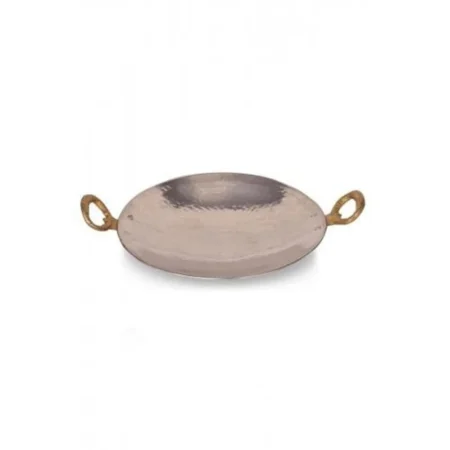
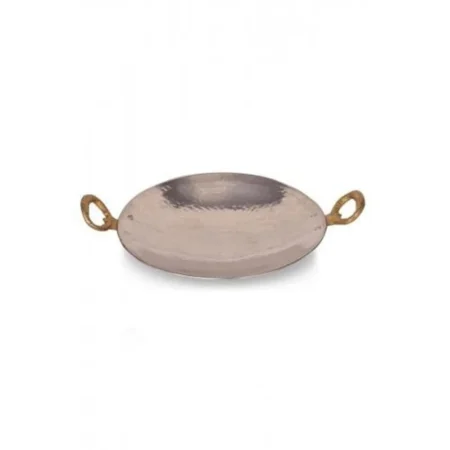
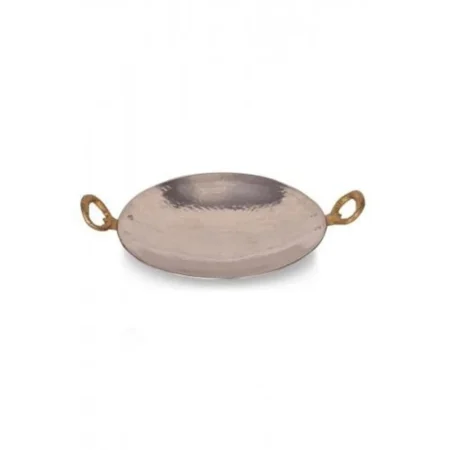
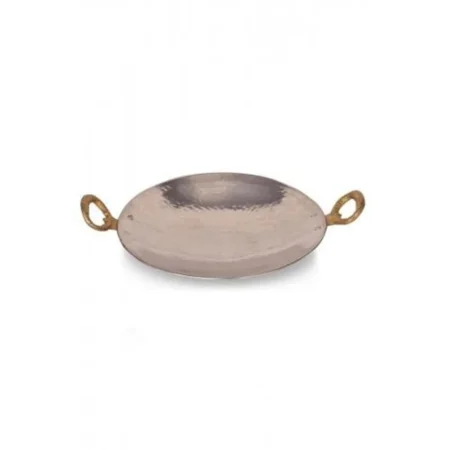
11 items in stock right now, from 16 cm to 36 cm. Other sizes and finishes are produced to order.
Buying for restaurants, kebab houses, hotels and retail
Griddles sell into two very different trades. Professional kitchens buy a heat source first and a pan second, and they buy replacements against a written specification. Homeware and gift retail buys the object, the box and the photograph, and cares about the outside face far more than about burner crowns.
Restaurants and kebab houses should start from the equipment. Send the burner type and output, the service pattern — cooked in the kitchen and carried out, or finished at the table — and the number of stations to be equipped, and the diameters will come back matched. Order spares in the same batch: a pan that goes to a table is a pan that gets dropped, and a replacement matched against a retained sample looks like the others while a replacement bought a year later from general stock does not.
Hotel banqueting typically wants the large sizes and a consistent finish across a buffet line, plus a plan for what the pans stand on. A copper disc carried hot to a table needs a trivet or a burner stand; specify them with the pans rather than sourcing them separately in a hurry.
Homeware and gift retail buys the presentation. Copper scuffs copper, so pieces travel separated and cornered rather than stacked bare, retail packs take rigid inserts because a disc that moves inside its box arrives dented, and a plain rim takes engraving cleanly where a house name is wanted. Carton dimensions and gross weights are issued with the quotation so your forwarder can price the movement against real figures rather than an estimate.
On paperwork the limits are worth stating before you ask. There is no contracted carrier here, so transport is arranged by the buyer unless you ask us to quote it separately, and export documentation on the Türkiye side is a paid service. The declaration at destination stays with the importer, because only a party established there can file it. Copper table and kitchen articles sit under heading 7418 of the World Customs Organization nomenclature at six digits; the national subheading and the duty rate are confirmed by your broker on the day of shipment, and classification remains the importer’s responsibility. A fuller walk-through is on our page about importing copper cookware.
How we work
BakırBul works through a long-term production partnership rather than a plant of its own: we specify the piece, our partner produces it, and we carry it under our own name. That is why a diameter outside the standing range, a heavier sheet for a searing station or a changed depth is a routine request here rather than an exception.
The sequence is the same every time. You describe the heat source and the service, we propose a specification, a sample is agreed, and the run is made against that sample. The sample is retained and the specification written down, so a reorder later is matched against a record instead of against whatever is on a shelf. On a hand-hammered product that record is the entire point, because the surface is struck rather than pressed.
There is no published minimum order, and that is deliberate rather than evasive. One diameter in one finish and a mixed equipment list for four dining rooms are different problems, and a single figure would be wrong for most of what we carry. Send the list with quantities and a destination country and you will get a straight answer about whether it works as an export shipment. Dates are handled the same way: a date is quoted against your actual list, because a plain disc and a hand-hammered banquet size do not take the same time, and a number published in advance would only be a number that turns out to be wrong.
Request a quotation
Send the burner type and output, a diameter range, whether the pans are finished at the table or in the kitchen, an approximate quantity and a destination country. That is enough for a quotation with carton dimensions and gross weights, which is what a freight forwarder needs in order to price the movement accurately.
If the equipment is not decided yet, send a photograph of the station or the dining table instead. Proposing a diameter from a picture of the burner is quicker and far more reliable than working from a list of codes, and it prevents the one mistake that spoils this product, which is a beautiful pan that is too wide for the flame under it.
Frequently Asked Questions
Can a copper griddle be used on an induction hob?
No. Copper is not ferromagnetic, so an induction hob cannot couple to it: it will not detect the pan and will not heat it. An interface disc placed between hob and pan does heat the steel plate rather than the copper, which is slow and uneven and removes the responsiveness that makes copper worth buying. For an induction kitchen we steer buyers to serveware, trays and coffee pieces instead, which are unaffected.
What thickness is a copper griddle, and does it matter?
The standing range is worked in sheet of roughly 0.8 to 1.0 mm. It matters a great deal. A thin disc answers the burner instantly and also loses temperature instantly when cold food lands on it, so it rewards small batches and a high flame. If a kitchen needs a pan that holds a sear through a heavy load, ask about a heavier gauge before ordering rather than after.
How big a griddle should I order?
Choose against the burner, not the covers. As a working rule, keep the disc within about three times the diameter of the burner crown, or the rim of a thin pan will run cooler than the centre. Small and mid-sized discs suit domestic and tabletop burners; the banquet sizes want a ring burner, a wok ring or an open fire.
Will a copper griddle work on a glass ceramic hob?
It will heat, with two reservations. Contact hobs transfer heat by touch, and a hand-hammered base is not perfectly flat, so heating is less even than over flame. The glass also marks if pans are slid rather than lifted. A flat-bottomed piece close to the size of the heating zone is the version to specify for a glass-topped kitchen.
Can I put a copper griddle in the oven?
A short finish in a moderate oven is normally no problem for the metal, but a tinned cooking face sets a ceiling, because tin softens and then runs at around 232 degrees Celsius. High-temperature roasting and grill elements are the risk, not the oven itself. Tell us how the pan will be used and the specification you are quoted will state what is on the cooking face.
Is the handle going to get hot?
Yes, quickly. Copper carries heat to the handles as efficiently as it carries it across the cooking face, which is the same property you are buying the pan for. Service staff need a cloth or a mitt. Where a handle has to be gripped bare, say so at enquiry, because that is a different fitting rather than something added to a finished pan.
Can a copper griddle go in a dishwasher?
We do not recommend it and we do not claim it. Machine detergent is aggressive towards copper and towards a tin lining, and the drying cycle leaves water marks that are harder to remove than the cooking residue was. Hot water, a soft brush and immediate drying is the whole method, and on an open disc it takes less time than loading a rack.
Do the pans come lined?
That depends on the piece, and it is a question we answer specifically rather than generally, because the right answer depends on how hot the pan will be run and what will be cooked on it. State the use at enquiry and the quotation will state the cooking surface. If your market needs documentation about surfaces that meet food, raise it before the order so it can be arranged.
Do you have a minimum order?
There is no published figure, and that is deliberate. One diameter in one finish and a mixed equipment list for several dining rooms are different problems, and any single number would be wrong for most of what we carry. Send the list with quantities and a destination country and we will tell you immediately whether it works as an export shipment.
How are copper griddles packed for export?
Discs nest, and bare copper nested against bare copper marks itself, so they travel separated, cornered, boxed in stack heights one person can lift and palletised. Retail packs get rigid inserts because a disc that moves inside its box arrives dented. Carton dimensions and gross weights go out with the quotation so your forwarder can quote against real figures.
The 2026 catalogue — the full range with codes, sizes and weights: open or download it here. For pans, pots and lids see copper cookware, for equipping a property see copper for restaurants and hotels, and for sizes outside the range see custom copper manufacturing.
Send us your list
A burner type, a diameter range, an approximate quantity and a destination country is enough to start. We come back the same day.
Last updated: 20 September 2026