
Wholesale Copper Serving Bowls
Copper serving bowls, specified for a real table
A copper bowl is the piece a room looks at, and it is also the piece that decides how long the food inside it stays at the temperature it arrived at. We supply hand-hammered copper serving bowls — wide centre-of-table bodies and small individual bowls, in red copper and antique oxide, tinned or bare according to what goes in them — to restaurants, caterers, hotels and homeware buyers.
Tell us what will sit in the bowl and for how long — salad, punch, mezze, dry fruit, a dressed dish on a buffet — and we will propose the diameter, the depth, the sheet gauge, the lining and the finish. That one sentence answers more of the specification than a catalogue code does.
A copper serving bowl is a presentation vessel rather than a holding vessel. Copper moves heat faster than almost any other metal a kitchen uses, so a hot dish in copper gives its heat to the room quickly and a chilled dish warms quickly, unless something under the bowl is holding the temperature for it.
Heat moves both ways
The conductivity that makes copper a good pan makes it a poor thermos. The bowl takes heat fast and gives it back just as fast.
Diameter is portions
A wide centre bowl and a small individual bowl are two different orders. Both get specified by what is being served, not by looks.
Lined for what goes in
Dressed salad, citrus punch and tomato stand for hours. Those interiors are tinned, and the lining is written into the specification.
The bare exception
Whipping bowls for egg white are deliberately unlined. If that is the job, say so, because a tinned interior will not do it.
Weight you can carry
A wide bowl is over a kilogram before anything goes in it. Rim, foot and depth decide whether one hand or two are needed.
Made to a drawing
Diameters outside the standing range, deeper bodies, engraving and matched finishes are made to order at the workshop we work with.
What a copper serving bowl does at a table, and what it does not
Copper serving bowls carry food to a table and hold it in front of people, which is a shorter job than it sounds. The metal itself does not keep anything warm or cold for long; what it does is arrive looking like nothing else on the table and survive being used every service for years.
Copper is one of the best conductors of heat in everyday use, second only to silver among the metals anyone puts on a table; the Royal Society of Chemistry’s element page for copper and the technical library at copper.org both set out the figures. In a pan, conductivity is the whole point: heat from one small flame spreads across the base instead of burning a ring into a sauce. In a bowl standing on a table, the same property works in the other direction. There is no flame underneath, so the bowl equalises with the room.
This is not a criticism of the material, it is the specification. A serving bowl is chosen for presence, for the way it reads under warm light, for the fact that it does not chip like ceramic and does not look like a hotel-supply catalogue. It is chosen to be seen, handled, carried and refilled. Once a buyer accepts that, the rest of the decisions become straightforward and nobody is disappointed on the third service.
Three neighbouring pieces get confused with this one and are worth separating now. A flat tray or plate is a carrying and presentation surface with no volume to speak of, and trays, plates and pouring vessels are covered on our copper serveware page. A hammam bowl is a wide, handle-less bath vessel for pouring water over the body, not a food vessel at all, and it has its own hammam bowl page. Pet bowls and garden water features come up in the same search results and are a different specification again; they are not what this page is about.
Serving bowls on the shelf right now
Stock on this page is read live from the warehouse rather than from a catalogue export, so a bowl shown here is a bowl on the shelf today. The grid changes through the week as pieces move, and diameters outside the standing range are still quotable because they are made to order.
The grid below reads the warehouse directly. If what you need is not in it, that is a reason to send the enquiry rather than a reason to stop.
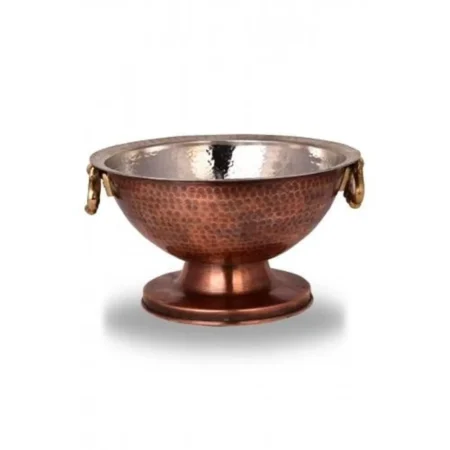
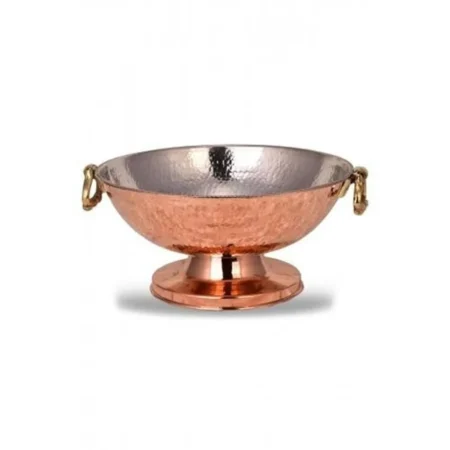
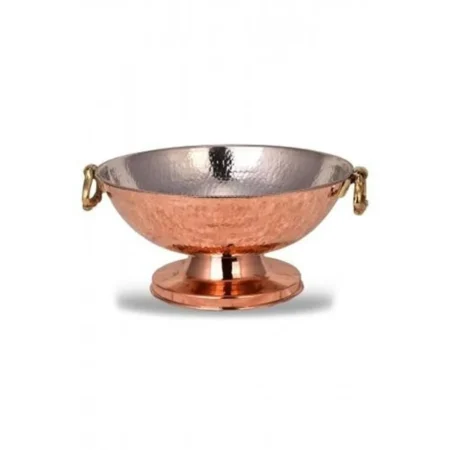
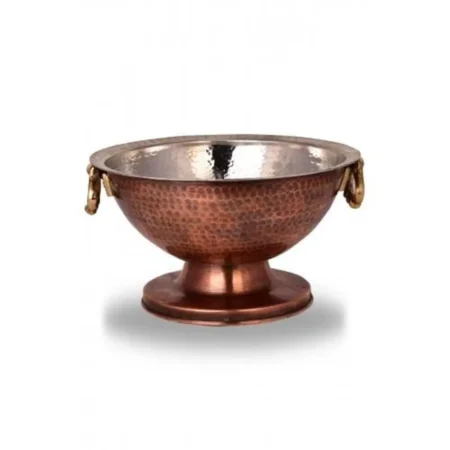
5 items in stock right now, from 8 cm to 32 cm. Other sizes and finishes are produced to order.
Heat: why copper serves food rather than holds it
Hot food in a copper bowl cools faster than the same food in a thick ceramic dish, because copper conducts heat outwards to the room as readily as it conducts it inwards from a flame. Anything that needs to stay hot on a buffet needs a heat source under it, not a better metal.
The physics is worth stating once, plainly, because it decides an operational choice. A material that moves heat quickly reaches the temperature of whatever surrounds it quickly. Put a hot dish into thick stoneware and the stoneware itself has absorbed a great deal of heat, which it then gives back slowly; put the same dish into a thin copper body and the copper is at room temperature within minutes and the food follows it down.
The practical consequence for a buffet is that copper belongs in one of two places. It belongs at a station where something is supplying heat underneath — a chafing frame, a bain-marie insert, a warmer, a burner — in which case the conductivity becomes an advantage again, because the bowl distributes that heat evenly across the base instead of scorching the middle. Or it belongs where the food is served and eaten quickly: a bowl that is refilled from the kitchen every twenty minutes never has time to cool, and that is how most restaurants actually run copper.
Where it does not belong is as a substitute for insulation. If a proposal on your desk says a copper bowl will keep a dish hot for an hour on an unheated table, it is wrong, and it is the kind of wrong that ends in a complaint from a function client. We would rather lose that line than write it.
One more heat note, because it decides whether a bowl can go near a hob at all. These are serving bodies, not pans. A serving bowl can be warmed in an oven at a low setting before service, which is a genuinely useful trick, and it should not be set over a direct flame like a saucepan. If you need a copper body built to take direct heat, our copper cookware page covers the cooking bodies, and the interaction between copper and different heat sources is set out in full on the copper and induction page, which explains why an induction hob will not heat solid copper at all.
Cold service: ice, condensation and a short window
Chilled food in a copper bowl feels cold immediately and stays cold briefly, and the outside of the bowl gathers condensation as soon as it is colder than the room. Both facts change what goes under the bowl and what the service cloth has to cope with.
The speed is a genuine advantage for a short service. A bowl taken from a cold room reaches the food almost instantly, so a dressed salad or a fruit course is at its temperature from the first plate rather than the fourth. For a passed course or a short buffet window, that is exactly what you want.
The condensation is the part that gets forgotten until the first function. A cold metal body in a warm room collects water on its outside within minutes, and that water runs down to the foot and sits there. On bare wood it leaves a ring; on linen it leaves a dark patch that a banqueting manager will notice before the client does. The answer is a coaster, an under-plate or a tray beneath the bowl as a matter of routine, and specifying a defined foot rather than a fully rounded base so the bowl sits on a rim instead of a wet curve.
If ice is going in with the food, say so at the enquiry stage. Ice in direct contact with a tinned interior is harmless, but the thermal shock of filling a warm bowl with ice, or a cold bowl with hot food, is the fastest way to stress a soldered joint on a foot or a handle. Bowls used that way are specified with that in mind.
Diameter and portions: the centre bowl and the small bowl
Copper serving bowls in this range run at roughly 27 and 32 cm across for the wide centre-of-table bodies, with small individual bowls down at about 7.5 cm. Diameter is chosen from what is being served and how many people reach into the bowl, not from the look of it on a shelf.
The wide bowls do the communal work. A body around 27 cm across sits in the middle of a table and serves a group without being passed constantly; the same shape at 32 cm becomes a station piece, a punch or a fruit display, the bowl a room notices from the door. The difference between those two diameters is much larger in volume than it looks on paper, because volume rises with the cube of the dimension rather than in step with it. A five-centimetre increase in width is not a five per cent change in what the bowl holds.
The small bowls do a different job entirely and are ordered by the dozen rather than by the piece. A bowl around 7.5 cm is a condiment, olive, dip, jam or breakfast bowl: one per cover, replaced constantly, washed constantly. Anything ordered per cover should be specified for the washing-up rack first and the table second, because that is where it spends the rest of its life.
Depth is the dimension buyers forget to specify and the one that makes the difference in service. A shallow wide bowl displays beautifully and dries out a dressed salad; a deeper body holds the dressing at the bottom and keeps the leaves alive, but it hides the food from anyone standing over it. Tell us which problem matters more in your room and the drawing follows. If the depth you need is not in the standing range, it is made to order.
Diameters between and beyond these figures are drawn rather than substituted. That is the practical advantage of specifying a piece instead of picking one: a banqueting set with a defined bowl width, or a retail range built around one distinctive size, does not have to bend itself around whatever is already in a warehouse.
Gauge, weight, rim and foot
Copper serving bowls in this range are raised from sheet between 0.7 and 0.8 mm and the wide bodies weigh between roughly 1,130 and 1,430 grams empty. Gauge decides how the bowl survives a service; rim and foot decide how it is picked up and where it sits.
Sheet gauge on a serving bowl does a different job from gauge on a pan. In a pan, thickness buys thermal mass and evenness. In a bowl, thickness buys resistance to denting and a rim that does not distort when a full body is gripped at one side. A thin bowl carried by the rim with two kilograms of salad in it flexes, and once it has flexed it never sits quite flat again. Sheet at the upper end of this range costs more to move and survives a banqueting department.
Then add what goes inside. A wide bowl at around a kilogram and a half empty is a three-kilogram object once it is full, held at arm’s length across a service pass. That is a two-handed lift, and the shape has to allow it: a rolled or beaded rim gives the fingers something to hold that a raw cut edge does not, and it also stiffens the mouth of the bowl, which is the same reason it exists on a bucket.
The foot decides the rest. A defined foot ring keeps the body off a wet surface, stops the bowl rocking on a hammered base and makes stacking predictable in a store cupboard. A fully rounded base looks softer and lives less comfortably on a flat table. Neither is better in the abstract; a display bowl and a working bowl want different answers, and it costs nothing to say which one you are ordering.
Hand-hammered surfaces are not only decorative here. The faceted surface work stiffens thin sheet, which is why a hammered body of the same gauge feels more solid than a smooth one, and it breaks up reflections so that fingerprints and water marks are far less visible across a long service.
Tin lining, acidic food and the bare-copper exception
Tin lining is a layer of tin laid over the inside of a copper vessel so that food meets tin instead of copper. Serving bowls that hold dressed, citrus or tomato-based food are specified as tinned, because acidic food standing in bare copper picks up metal from it.
The rule is about contact time as much as acidity. A dry bowl of nuts or bread is a mild case. A vinaigrette-dressed salad standing for an hour and a half on a buffet, a citrus punch with fruit in it, a tomato-based mezze — these are long, wet, acidic contacts, and they are the reason the lining exists. Specify the interior by what the bowl will actually hold in your service, not by what the category is called.
There is one deliberate exception and it runs the other way, which surprises buyers who assume a lining is always better. The classic copper bowl for whipping egg whites is unlined by design: the reaction between copper and the proteins in the white is what stabilises the foam, and a tinned interior does not do it. If you are buying whipping bowls, a tinned bowl is the wrong product and we would rather you told us at the enquiry stage than discovered it in a pastry section. It is the same trap as the French preserving pan, which is also deliberately bare, and it is worth saying out loud because most of our bowls are specified the other way.
On paperwork, we prefer to be blunt. We do not hold a food-contact test report as a standard inclusion, and there is no such thing as a blanket certificate that makes a copper bowl approved everywhere. What exists is a framework — Regulation (EC) 1935/2004 and the EDQM technical guide on metals and alloys in Europe, the FDA Food Code in the United States — plus a laboratory test against it for a defined piece. If your market asks for that, say so with the enquiry, because arranging a test before production is straightforward and arranging one at a border is not. What is realistic is set out on our food-contact compliance page, and the general question is answered on is copper cookware safe.
Finishes on a laid table
Copper serving bowls are supplied in bright red copper and in antique oxide, and the choice is an operational one rather than a matter of taste alone. Red copper is the striking finish and the demanding one; oxide is already dark, so handling marks and darkening disappear into it.
Bright red copper is why people buy copper in the first place. Under warm light it does something no other table material does, and a room notices it. It is also bare metal reacting with air, which means it darkens, and it shows every fingerprint from a service. A property that chooses it needs somebody whose job it is to keep it bright, and that is a rota, not a product.
Antique oxide is the answer for rooms that do not have that person. The surface is deliberately darkened, so further darkening blends in, fingerprints are invisible at two paces and the bowl reads as an object with a history rather than a piece that needs attention. For a busy buffet, a bar or an outdoor terrace it is usually the right call.
Hammered and smooth bodies behave differently again. A hammered surface scatters light, so water marks and small scratches vanish into the pattern; a smooth body is cleaner and more modern and shows everything. Mixing the two across one order is possible and generally a mistake: a table set with half-hammered and half-smooth bowls reads as a mismatch rather than a collection.
Whatever the finish, there is no lacquer on these bodies. Coated copper stays bright without work and eventually crazes, lifts at the rim and cannot be polished back. Bare metal ages and can always be brought back, which is the trade we would rather make on a piece that is meant to last.
Buying for restaurants, caterers and hotels
Hospitality buyers need three things from copper serving bowls: diameters that match the service rather than the shelf, a finish that survives the room without a polishing rota, and the ability to order the identical bowl again in two years when three have been dented.
Start with breakage and attrition, because it is the number that actually decides the order. Copper does not chip or shatter; it dents and it goes missing. A dented bowl is still usable, which is both an advantage over ceramic and a reason nobody notices the fleet degrading until a function looks tired. Order spares with the main run, and order them in the same batch, because a piece made alongside the original is a closer match than a piece made later.
Caterers have the hardest brief, because their bowls travel. A bowl that spends its life in crates, vans and other people’s kitchens wants heavier sheet, an oxide finish and a defined foot, and it wants stacking to have been thought about before the first job rather than after. Say that in the enquiry and the specification changes materially.
Hotels tend to split the order: a small number of large display bowls for the buffet or lobby, and a large number of small bowls for breakfast condiments. Those are two different specifications in one quotation, and they should be priced and packed as two lines. If you are furnishing a property rather than replacing pieces, the wider list is on our page for restaurants and hotels.
Matching later is the requirement most suppliers quietly fail. We keep the written specification and a retained sample against your order, so a replacement two years from now is made against the drawing and compared with the sample rather than against whatever happens to be in a warehouse that week.
Care, washing and the dishwasher question
Copper serving bowls are washed by hand in warm water with a mild detergent and dried immediately, and food is not stored in them between services. Machine washing is the single habit that ages a copper bowl fastest, because the detergent attacks the metal and the lining together.
Immediate drying does more for the appearance of a copper bowl than any polish. Water left to evaporate on the surface leaves the minerals behind as spots, and those spots are harder to remove than the food was. A cloth at the wash-up station, used as part of the routine, removes the need for most of what people buy polish for.
Storing food in a bowl overnight is the other habit worth banning outright. It is not dramatic and nothing visible happens the first time; it is a slow way to dull a tin lining and, in a bare bowl, a slow way to put metal into food that has no business carrying it. Empty, wash, dry, store.
Abrasive pads are the wrong tool on a tinned interior. They take the stain off and they take a thin layer of the lining with it every time, and a lining that is worn through in one patch means the piece is due for re-tinning rather than for another scrub. Re-tinning is ordinary maintenance in Türkiye and not a write-off, but it takes the bowl out of service. The routine in full, including what not to use, is on our copper care page.
Ordering from Türkiye: enquiry, sample, series
Ordering copper serving bowls from Türkiye runs in three steps: a written enquiry with diameters, linings, finishes and quantities; a sample confirmed against that specification; then the series against the approved sample. Customs classification and clearance remain the importer’s responsibility in the destination country.
The enquiry carries the weight. Send the diameters in centimetres, the depth if it matters, whether the interiors are tinned or bare and why, the finish, an approximate quantity, whether engraving is wanted and the destination country. The destination is not small talk: it decides packing, documentation and whether the shipment makes sense as it stands.
On minimum order quantity there is no published figure, deliberately. The sensible threshold for one diameter in one finish is nothing like the threshold for a mixed list of large display bowls and small breakfast bowls with engraving, so any number printed on this page would be wrong for most of the people reading it. Send the list with quantities and you get a direct answer the same day.
Classification: copper table, kitchen and household articles fall under heading 7418 of the Harmonised System, with 7418.10 covering table, kitchen and other household articles and parts of them. Those six digits are the international level maintained by the World Customs Organization. Every country then adds its own national digits and its own duty rates, and those change over time; the classification and the declaration in the destination country are the importer’s responsibility, and a customs broker there is the right person to confirm them against the shipment date.
On logistics, the limits are stated before anyone plans around them. There is no contracted forwarder behind this page: shipping is arranged by the buyer, or quoted through a local agent when you ask for it. Export paperwork is a chargeable service and it is the Türkiye side of the transaction — invoice, packing list, certificate of origin, movement certificate where a trade agreement applies. Clearance at the far end can only be handled by a party established there. The wider process is set out on our importing copper cookware page.
How we work
BakirBul writes the specification for a piece, the workshop we work with makes it, and the run goes out under our own name after our own check. There is no plant behind this page and no inherited-workshop story attached to it, which is why the drawing matters so much.
The arrangement is a long-term production partnership rather than a buying agency, and for a wholesale buyer the difference is practical. Because the specification is written on our side and the same workshop makes it, a diameter, a depth or a rim that is not in the standing range can be drawn and made rather than quietly substituted with something close. A repeat order goes back to the same drawing rather than to a fresh guess.
The pieces are handmade and hand-hammered, and the tinning is done by hand. The people doing that work are skilled and they are not ours to claim as a heritage; a supplier who tells you about their own furnaces while quoting the same range as everyone else is telling you a story rather than a fact.
Quality control happens before dispatch and against your written specification: diameters measured, rims checked for flatness, feet checked for rock, linings inspected, finishes compared with the retained sample. Bowls that fail do not go in the carton.
Request a quotation
A copper serving bowl quotation needs five things: the diameters in centimetres, whether the interiors are tinned or bare, the finish, an approximate quantity and a destination country. What the bowls will hold, in one sentence, sharpens all five of those answers.
Write in English, in Turkish, or in whatever conveys the list most accurately. A photograph of a bowl you already buy, with the diameter and depth written beside it, is often faster than a paragraph of description. We come back the same day.
The 2026 catalogue — the full range with codes, sizes and weights: open or download it here. For trays, plates and pouring vessels see copper serveware, for drinkware see copper mugs and cups, and every guide we publish is listed on our resources page.
Frequently Asked Questions
Are copper serving bowls safe for food?
A bowl specified with a tin lining puts tin, not copper, in contact with the food, which is the arrangement kitchens have used for centuries. Bare interiors are suitable for dry and short-contact service and not for acidic food left standing. Tell us what goes in the bowl and the interior is specified accordingly rather than assumed.
Will a copper bowl keep food hot on a buffet?
Not on its own, and we would rather say so now than be asked about it after a function. Copper gives heat to the room as readily as it takes it from a flame. On a buffet it belongs over a warmer, a burner or a bain-marie insert, where its evenness becomes an advantage, or on a station that is refilled frequently.
Can you whip egg whites in these bowls?
Only in a bare one. The stabilising effect comes from the reaction between copper and the egg proteins, so a tinned interior will not do it. If whipping bowls are what you are sourcing, say so at the enquiry stage and the interiors are specified unlined for that purpose; most of the range is specified the other way.
What diameter do we need for a table of eight?
A body in the region of 27 cm across is the usual centre-of-table answer for a group that share from one bowl, and a wider body around 32 cm becomes a station or display piece rather than a table one. Volume rises steeply with width, so a small change in diameter is a large change in what the bowl holds.
Will a chilled bowl mark the table?
Yes, if nothing is under it. A metal body colder than the room gathers condensation within minutes and it runs down to the foot. A coaster, under-plate or tray as routine solves it, and specifying a defined foot rather than a fully rounded base keeps the wet curve off the linen.
Can copper serving bowls go in a dishwasher?
It is not something we recommend, and it is not something we claim. Machine detergent is aggressive towards copper and towards a tin lining, and the drying cycle bakes on water marks that are harder to shift than the food was. Warm water, a mild detergent, a soft cloth and drying straight away is the whole method.
What is the difference between a serving bowl and a hammam bowl?
They are different objects for different rooms. A hammam bowl is a wide, shallow, handle-less vessel for lifting water from the basin of a Turkish bath and pouring it over the body; it meets water and skin rather than food. A serving bowl is a food vessel and its lining, depth and foot are specified for that.
Can you engrave a restaurant or hotel logo on the bowls?
Yes. A crest or name sits on the outside wall where guests see it and an inventory code goes under the foot where they do not. Hand engraving is deep and traditional and reads well as a crest; laser marking is precise and repeatable and handles a fine logo better. Send vector artwork and we confirm the placement on a sample before the run.
Do you have a minimum order quantity?
There is no published figure and that is a deliberate decision rather than an evasion. The threshold that makes sense for a single diameter in one finish is not the threshold for a mixed list of display and breakfast bowls, so one printed number would mislead most readers. Send the list with quantities and a destination country.
How are the bowls packed for export?
Bowls nest, and bare copper nested against bare copper marks itself, so they travel separated, cornered and boxed in stack heights one person can lift, then palletised. Retail packs get rigid inserts, because a bowl that can move inside its box arrives dented. Carton dimensions and gross weights go out with the quotation.
Send us your list
Diameters, linings, a finish, an approximate quantity and a destination country is enough to start. One line about what the bowls will hold makes the answer sharper. We come back the same day.
Last updated: 20 September 2026