
Wholesale Copper Incense Burners
Copper incense burners, bought in quantity
An incense burner is the only copper object in a homeware range that is sold in order to be set on fire, and that single fact changes every specification behind it. We supply solid copper incense burners — hanging bowls on chains, standing bowls and pierced lidded forms, in red copper, antique oxide, brushed matt and nickel — to homeware and gift retailers, spa and hotel buyers, and importers who need a commodity code before they can quote.
Tell us how the burner will be lit — charcoal discs, resin on a screen, cones, or sticks — because that one answer decides the depth, the base form and whether a sand liner belongs in the box.
Copper incense burners are shallow copper vessels made to hold burning charcoal, resin, cones or sticks, supplied in hanging, standing and lidded forms. Because the fuel touches the metal directly, the interior of a censer is specified bare, without the tin lining that every copper cooking vessel carries.
Bare inside, deliberately
Tin softens and runs long before a charcoal disc stops glowing. A censer is the one copper piece we supply unlined, and we put that in writing.
Three forms, three jobs
Hanging on chains, standing on a base, or closed under a pierced lid. The choice follows who lights it and whether it is carried.
Sized for one hand
Bowls run roughly 6.5 cm to 11 cm across and 6.5 cm to 13 cm tall, under 200 grams, which is gift-shelf territory rather than freight.
Finishes that live with soot
Antique oxide and brushed matt absorb heat marks. Bright red copper and nickel show them, and somebody has to be assigned to polishing.
Commodity code stated plainly
Copper household articles of this kind sit under heading 7418. Classification stays with the importer and their broker, and we say so.
Made to drawing
Depths, pierced patterns, chain lengths and base diameters outside the range are produced at the workshop we work with.
What a copper incense burner is, and the names it goes by
Copper incense burners, also called censers, thuribles, frankincense burners or buhurdanlık in Turkish, are metal vessels built to contain a small controlled fire. A bowl holds the charcoal or the resin, the body carries that heat away from whatever the burner is standing on, and the form decides whether it hangs, stands or closes.
The English vocabulary around this object is looser than the buying decision behind it, and that is where most sourcing errors begin. A censer or thurible is a vessel for burning charcoal and resin, usually deep enough for a bed of ash and often suspended on chains. An incense holder is frequently something else entirely: a flat plate or a pierced block that supports a stick and catches its ash, with no fire in it beyond the tip of the stick. Buyers write to us asking for one and describing the other, so the first question we ask is never about diameter.
A second distinction is worth stating because the search results blur it. The tall footed box burner familiar from the Gulf, the mabkhara used for oud chips, is a different object with a different silhouette, usually much taller in proportion to its opening and often built in wood with metal fittings. It is not in what we carry. What we carry are bowls: a rounded aromatherapy form and a chained cauldron form, both hand-worked in sheet copper, both designed around a charcoal disc or a small resin screen. If your market expects the Gulf silhouette, say so at the enquiry stage rather than after the sample arrives, because the answer will be a drawing conversation and not a catalogue one.
Copper is the traditional metal for this object for a plain physical reason rather than a decorative one. It survives repeated heating without warping the way thin steel does, it does not shed a coating into the smoke, and it recovers its shape after decades of thermal cycling. What it also does is conduct that heat outward extremely fast, which is the theme of the whole page: almost every design decision in a copper censer exists to manage the heat the fuel puts into the metal.
Why the inside of a censer is left bare, and a copper pan’s is not
The interior of a copper incense burner is left unlined because tin, the lining used inside copper cookware, melts at about 232 degrees Celsius, while a lit charcoal disc sits several hundred degrees above that. Tin inside a censer would soften, pool and blister on the first use, so bare copper is the correct specification.
This is the single most counter-intuitive point in the category, and it is worth spelling out because it reverses the rule buyers learn everywhere else on this site. Every copper pot, pan, tray, mug and sauce dish we supply is tinned on every surface that meets food. Tin is there because copper reacts with acid, and the lining keeps the food and the copper apart. The lining is not optional and we will not leave it off a food vessel to save money.
A censer inverts that logic. Tin is a soft metal with a low melting point — the Royal Society of Chemistry puts it at roughly 232 degrees Celsius — and a self-igniting charcoal disc of the kind sold for resin runs far hotter than that once it has taken. Copper itself melts above a thousand degrees and is entirely untroubled. So the metal that would protect a stew is precisely the metal that fails first in a burner, and a supplier who offers you a tin-lined censer has either not thought about it or is reading from a cookware spec sheet.
There is a consequence for your product copy, and it matters more than it sounds. Because the interior is bare, a copper incense burner is not a food vessel and must not be described or repurposed as one. It is not a sauce dish, not a nut bowl, not a candle dish that later holds olives. If a customer asks for a piece that does double duty on a table, the answer is a different body from the serveware range with a tinned interior, and we will quote that instead. Mixing the two is exactly the kind of quiet mistake that turns into a return.
Fuel decides the vessel: charcoal, resin, cones and sticks
Charcoal discs, loose resin, cones and sticks each put a different amount of heat into a copper burner, and the vessel has to match. Charcoal is the hottest and needs a bed of sand or ash under it, resin needs a screen above the coal, cones sit directly on sand, and sticks need a holder rather than a bowl.
Charcoal is the demanding case and the one worth designing for. A self-igniting disc is lit, allowed to spark through, and then sits in the bowl glowing for a long stretch while resin is fed on top of it. Put that disc straight onto thin copper and two things happen: the base of the burner becomes genuinely dangerous to touch, and the inside of the bowl develops a permanent dark burn ring at the contact point. Neither is a defect in the metal; both are the absence of an insulating layer. The fix is old and costs nothing: a centimetre or two of clean dry sand, or the accumulated ash from previous burns, spread across the bottom of the bowl.
Resin — frankincense, myrrh, copal, benzoin — is rarely burned directly. It is warmed above the coal on a small mesh screen or a thin mica plate so it melts and smokes rather than charring to a bitter black residue. A burner that will be used this way wants enough internal depth for the coal plus the screen above it, which is the main reason two bowls of the same diameter are not interchangeable.
Cones are the easiest case. They are self-contained, they burn down in a few minutes, and they sit happily on sand in any of the bowl forms. Sticks are the awkward one and we would rather say so than sell the wrong thing: a bowl is not a stick holder. A stick needs either a pierced seat to stand it upright or a long channel to catch the ash as it falls, and neither feature is present in a round bowl. Sand in the bowl will hold a stick upright at a pinch, and some retailers sell them that way, but if sticks are the main use in your market then you are buying a different object and we will tell you that before you place the order.
Heat, the base, and the surface underneath
Copper conducts heat roughly twenty times faster than stainless steel, so the base of a burner in use reaches a temperature that will mark a wooden shelf or a painted surface. Standing forms need feet, a trivet or a stone tile beneath them, and hanging forms move the problem into the air instead.
This is the safety line that most incense burner listings skip, and skipping it creates the complaint. Copper’s conductivity is the reason it is prized in cookware — the figures are on the Copper Development Association reference pages — and it is the reason a burner that has held a lit disc for twenty minutes cannot simply be set down on a veneered side table. Heat that would take minutes to travel through a ceramic body arrives at the outside of a copper one almost immediately.
Three design answers exist and all three are represented in what we carry. A raised foot or a rolled base ring lifts the hot metal off the surface and leaves an air gap. A separate saucer or stone coaster ships alongside and takes the heat instead. Or the burner hangs on its chains, which removes contact altogether and is why the suspended form has survived for centuries in ritual use where the vessel is swung rather than set down.
If you are a retailer, the practical recommendation is to print one line on the insert card: use sand or ash in the bowl, stand the burner on a heatproof surface, and let it cool before moving it. It costs nothing, it prevents the most common customer complaint in the category, and it is the difference between a shop that knows its product and one that is drop-shipping photographs.
Hanging, standing and lidded: choosing the form
Hanging burners swing on three chains and never touch a surface, standing burners sit on a foot and suit a fixed spot, and lidded burners close over the coal so smoke leaves through a pierced pattern rather than rising in a column. The choice follows the ritual, the room and who handles the piece.
The hanging form in our range is the chained cauldron body: a rounded bowl with a rolled rim, three points for chains and a ring at the top so it can be carried, swung or suspended from a hook. It is the shape people picture when they hear the word thurible, and it has an obvious retail advantage in that it photographs as an object rather than as a dish. It also solves the hot base problem completely. Its disadvantage is that it needs somewhere to hang, and in a small flat that is not always obvious.
The standing form is the aromatherapy bowl: a compact rounded body on a small base, made to sit on a shelf, a mantelpiece or a spa reception desk and stay there. It is the easier sell in general homeware because it needs no installation, and it is the one that most needs the heatproof surface line on the insert card.
The lidded form changes the smoke rather than the heat. A pierced lid slows the burn slightly, hides the glow and turns the smoke into several thin streams instead of one plume, which reads as calmer in a room and keeps ash from being disturbed by a draught. It also conceals the coal, which matters in a hotel lobby or a treatment room where an open ember is not a good look. The trade-off is cleaning: ash collects under a lid and someone has to take it off and empty it.
One quiet variable behind all three is the rim. A rolled or beaded rim is stiffer, safer in the hand and far less likely to deform in a carton; a raw cut edge is cheaper and feels it. Ask which one a quotation is based on, from us or from anybody else, because it is the easiest place for a price to be shaved.
Sizes, sheet gauge and weight, and what they mean on a shelf
Copper incense burners in the current range measure roughly 6.5 cm to 11 cm across the bowl and 6.5 cm to 13 cm tall, in sheet around half a millimetre thick, weighing between about 150 and 190 grams. Those numbers put the object in gift packaging and parcel freight rather than in cookware logistics.
Four measurements decide how a censer behaves and they pull against each other. Bowl diameter sets how much ash and how large a coal it will take, and above about eleven centimetres a burner starts reading as a dish rather than a censer. Internal depth decides whether a screen fits above the coal. Height, which in the hanging form includes the chains, decides how it displays. Sheet gauge decides how it feels in the hand and how it survives a carton.
Half a millimetre is the right gauge here and it is worth understanding why, because for cookware we argue the opposite. A pan needs mass so that the temperature does not collapse when cold food goes in; a burner needs no thermal reserve at all, because its heat source sits inside it and replenishes itself. What the sheet has to do is hold its shape through repeated heating and cooling and survive being knocked, and hand-worked copper at this gauge does both. A heavier body would add cost and freight weight for no functional gain, which is why the range stays light.
The weight band matters commercially more than it looks. Under two hundred grams, a burner ships as a gift item, packs several to a carton a single person can lift, and sits inside the weight brackets that most parcel carriers price aggressively. It also means the piece can be sold boxed at a gift price point rather than as a heavy homeware line, which changes the kind of retailer it suits.
The grid below is read live from the warehouse. It shows pieces on the shelf today rather than a catalogue photo set, and sizes or finishes that are absent can still be quoted, because bodies outside the standard range are made to order.
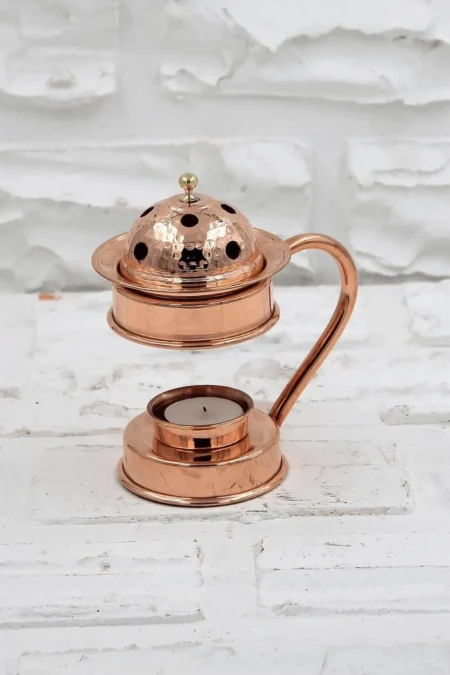
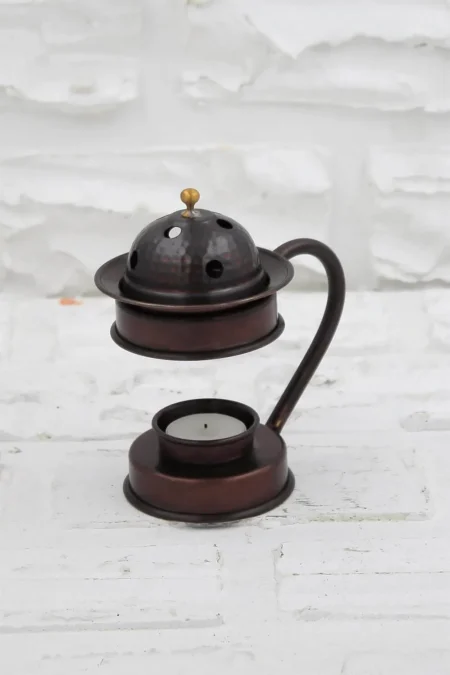
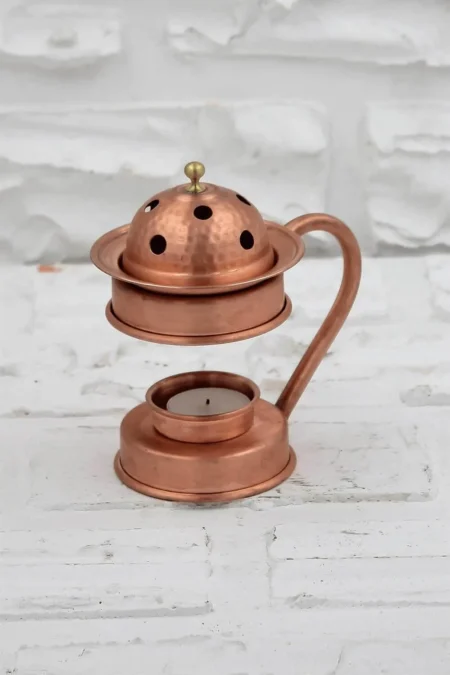
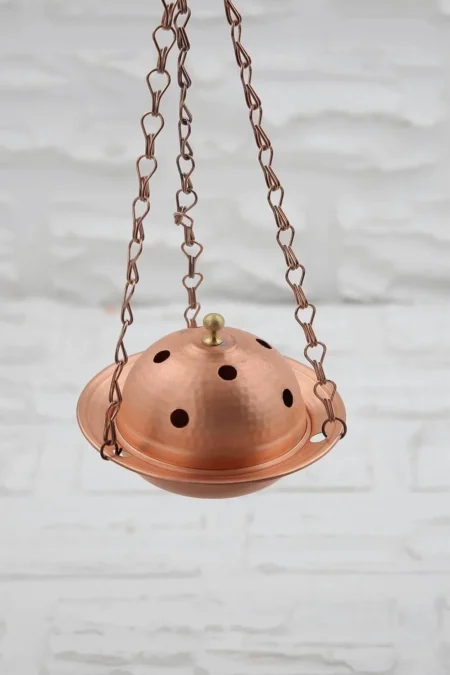
13 items in stock right now, from 7 cm to 11 cm. Other sizes and finishes are produced to order.
Finishes: red copper, antique oxide, brushed matt and nickel
Copper incense burners are supplied in red copper, antique oxide, brushed matt and nickel-plated finishes. Because a censer is heated hard and repeatedly, the finish decision is mostly about how visibly it records that heat: oxide and brushed surfaces absorb the change, bright red copper and nickel display it.
Bright red copper is the most striking finish on a shelf and the most demanding in use. Copper reacts with air and darkens on its own, and heat accelerates the process enormously; a burner used weekly will develop a mottled bloom around the bowl within a season. That is not damage, and many customers prefer it, but a retailer selling on the photograph of a polished piece needs to say so in the listing or handle the emails afterwards.
Antique oxide is the pragmatic choice for anything that will be used rather than displayed. The surface is already dark, so soot and heat marks blend into it instead of standing out, and no polishing rota is needed. For spa, hotel and treatment-room buyers this is almost always the finish we recommend first, because nobody in those settings has been assigned to polish anything.
Brushed matt, called skoç in Turkish, is the middle path: a fine directional grain that diffuses reflections and hides fingerprints, dark enough to forgive marks but lighter and more contemporary than oxide. It photographs well against pale ceramics and suits the modern wellness aesthetic that a good part of this market buys into.
Nickel plating deserves a caveat rather than a sales line. Plating sits on the outside of the body, it is bright, it resists tarnish far longer than bare copper, and it reads as silver rather than as copper in a room. What it does not enjoy is prolonged direct heat, so we specify it for the exterior and the chains and we are candid that a burner used with charcoal several times a week is not the ideal home for a plated surface. If the piece is going into a display or will be used with cones occasionally, plating is a perfectly good answer. If it will be run hard every day, oxide will outlast it.
The purity question, and what a copper label can promise
Copper incense burners are widely listed online as “pure copper”, and there is no grading certificate behind that phrase in the homeware trade. What can be stated honestly is that the body is solid copper sheet rather than plated steel or a copper-coloured alloy, and that a scratch shows the same metal underneath.
The phrase is one of the most-used in this category and one of the least meaningful, so it is worth taking apart. In an industrial context copper is sold to defined grades with stated compositions, and a mill certificate accompanies the coil. In the homeware trade that paperwork almost never travels with a finished decorative object, and we do not claim it does. Anybody who tells you a small hand-worked censer carries a purity certificate is describing something else, or hoping you will not ask.
What can be checked, and what a buyer should actually check, is the thing the phrase is standing in for. Is the body solid copper sheet, or steel or zinc alloy with a copper-coloured coating? The difference is easy to establish: file or scratch a hidden spot on a sample and look at the colour underneath, weigh the piece against its dimensions, and tap it. A plated body shows a pale core at the scratch, and it will usually be lighter or heavier than copper of that size depending on the base metal. We are happy for you to do exactly that to a sample before you commit to anything, and it is a better test than any sentence in a listing.
The brass question comes up alongside it, and it deserves the same plainness. Brass is a copper alloy, it is yellow rather than red, it is a perfectly legitimate material for burners and it is not what we are describing here. If a quotation from anybody mentions copper and shows a yellow object, ask which metal is actually in the piece before you compare prices, because the two do not cost the same and they do not age the same way.
The commodity code, and what we will not tell you about duty
Copper incense burners are household articles of copper and sit in Chapter 74 of the Harmonized System, under heading 7418, with table, kitchen and other household articles of copper. Classification responsibility belongs to the importer and their customs broker, and duty rates depend on the destination and the date of shipment.
This is the one genuinely technical question in the category and the reason a fair number of buyers arrive at this page in the first place. The Harmonized System is maintained by the World Customs Organization and is harmonised internationally only to six digits. Heading 7418 covers table, kitchen or other household articles and parts thereof, of copper; a bowl-form burner of solid copper sits comfortably inside that description, and 7418.10 is where household articles of this type are usually found.
Beyond six digits every country writes its own subheadings, and that is where we stop. We will not publish a ten-digit code for your market, and we will not quote you a duty rate, because the tariff line depends on the destination country, on the exact construction of the piece, and on the rules in force on the day the goods are declared. Classification is a legal responsibility that belongs to the importer of record and their broker, and a supplier who hands you a confident number for a country they do not trade into is doing you no favours. Ask your broker, give them a sample or a drawing and the material, and get the answer from the party who is accountable for it.
What we can do is provide what the broker needs: an accurate commercial description, the material, the dimensions and the weights, and the export documentation prepared on the Turkish side. That documentation is quoted as a service rather than assumed to be included, there is no freight forwarder contracted on our side, and the customs declaration in the destination country stays with the importer because only a party established there can make it. The full picture is on our importing page, including proof of origin and the documents that travel with a shipment.
Buying in wholesale quantities: packs, boxing and marking
Wholesale buyers of copper incense burners usually order a mixed list of forms and finishes rather than a single line, packed either loose for a warehouse or individually boxed for retail. There is no published minimum figure; the practical approach is to send the list with quantities and a destination country.
We do not publish a minimum order quantity and that is deliberate rather than evasive. One form in one finish and a mixed gift assortment are completely different problems for a workshop, and any single number we printed would be wrong for most of what we carry. Send the list with the quantities you actually want, tell us the destination country, and we will say immediately whether it works as an export shipment or whether it needs consolidating with something else.
Packing decides what arrives. Burners nest, and bare copper nested against bare copper marks itself, so pieces travel separated by an insert and boxed at stack heights one person can lift. Chains need to be restrained or they whip against the bowl in transit and leave small bright dents on an oxide surface that are very visible under shop lighting. Retail packs get a rigid insert, because a piece that moves inside its own box arrives dented no matter how good the outer carton is. Carton dimensions and gross weights go out with the quotation so your forwarder can quote against real figures rather than estimates.
Marking works well on this body. A plain shoulder or the underside of a base takes a shop name, a spa logo or an inventory code cleanly. Hand engraving is deep, traditional and suits a crest; laser marking is precise and repeatable and suits a fine logo or a run of codes. Send vector artwork and placement is confirmed on a sample before a run starts. For a form that does not exist in the range at all — a deeper bowl, a different pierced pattern, a longer chain, a matched saucer — new work is made to drawing at the workshop we work with when the quantity justifies it, and the process is described on our custom manufacturing page. What we will not do is copy a design that belongs to somebody else.
Care, ash and what your customer should be told
Copper incense burners are cleaned by emptying the cold ash, wiping the bowl with a dry cloth and washing the exterior by hand only when necessary. Machine washing is not recommended, the burn ring inside the bowl is normal and permanent, and the piece must be fully cold before it is moved or stored.
The routine is short enough to print on a card. Let the burner cool completely. Tip the ash out and keep some of it, because a bed of old ash is the best insulator the bowl will ever have. Wipe the interior dry rather than scrubbing it; the dark ring where the coal sat is a record of use, not dirt, and no amount of effort will restore the inside to factory colour while the piece is still being used for its purpose.
The exterior is ordinary copper care: warm water, a mild detergent, a soft cloth, and drying immediately, because the marks left by air-drying are harder to remove than the dirt was. If the customer wants the outside bright, a copper polish or the traditional half lemon and salt will do it, followed by a thorough rinse and dry. Machine detergent is aggressive towards copper and the drying cycle leaves spotting, so we neither recommend a dishwasher nor claim the pieces survive one. The full routine, including what darkening is and is not, is on our copper care page.
Two warnings belong with every piece sold at retail. Never move a burner that still contains a live coal, because the chains and the body are both at the temperature of the fire inside them. And never leave a lit burner unattended near soft furnishings, which is the same rule that applies to a candle and gets forgotten for the same reasons.
How we work
BakırBul works through a long-term production partnership rather than a plant of its own. We specify the piece, our partner produces it, and we carry it under our own name, check it in our own warehouse and ship it from there. Forms outside the standard range are made to drawing.
Copper is selected from the workshops of Kahramanmaraş and other Anatolian copper towns, brought into our own warehouse, checked against the order and shipped from there. Two things follow from that arrangement and both favour the buyer. Because we specify rather than resell whatever a catalogue happens to contain, a repeat order can be matched against what you received last time. And because checking happens in our own warehouse before a shipment leaves, the rejects are ours rather than yours.
On documentation we say what we hold and no more. We do not hold a food-contact test report for these pieces, and a censer is not a food vessel in any case — its interior is bare copper by design. If your market requires documentation for a copper item you intend to use with food or drink, tell us before the order rather than at the border, because testing has to be arranged in advance and it changes both the specification and the timetable. The framework that governs food-contact copper, and the certificates that genuinely do not exist, are set out on our food contact page.
Where a shape does not exist in the range, new tooling is made at the workshop we work with when the quantity justifies it, and that is how most of the non-standard pieces we carry began. Any surface intended to meet food is tinned rather than left bare, which is precisely the rule that does not apply to this product and is worth restating so the two never get confused in a purchase order.
Request a quotation
Send the form you want, the finish, an approximate quantity and a destination country, and say how the burners will be lit and who will handle them. That is enough for a price and a realistic timetable. If you need a commodity code confirmed for your market, ask your broker and we will supply the description they need.
Frequently Asked Questions
What is the HS code for a copper incense burner?
At the internationally harmonised six-digit level, household articles of copper of this type sit in Chapter 74 under heading 7418, and 7418.10 is where they are usually found. Beyond six digits each country writes its own subheadings, so the full code and the duty rate depend on your destination and on the rules in force when the goods are declared. Classification is the importer’s legal responsibility and belongs with your customs broker, who should see a sample or a drawing before giving you a line.
Are copper incense burners lined with tin inside?
No, and they should not be. Tin melts at around 232 degrees Celsius and a lit charcoal disc runs well above that, so a lining inside a censer would soften and blister on the first use. The interior is bare copper deliberately. That is the opposite of the rule for copper cookware, where every surface meeting food is tinned, and it is the single specification buyers most often get backwards.
Can I use a copper incense burner as a bowl for food?
No. The interior is unlined copper, which is correct for fire and wrong for food, and once a burner has been used it also carries soot and ash residue. If you want a copper piece that can serve food, that is a different body from the serveware range with a tinned interior, and we will quote it separately. We will not describe an unlined censer as suitable for food or drink.
Do I need sand in the bottom of the burner?
With charcoal, yes, and it costs nothing. A centimetre or two of clean dry sand, or the ash left from previous burns, insulates the base, keeps the outside of the bowl cooler and stops a permanent burn ring forming at the contact point. With cones it is also the easiest way to hold them level. Sand is not supplied in the box unless you ask for it to be part of a retail pack.
Does the burner get hot underneath?
Yes. Copper conducts heat roughly twenty times faster than stainless steel, so a burner that has held a lit coal will make its base hot enough to mark a wooden or painted surface. Use a raised base, a stone tile or a saucer, or choose the hanging form, which never touches a surface at all. This is the line we recommend retailers print on the insert card, because it prevents the most common complaint in the category.
Which finish lasts best for daily use?
Antique oxide, in almost every setting where the burner is actually used rather than displayed. The surface is already dark, so soot and heat marks blend in and nobody has to be assigned to polishing. Brushed matt is a good second choice and looks more contemporary. Bright red copper is the most striking and the most demanding. Nickel plating is bright and tarnish-resistant but is not the ideal surface for a piece run hard with charcoal every day.
Can you burn incense sticks in these?
A bowl is not a stick holder, and we would rather say that than sell you the wrong object. A stick needs a pierced seat to stand it upright and a channel to catch the falling ash, and a round bowl has neither. Sand in the bowl will hold a stick at a pinch, and some retailers sell them that way, but if sticks are the main use in your market you are buying a different product and we will tell you so before the order.
Is this pure copper?
There is no purity certificate behind that phrase in the homeware trade, and we do not claim one. What we will state is that the body is solid copper sheet rather than plated steel or a copper-coloured alloy, and you can verify it yourself on a sample: scratch a hidden spot and look at the colour underneath, weigh the piece against its dimensions, and check the price against what copper of that weight actually costs.
Do you have a minimum order?
There is no published figure, and that is deliberate rather than evasive. One form in one finish and a mixed gift assortment are different problems for a workshop, and any single number would be wrong for most of what we carry. Send the list with quantities and a destination country and we will tell you straight away whether it works as an export shipment or needs consolidating with something else.
Can you make a burner to our own design?
Yes, when the quantity justifies the work. Depths, bowl diameters, pierced lid patterns, chain lengths and matched saucers are all made to drawing at the workshop we work with, and a sample is approved before a series starts. Send a dimensioned drawing or a physical reference, and keep the approved sample, because that is what a repeat order is matched against years later. We will not copy a design that belongs to somebody else.
The 2026 catalogue — the full range with codes, sizes and weights: open or download it here. For trays, plates and bowls that do meet food see copper serveware, for the commodity code and shipping documents see importing copper from Türkiye, and the cleaning routine in full is on our copper care page. More background reading sits in our resource library.
Send us your list
A form, a finish, an approximate quantity and a destination country is enough to start. Tell us how the burners will be lit and we will match the depth and the base to it.
Last updated: 20 September 2026