
Wholesale Copper Pitchers and Water Jugs
Copper pitchers and water jugs, specified for the table
A pitcher is the heaviest thing a server lifts at a table and the one piece every guest watches being poured. We supply tin-lined solid copper pitchers and water jugs — from small cream and milk jugs up to two-and-a-half-litre buffet bodies, smooth, hand-hammered or hand-engraved, in red copper, antique oxide, brushed matt and nickel plating — to hotels, restaurants, breakfast rooms, caterers, homeware retailers and gift importers.
Tell us how many glasses one fill has to cover, who carries the jug and where it gets washed. Those three answers settle the capacity, the handle and the finish before anybody looks at a photograph.
A copper pitcher is a handled copper jug with a pouring lip for serving water and cold drinks. BakırBul supplies them tin-lined on the inside: milk and cream jugs from about 500 ml, and pitchers from about 1 litre to 2.5 litres, each specified by the glasses it must fill, its full weight and the washing routine.
Tin inside, copper outside
Every pitcher we supply is lined with tin. The drink touches the lining rather than the copper, and bodies are not shipped unlined.
Milk jugs from 500 ml, pitchers to 2.5 litres
Small jugs for milk, cream and coffee-side water; pitchers for the table and the buffet. Choose by how many glasses one fill must cover.
The handle carries the water
Handles decide how a full jug pours. Check the joint and the balance on a filled sample, not an empty one.
Smooth, hammered or engraved
Part of the range is hand-hammered, part carries hand-engraved decoration and part is left smooth. Each behaves differently in service.
One finish across the set
Red copper, antique oxide, brushed matt or nickel plating, matched across pitcher, cups and tray in a single quotation.
Lids on request
The bodies on the shelf today are open-topped. A lidded pitcher for a terrace or a buffet is quoted as a made-to-order piece.
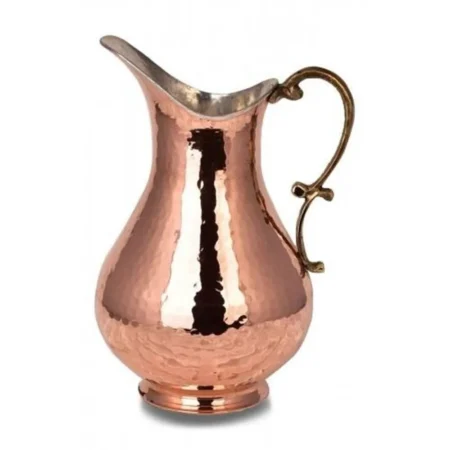


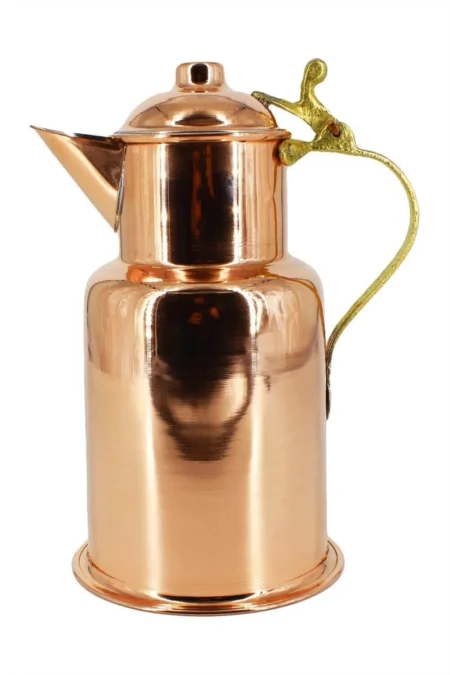
Pitcher, jug, carafe or ewer: naming the piece before quoting it
Copper pitchers, jugs, carafes and ewers overlap in English listings but not in service. A pitcher or jug has a handle and a pouring lip; a carafe is usually handleless with a narrow neck; the Turkish ewer, the ibrik, has a long spout and often a lid. The current range is the handled pitcher and jug.
English is loose here, and the looseness costs a round of emails. Buyers looking for a Turkish copper pitcher write asking for a water jug, a pitcher, an ewer or a carafe, and each word can point at a different object. In the Turkish trade the handled table jug is a sürahi; the small jug with a short lip, used for milk or cream beside coffee and tea, is a sütlük; the carafe, karaf, has a neck and shoulder and is poured straight into the glass, usually without a handle; and the ibrik is the tall ewer with a long curved spout, historically used to pour water over the hands and still made as a ceremonial and decorative piece.
What sits on the shelf today are handled pitchers from roughly one litre to two and a half litres, and smaller jugs between about 500 ml and 1,250 ml, which are cream and milk jug shapes that also serve water well beside a coffee. A long-spouted ewer with a matching basin is not part of the current range. If your listing, spa concept or hammam room calls for one, send a drawing or a clear photograph and we will say plainly whether it can be made to order, rather than offering the nearest jug under the same name. What the word “Turkish” can and cannot promise in a copper listing is set out on our Turkish copper page.
Capacity per table: reading the 500 ml to 2,500 ml band
Copper pitcher capacity is best chosen from the number of glasses one fill must cover. Around 500 ml to 1,150 ml suits one or two covers and water served beside coffee; about 1,400 ml covers the first round at a four-person table; 2,000 ml to 2,500 ml belongs on buffets, banquet tables and group service.
Start with the glass rather than the jug. A tumbler holding 250 ml means a two-litre pitcher pours eight of them if nobody adds ice and nobody fills to the brim, which in practice never happens. Ice displaces a quarter to a third of a glass, and a jug carried across a dining room is never filled to its rim, because a full jug spills on the first step. A realistic working rule is that a pitcher delivers about four fifths of its stated capacity, and a quotation should say whether its figure is the brim volume or the working volume. Ask, because suppliers rarely volunteer which one they mean.
The small end of the band is the breakfast and coffee-side size: it sits beside a tea service without dominating the tray, pours two glasses cleanly, and is the easiest body to box for retail. The middle, around 1,000 ml to 1,400 ml, is the restaurant workhorse. It covers the first round for a table of four with ice and still leaves a top-up, it is light enough for a server to pour one-handed while holding a tray, and it fits a standard refrigerator shelf. For a dining room with no other information, start there.
From 2,000 ml upwards the question is no longer how many people one jug serves but how many trips your staff make. On a buffet or a banquet table of ten, one large jug per table saves several kitchen runs an hour; on a summer terrace it is the difference between guests waiting and guests served. Two things come with that size. The first is height: some of the taller bodies stand around 26 to 27 cm, which does not fit every fridge door or under every tap, so measure the storage before you order. The second is weight, which is the next section.
Weight in the hand: handles, spouts and lids
A copper pitcher’s handle carries the water as well as the copper. Empty bodies weigh roughly 230 g to 850 g, and a full 2,500 ml jug weighs just over three kilograms on a single handle joint, so the handle’s shape, its joint and the balance of the pour matter more than the finish when a venue orders in quantity.
A litre of water weighs a kilogram, and that is the calculation buyers skip. A large jug that feels substantial and pleasant when empty becomes a lever when full: the weight sits in the body, the hand sits on the handle, and every pour twists the joint where one meets the other. In a busy service that joint is loaded hundreds of times a week, often while the server’s other hand holds a tray. The finish is what guests notice first; the handle is what staff notice every shift.
The practical test is simple, and any buyer is welcome to run it on a sample. Fill the jug to the brim, hold it by the handle at arm’s length for half a minute, then pour into a glass standing on a table. Watch whether the wrist has to fight the jug to control the pour, whether the handle flexes at the joint, and whether the knuckles clear the body. Whoever you buy from, get the handle construction in writing and inspect that joint on the sample; it decides whether a set lasts a season or several.
The lip comes next. A well-formed pouring lip cuts the stream cleanly when the jug is tilted back; a poor one dribbles down the outside and onto the tablecloth, and a pour onto a white cloth tells you which in ten seconds. The lip is also what takes the knocks at the sink, since a pitcher is washed by its handle and its front end meets the tap and the basin. A heavier gauge helps, which is one reason sheet thickness across the range runs from about 0.40 mm on the lighter milk jugs to about 1.20 mm on the heaviest pitchers.
Lids are the question asked most often after capacity, and the honest answer is that the bodies on the shelf today are open-topped. A lid earns its place outdoors and on a buffet, where an open jug collects dust, leaves and insects; in a dining room with table service it matters far less. It also adds a washing step and a separate part that tends to get separated. Where a lidded body is needed, it is quoted as a made-to-order piece produced at the workshop we work with, and spare lids belong on the first order rather than a year later.
The lining: why the drink never touches the copper
Copper pitchers from BakırBul are tin-lined on every interior surface, so the water or drink inside meets tin rather than copper. That matters most for lemon water, juice, iced tea and cold mixed drinks, which are acidic, and it is the reason these pitchers are not shipped with a bare interior whatever the request.
A showpiece jug on a restaurant table rarely holds plain water for long. It gets sliced lemon, cucumber and mint, a fruit infusion for the breakfast buffet, lemonade on the terrace or something mixed at the bar. All of those are acidic, and acid dissolves bare copper. United States food-service rules put that into a single line: the FDA Food Code, in section 4-101.14, does not allow copper to be in contact with foods below pH 6, which takes in fruit juices and most flavoured waters. The lining is how a copper jug meets that rule.
The European framework takes a different route to a similar place. Regulation (EC) No 1935/2004 requires that materials in contact with food do not transfer their constituents in harmful quantities, and in the absence of an EU measure specific to metals, national authorities commonly refer to the technical guide on metals and alloys from the EDQM at the Council of Europe; that guide gives specific release limits for both metals a lined jug brings to the table. How that plays out for an importer is on our food contact compliance page.
Tin gives way to heat long before copper does: it liquefies at roughly 232 °C in the element data from the Royal Society of Chemistry. For a water jug that is irrelevant in normal service and decisive in one situation: a pitcher is not a kettle. It never goes on a flame, a hotplate or any other heat source to warm its contents, because a nearly empty jug on direct heat can reach the melting point of its lining within minutes.
The lining is not a price option in our quotations. We do not supply drinking pitchers with a bare copper interior, and would sooner decline the business than ship one into a food-service setting and leave the buyer to learn the rule from an inspector.
Copper water, benefits claims and an honest mismatch
Copper water vessels used in the Ayurvedic tradition are deliberately bare inside, because the practice depends on water standing in contact with copper. BakırBul’s pitchers are tin-lined, so they are the wrong product for that use, and BakırBul does not claim any health effect for water kept in copper, positive or otherwise.
A good share of searches for a copper pitcher are really searches for this. Storing drinking water overnight in a copper vessel, known in India as tamra jal, is a long-standing practice, and many buyers who reach this page are sourcing exactly that product for a wellness shop, a yoga studio or an online store. It is a genuine tradition with a genuine following. It is simply not what our jug is, and it would be a disservice to let the word “copper” in both descriptions blur the difference.
The difference is the lining. In a tin-lined pitcher the water sits against tin, so whatever a buyer expects from copper contact does not happen in this vessel, by design. Selling our jug under a “copper-charged water” description would misdescribe it and invite a complaint from exactly the customer the listing meant to please. If that is your market, you need a bare-interior vessel from a supplier who specialises in it, and we are not that supplier. The accurate description of our jug is also the safe one: a copper water jug with a tin-lined interior, for serving water and cold drinks at the table.
On the health question we keep to what can be sourced. Copper is an essential trace mineral; the fact sheet from the Office of Dietary Supplements at the US National Institutes of Health sets out how much adults need and puts the adult upper limit at 10 mg per day. Claims that drinking from a copper vessel improves immunity, digestion or anything else are a different matter: we are not aware of evidence that a jug is a meaningful route for copper intake, and we do not repeat those claims in our listings or our correspondence. The wider safety questions are answered on our page is copper cookware safe.
Hand-hammered, hand-engraved and smooth bodies
Copper pitchers in the range come in three surface constructions. Some are hand-hammered, covered in small facets struck into the sheet; some carry hand-engraved decoration (el işleme in Turkish) cut into the wall; and some are left smooth. The construction changes the look on the table, the grip, and how visibly the jug shows fingerprints, polish residue and dents.
Hand-hammered bodies are the ones most buyers picture when they search for a hammered copper pitcher, and they are part of the range rather than all of it. Each facet catches light at a slightly different angle, so the jug glows rather than reflects, and the texture forgives. A small knock in service disappears among the existing marks, fingerprints scatter instead of standing out, and a wet hand gets a little more purchase than on a smooth wall. For a heavily used jug in a busy room, those are practical advantages rather than decorative ones.
Hand-engraved bodies carry a pattern worked into the metal by hand: bands, panels and traditional Anatolian motifs. They are the most distinctive pieces on a table and a natural choice for a gift line or a retail display. The trade-off is that polish and soap residue collect in the grooves, so an engraved jug needs a soft brush as well as a cloth. Smooth bodies suit contemporary interiors and take an engraved crest or logo more cleanly than any textured surface, but every dent and fingerprint shows; behind a busy bar the better answer is usually a hammered body or a darker finish.
Over any of the three constructions, the exterior finish is a separate decision. Bright red copper is the classic look and darkens with air and handling, so a set drifts out of match unless somebody polishes to a schedule. Antique oxide is a darkened patina applied when the piece is new and absorbs further ageing almost invisibly, which is why hard-working venues favour it. Brushed matt, skoç in Turkish, has a fine directional grain that hides fingerprints. Nickel plating gives a silver appearance that sits comfortably beside stainless cutlery.
Cold drinks: what a copper jug does to temperature
A copper jug passes heat very quickly in both directions. Chilled before service, it feels cold to the hand at once and beads with condensation; left standing in a warm room, it lets the water inside warm towards room temperature much faster than an insulated jug would. Venues that want cold water keep the jugs in the fridge between rounds.
Copper is among the best thermal conductors used in homeware, with reference data published by the Copper Development Association, so a copper jug hands temperature on quickly rather than holding it. The routine that follows is cheap: keep two jugs per station, one in service and one in the fridge, and swap them instead of topping up a warm jug with cold water; never put a filled jug in a freezer, because freezing water can bulge a thin wall. In a humid room a cold jug beads with condensation that runs onto oiled wood, marble or linen, so stand each jug on a small tray or coaster and wipe the handle before carrying it, since a wet handle on a heavy full jug is how accidents happen. The same physics at its extreme is covered on our copper ice bucket page.
Pitcher, cups and tray as one service
Copper pitchers are most often ordered together with cups and a tray, and the set only works if two things match: the finish across every piece, and the capacity, so that one fill of the jug covers the cups it is served with. Quoting the three together also keeps production runs, packing and later reorders aligned.
Finish matching sounds obvious and is routinely missed. Red copper, nickel plating and antique oxide placed side by side on one tray read as a collection of unrelated objects rather than a set, and even within one finish, pieces from different production runs can vary slightly in tone. The fix costs nothing at the quotation stage: state the finish once for the whole list and ask for pitchers, cups and trays to be produced and packed as one order.
Capacity matching is the arithmetic that makes a set usable. If the cups hold around 300 ml and the table seats four, a jug of about 1,400 ml covers one round with ice; if the set is sold as a pitcher and six cups for a family table, the jug belongs in the two-litre band. Reverse the calculation and staff walk back to the kitchen all evening. Tell us the cup you intend to use, or ask us to propose one, and the jug is sized around it.
For drinkware, straight tumblers, the handled Turkish maşrapa and other cups are covered on our wholesale copper drinkware page, and the cocktail bodies often bought alongside a jug for the mixer are on the Moscow Mule mugs page. The tray has to hold the base of the jug and the cups without crowding, and it doubles as the drip protection described above; shapes and sizes are on our hammered copper trays page, and stemmed wine cups on the copper goblets page.
Retail and gift buyers usually want the set boxed. A pitcher with two, four or six cups is one of the most straightforward gift propositions in copper, and its packaging has to deal with awkward geometry: the handle and the lip stick out, and anything that can move inside the box arrives dented however strong the outer carton is. Retail boxing with fitted inserts is quoted per set, and every quotation lists the carton sizes and packed weights, so your freight agent works from measured numbers rather than estimates.
Care in a working venue
Copper pitchers are cleaned in the sink with lukewarm water and a gentle detergent, rinsed, dried straight away and stored so air reaches the inside. They stay out of the dishwasher, are never scoured inside, and drinks are not left standing in them overnight, because the life of the tin lining depends on how it is washed.
A commercial dishwasher is the fastest way to shorten a copper jug’s working life. Its chemistry is strongly alkaline, which eats at tin on the inside and discolours copper on the outside, and its heated drying bakes water spots onto the exterior that take longer to shift than a hand wash would have taken. If a venue cannot commit to hand washing, that is worth deciding before the order, not after the first month.
Hard water leaves its own mark. Where the supply carries a lot of lime, a white film builds up inside a water jug over a few weeks. It is harmless and comes off with a soft cloth and a little white vinegar diluted in water, rinsed away promptly and followed by a normal wash. What does not belong inside the jug is a scouring pad, a wire brush or an abrasive cream: they remove lining faster than any amount of use. Polish belongs on the outside only; our copper care page covers the rest of the routine.
Tin wears with use rather than failing suddenly. Once red metal appears in wide patches on the base or the lower wall rather than as a pinpoint, the jug is due for re-tinning, a service offered by specialist tinsmiths. We do not quote a lifespan in years, because the lining thickness on these pitchers is not measured and any number would be a guess. How long copper pieces last in service, and when relining beats replacement, is covered on our copper lifespan page.
Documents, origin and customs
BakırBul has no laboratory food-contact report on file for its copper pitchers, and says so before an order is placed. Where a market or a retail customer requires one, testing is arranged in advance on the actual body and lining. Copper household articles generally fall under HS heading 7418, but the final classification is the importer’s decision.
Procurement teams ask for certificates, and the useful answer is the accurate one. There is no such certificate as an agency approval for a copper water jug from the US authority buyers usually name; in the United States the relevant text is the Food Code section quoted earlier, which states and counties adopt and inspect against. In the European Union a buyer can reasonably receive a declaration referring to the framework regulation and, where the customer insists, laboratory migration results obtained on the very jug and lining being ordered. That test takes money and time, which is why it belongs in the first message.
On customs we state what we know and stop there. A copper water jug belongs, in principle, to Harmonized System heading 7418, subheading 7418.10 for tableware and household articles of copper, the six-digit level being set internationally by the World Customs Organization. Everything after those six digits, and every duty rate, is national; rates are confirmed on the shipment date, and classification is the importer’s responsibility, best confirmed with your customs broker.
Origin is equally plain. These pitchers are made in Türkiye (Turkey) and arrive in any other country as an import. If your programme, listing or customer promise requires domestic manufacture in the United States, we are the wrong supplier, and the reasons are set out on our page for American buyers. Turkish export paperwork can be prepared on our side as a separately priced service. No freight company is contracted to us, so the buyer or the buyer’s forwarder normally books transport, and the import declaration in the destination country is filed by the importer, since it has to come from someone registered in that country. The full sequence is explained on our importing page.
Engraving, private label and made-to-order bodies
Copper pitchers can be engraved, boxed under a buyer’s own label, or quoted as made-to-order pieces outside the current range, such as lidded bodies or, where the form allows, long-spouted ewers. Engraving usually goes on the side facing the guest, opposite the handle; custom bodies are produced at the workshop we work with once drawing and quantity are agreed.
Engraving is where a copper jug becomes a hotel’s own. A crest, a restaurant name or a wedding date sits on the wall facing away from the server’s hand, where the guest sees it during the pour; an inventory code can go under the base. A cut made by hand reads as heritage and suits a coat of arms; a laser mark is crisper, identical from jug to jug, and better for small type or numbered sets. Fine detail holds best on a smooth wall. We work from vector files, and the position of the mark is agreed on a sample, available on request, before the batch is started.
Made-to-order work covers what the shelf does not: a capacity between the standard bands, a lidded body for outdoor service, a squatter jug that fits under a particular tap, or an ewer shape for a spa or a themed room. Our partner produces these to a drawing once the quantity justifies it, and the sequence of drawing, sample, approval and series is explained on our custom manufacturing page. Another brand’s protected design is not reproduced on request, and we will not leave a drinking surface unlined because a drawing shows bare copper inside.
How we work
BakırBul supplies copper pitchers through a long-term production partnership. We specify each piece, our partner produces it, and we carry it under our own name, check it in our own warehouse and ship it from there. Anything outside the standing range is made to drawing rather than substituted with the nearest available shape.
The pitchers come from workshops in Kahramanmaraş and other Anatolian copper towns, and each one is checked against the order in our warehouse before it leaves. For your own peace of mind, ask for a sample and check the pour, the handle joint and the lining yourself before a series is agreed. Because we specify rather than resell whatever happens to be available, a reorder can be matched against the last delivery, and the rejects stay with us rather than arriving at your door.
Request a quotation
A copper pitcher quotation needs the capacity or the number of glasses per fill, the surface and finish, whether cups or a tray should match, an approximate quantity and the destination country. There is no published minimum order; send the list as it really is, and the reply confirms whether it can travel as an export consignment.
No minimum order quantity appears on this page, deliberately. A run of jugs in one size and finish and a matched pitcher, cup and tray programme for a hotel group are not the same job, so a single threshold would mislead more buyers than it helped. Mention lids, engraving, retail boxing and any document your market requires in the same message, so the first reply can be a real one.
Frequently Asked Questions
Is a copper pitcher safe for drinking water?
A tin-lined one is, and every pitcher we supply is lined on every interior surface. The water touches the tin, not the copper, which also makes the jug suitable for lemon water, juice and other acidic drinks that should not stand against bare copper. Wash it by hand, dry it straight away, and have it re-tinned when copper shows through across a broad area.
Can I use these pitchers for Ayurvedic copper water?
No. That practice depends on water standing in direct contact with copper, and our pitchers are tin-lined, so the water never reaches the copper by design. They are the wrong product for that use, and we do not claim any health effect for copper water. If your market wants a bare-interior vessel, you need a supplier who specialises in one.
Do you have copper pitchers with a lid?
Not on the shelf today; the current bodies are open-topped. A lidded pitcher is quoted as a made-to-order piece, which makes sense for terraces and buffets where an open jug collects dust and insects. If you go that route, order spare lids with the first batch, because in most kitchens the lid is the first part to go missing.
What sizes do copper water jugs come in?
There are two groups. Milk and cream jugs start at about 500 ml and suit coffee-side water, milk or cream; pitchers run from about 1 litre to 2.5 litres, with around 1,000 to 1,400 ml covering a table of four and two litres and above belonging on buffets and banquet tables. Choose by glasses per fill; a jug is carried at about four fifths of its brim volume.
Can copper pitchers go in the dishwasher?
They should not, and we do not sell them as machine-safe. Dishwasher chemistry is strongly alkaline, so it wears the soft tin inside and dulls or stains the copper outside, while the heated drying stage leaves marks on the exterior. A sink, lukewarm water, a gentle detergent, a soft sponge and a towel straight afterwards is all a copper jug needs.
Can you supply a pitcher with matching cups?
Yes, and it is the most common way pitchers are ordered. State one finish for the whole list so every piece matches, and tell us the cup capacity so the jug can be sized to fill a round. Retail sets of a pitcher with two, four or six cups can be boxed with fitted inserts, quoted per set.
Are your copper pitchers made in the USA?
No. They are Turkish copper, made in Turkey in Anatolian copper towns, and they arrive in the United States as an import, with the buyer as importer of record. If your programme or listing requires domestic manufacture, we cannot meet it, and we would rather say so in the first message than after samples have been exchanged.
Can a copper pitcher be used to heat water?
No. A pitcher is a serving vessel, not a kettle. Its tin lining turns liquid at roughly 232 °C, and a nearly empty jug set on a flame or hotplate gets there fast. For hot drinks, use a vessel built for the heat, such as a kettle or a Turkish coffee pot, and keep the pitcher for cold service.
The 2026 catalogue — the full range with codes, sizes and weights: open or download it here. For cups and tumblers see wholesale copper drinkware, for trays, plates and bowls see copper serveware, and if you are furnishing a whole property see copper for restaurants and hotels. More background reading sits in our resource library.
Send us your list
A capacity or a glasses-per-fill figure, a surface, a finish, an approximate quantity and a destination country gets the quotation moving. Add the cups and tray if the set should match, and the jug is sized around them.
Last updated: 24 September 2026