What Is Turkish Copper? A Guide to Turkish Copperware
Turkish copper, explained plainly
“Turkish copper” covers a coffee pot bought in a bazaar, a tin-lined pan in a restaurant kitchen and a hammered tray on a hotel wall. This guide sorts out what the name actually means, how to tell real copper from something merely copper-coloured, why the inside of a Turkish pot is silver, how hand and machine hammering differ, and where people buy it — including the places we would send you that are not us.
BakırBul supplies Turkish copper to businesses, so read this knowing where we stand. The answers below are the ones we would give a friend before a first trip to the Grand Bazaar.
Turkish copper is handmade copperware from Türkiye (Turkey): cezve coffee pots, sahan pans, sini trays, ibrik ewers, pots and bowls hammered or spun from copper sheet by coppersmiths in Kahramanmaraş, Gaziantep and Erzincan. What sets it apart is hand hammering, sheet heavy enough to cook in, and a tin lining on every surface meant for food.
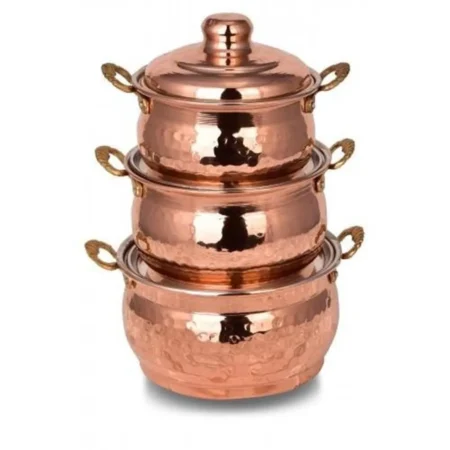

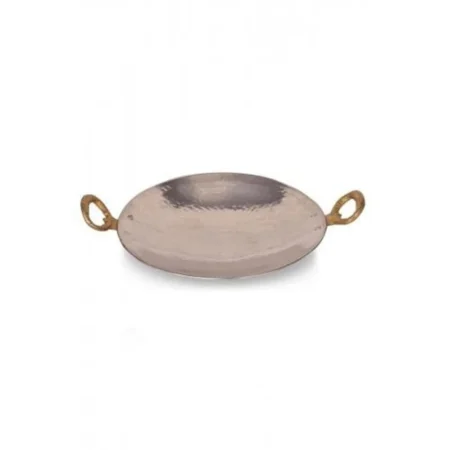
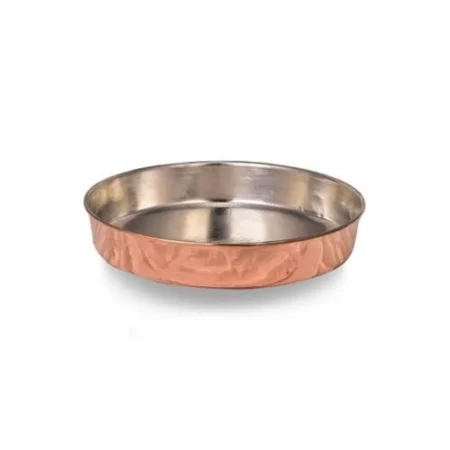
134 items in stock right now, from 12 cm to 36 cm. Other sizes and finishes are produced to order.
What makes copper “Turkish”
Turkish copper is defined by where a piece is shaped and finished, not by where the ore was mined. Copper sheet is a traded industrial material; what makes a pot Turkish is the coppersmith’s forming, the hammer texture, the tin lining applied by a tinsmith, and forms such as the cezve, the sahan and the hamam bowl.
Two very different things turn up when someone searches for copper from Turkey. One is the metal as a commodity — cathode, wire rod, scrap and a price per tonne. The other is copperware: objects made from copper for the kitchen, the table, the bath and the home. This page is entirely about the second. If you are buying copper as a raw material, the vocabulary, the paperwork and the suppliers are different, and we are not one of them.
Within copperware the word “Turkish” does real work. It describes a set of forms that grew out of Anatolian and Ottoman kitchens, a way of finishing the metal, and a trade organised around two crafts. The bakırcı is the coppersmith who raises, hammers and assembles the body. The kalaycı is the tinsmith who lines it. In a Turkish town those have traditionally been separate shops, often on the same street, and a pot passes through both before it is ready to cook in.
Anatolia’s relationship with the metal is very old. Some of the earliest worked copper objects known anywhere come from Neolithic settlements in the south-east of the country, and copper deposits in the region have been worked for thousands of years. None of that means today’s sheet was dug from Anatolian ground — sheet copper is rolled at mills and bought on the market like any other industrial material. The origin that matters for a buyer is the workshop, not the mine.
What survives from that history is a repertoire. The cezve, the long-handled pot for Turkish coffee. The çaydanlık, the two-tier teapot. The sahan, a shallow dish that goes from heat to table. The tepsi, the round tray. The hamam tası, the bowl used to pour water in a Turkish bath. The maşrapa, a handled cup. A shop selling copper anywhere in the world will recognise these shapes as Turkish before reading a label. The Turkish word for copper itself is bakır, which is why a Turkish listing reads “bakır cezve” rather than “copper cezve” — and why the phrase Turkish copper kitchenware, or Turkish copperware, usually points to the same set of objects.
The copper towns: Kahramanmaraş, Gaziantep, Erzincan and Istanbul
Turkish copper comes from several towns rather than one. Kahramanmaraş, Gaziantep and Erzincan each have a registered geographical indication for their copper craft, and Istanbul’s Grand Bazaar is where most visitors first meet Turkish copper, usually made somewhere else. Each town has its own decorative style.
Kahramanmaraş. One of the largest concentrations of working coppersmiths in the country. Its copper handcraft, registered as Maraş Bakır El İşlemesi, is protected as a geographical indication in the register kept by the Turkish Patent and Trademark Office. A geographical indication ties a product’s name to a place and a method; it is the same legal idea that protects a regional cheese. For a buyer it is a useful signal of a living trade, not a certificate that any individual piece is good. Our warehouse is in Kahramanmaraş, which is why the town appears so often on this site.
Gaziantep. Better known abroad for its food, the city also has one of the best-known coppersmiths’ markets in the country, the Bakırcılar Çarşısı in the old town. Gaziantep copper handcraft has been a registered geographical indication since 2010, and local work leans towards engraved and embossed decoration — trays, coffee sets, bowls — sold in a bazaar where coppersmiths still work alongside the shops.
Erzincan. An eastern town with a long copper tradition of its own, known for fine engraved decoration. Its copper-making and hand-decoration craft was registered as a geographical indication in 2002.
Istanbul. The shop window rather than the workshop. The Grand Bazaar and the streets around it sell copper from across the country, alongside pieces made for the tourist trade. It is a fine place to handle Turkish copper and a poor place to learn where a given piece was made.
The practical lesson is that “Turkish copper” is a family of regional traditions, and quality varies within each town as much as between them. A buyer is better served by asking about sheet, lining and finish than by asking which town. BakırBul selects across several of these centres for the same reason: no single street makes every form well.
Is Turkish copper real copper?
Turkish copper sold by a working coppersmith or a serious supplier is solid copper sheet, but copper-coloured imitations turn up in most tourist markets: brass, copper-plated steel, and sheet too thin to cook in. A magnet, the colour of an exposed edge, the weight in the hand and a stated sheet thickness separate them within a minute or two.
Most of the confusion comes from three substitutes, and none of them is always sold dishonestly. Brass is a copper-zinc alloy with a yellow-gold colour; it makes handsome decorative pieces and handles, and Turkish shops sometimes describe it with the word sarı, “yellow”. Copper-plated steel is a steel body with a thin copper skin, cheap and convincing in a photograph. Thin decorative copper is real copper rolled so light that it dents under a thumb and would scorch food on any flame. Here is how to tell them apart without a laboratory.
- The magnet test. Copper does not attract a magnet. If a fridge magnet grips the body, there is steel under the copper colour. The reverse proves less than it seems: brass and aluminium ignore a magnet too, so a magnet that slides off rules out plated steel and nothing else.
- The colour of an exposed edge. Freshly exposed copper is salmon-pink to red-brown. Look at the underside of the base, the rolled rim, or any worn spot. A yellow edge means brass; a grey edge under a pink surface means plating.
- Weight in the hand. Two pieces of the same diameter that feel very different are made from different sheet, whatever the label says. Lightness is the one quality a photograph can never show.
- A stated thickness. A seller who knows the work can tell you the starting sheet thickness in millimetres. A seller who cannot is usually selling decoration, which is fine as long as nobody plans to cook in it.
- The inside. Silver-grey inside a pot is normally tin; a glossy clear coat is lacquer, which marks a decorative piece; bare copper inside a vessel meant for food is a warning.
A patterned surface is not proof of anything either. Some “hammered” texture is pressed into thin sheet by a die and never saw a hammer; it looks right on a shelf and flexes in the hand. The difference between cookware and decoration photographed as cookware is set out in detail on our copper cookware page, and the checks to run on a supplier rather than on a single piece are on sourcing copper cookware.
Tin lining: why the inside of Turkish copper is silver
Tin lining, called kalay in Turkish, is the soft silver-grey layer a tinsmith applies with heat to copper surfaces meant for food. Tin keeps acidic ingredients off the copper, melts at around 232 °C and wears with use. A worn lining is renewed by re-tinning, while the copper body underneath lasts for decades.
Copper is superb at moving heat and a poor surface for food to sit against. Acid — tomato, lemon, vinegar, wine, yoghurt — draws small amounts of copper out of a bare surface. Copper is an essential nutrient in small amounts, and the NIH Office of Dietary Supplements publishes both the daily requirement and the upper limit; the lining exists so that cooking never becomes a question of how close to that limit a sauce might get.
Traditional Turkish tinning is done by hand. The kalaycı scours the inside, heats the piece over a fire, cleans the hot surface with a flux, and wipes molten tin across it with a pad of cotton until it bonds. The result is not a mirror. A hand-tinned lining shows faint wipe marks, a slightly uneven sheen and sometimes a darker patch near the rim. None of that is a fault; it is how you recognise tin rather than a plated or sprayed interior.
Tin’s low melting point — the Royal Society of Chemistry gives it as 231.9 °C — explains the one rule that matters: never heat a tin-lined pan empty. Fat or liquid goes in first. Steel utensils scratch it, scouring powders strip it, and daily high-heat service wears it faster than home cooking. When reddish copper starts to show across the working surface, the piece goes back to a tinsmith. The arithmetic of how often that happens, and what it costs a working kitchen, is on copper cookware lifespan.
Whether copper is safe to cook in comes down to this layer, and we have answered the question at length, including the popular health claims that do not hold up, on is copper cookware safe. For businesses selling into regulated markets, one more point needs saying plainly: we do not hold a food-contact test report as standard. If your market or your own buyer requires one, say so before the order, because testing has to be arranged against a specific piece. What such a report should contain is explained on food contact and compliance.
Every surface of ours that meets food is tin-lined. Pieces that never meet food — vases, planters, candle holders, most wall trays — carry no lining at all, and need none.
Are copper Turkish coffee pots safe?
Copper Turkish coffee pots are safe when the inside is tin-lined and the lining is intact. A cezve heats coffee for a few minutes rather than holding it for hours, which keeps contact short. The unsafe versions are unlined decorative pots sold as souvenirs, and old pots whose tin has worn through to bare copper.
The cezve is the piece most people bring home from Türkiye, and the question comes up more than any other. Coffee is mildly acidic, which is exactly why a cezve meant for use is tinned inside. Brewing takes a few minutes on low heat, the coffee is poured straight into cups, and the pot is rinsed. That pattern is gentle on a lining; the risks sit elsewhere.
The first risk is buying a souvenir as a working pot. Small, highly polished cezves with a lacquered or bare interior are sold as ornaments in many tourist streets. Tilt the pot towards the light and look inside: dull silver-grey is tin; bright copper or a clear glossy coat means the pot was made to be looked at. The second risk is age. A pot that has been used daily for years may show a copper-coloured ring where the coffee sits, which means it is due for re-tinning rather than for the bin.
Two habits keep a cezve lined for years: never put it on the heat empty, and never scour the inside. Turkish coffee itself is inscribed by UNESCO on its list of the intangible cultural heritage of humanity, which says something about how seriously the pot is taken at home. Sizes, handle materials and the difference between a cezve, an ibrik and a dallah are covered on our Turkish coffee pots page.
Hand-hammered or machine-hammered Turkish copper
Hand-hammered Turkish copper, el dövme in Turkish, carries facets struck one at a time, so the size, depth and spacing of the marks vary across the surface. Machine-hammered copper, makine dövme, has a regular repeating pattern and usually costs less. Both are genuine copper, and both are sold honestly when the listing names the method.
Hammering is more than decoration. Striking copper cold hardens it and gives a thin wall some stiffness; the facets also scatter light, which is why a hammered tray looks warmer than a spun, smooth one. The Turkish trade distinguishes the two methods in plain words, and a good listing states which one applies.
Telling them apart takes a raking light. Hold the piece so light crosses the surface at a low angle. Hand-struck facets overlap irregularly, change size as the smith works round a curve, and grow tighter near the rim and the base where the hammer has to follow the shape. Machine hammering repeats: the same facet at the same pitch, row after row, often with a visible seam where the pattern restarts. Neither is a defect. Hand work is chosen for the table and the display, where the variation is the point; machine work for volume, where regularity and price matter more.
The one misleading case is a pattern pressed into sheet too thin to have been hammered at all. Press on the wall with a thumb. Hammered copper of cooking weight will not move; decorative foil flexes. The same test sorts serving pieces — a hammered copper tray is expected to be lighter than a pan, but it still should not bend when lifted full.
What Turkish copper is made into
Turkish copper is made into cookware, coffee and tea service, serving pieces, drinkware, bath bowls and decorative objects. The best-known forms are the cezve coffee pot, the two-tier teapot, the shallow sahan, hammered trays, the hamam bowl used in Turkish baths, and the samovar. Each family has its own logic of lining, sheet weight and finish.
A Turkish copper range is easier to understand by job than by object. Anything made to cook in should be tin-lined and wants heavier sheet. Anything that serves should be lined where it touches food and can be lighter. Anything decorative needs no lining and is judged on finish alone. These pages go into each family in depth:
- Pots, pans, sahan and oven dishes — copper cookware
- The cezve and coffee sets — Turkish coffee pots
- Two-tier teapots and tea sets — copper teapots and tea sets
- Trays, plates, pitchers and bowls — copper serveware
- Round and oval hammered trays — hammered copper trays
- Mugs, tumblers and goblets — copper mugs and drinkware
- Bowls for the Turkish bath — copper hammam bowls
- Tea urns — copper samovars
- Every category on one page — all product groups
Finish is the other axis. The same body can leave the workshop bright red, deliberately darkened, nickel-plated silver or brushed matt, and the choice changes how much polishing a piece will ask for. Whatever the finish, the outside of copper changes colour in air over time; the everyday routine, and how to bring back a piece that has darkened, is on living with copper. Background on the metal’s properties is published by the Copper Development Association.
Vintage and antique Turkish copper versus new
Vintage Turkish copper is older household work, often with engraved names, dates or owners’ marks, a dark patina and a lining of unknown age. New Turkish copper arrives with a known lining and stated dimensions. BakırBul supplies new pieces only and does not value, authenticate or trade antiques, so this section describes the difference rather than a price.
Old Turkish copper turns up in flea markets and antique shops across Europe and the Middle East: large cauldrons, lidded food carriers, trays and bowls, some carrying inscriptions in Ottoman script, a family name or a date scratched into the rim. Pieces like these have real charm and sometimes real value. Establishing that value is a specialist’s job — an antiques dealer, an auction house or a museum curator — not a supplier’s.
Three cautions apply before cooking in anything old. The lining is of unknown age and composition, so treat it as due for renewal and have a tinsmith re-tin the piece before it meets food. Dents are usually harmless; splits, soft patches and old repairs near the base are not. And darkness is not proof of age: new copper is sold in a deliberately oxidised finish, which is a legitimate surface treatment rather than an antique. When the “antique” price rests entirely on the colour, walk on.
If you are buying a genuine antique inside Türkiye, remember that Turkish law prohibits the export of movable cultural property, and an old piece may need a museum assessment confirming it is not classed as such before it can leave the country. Ask about this before paying, not at the airport.
Where to buy Turkish copper: the Grand Bazaar, Gaziantep or online
Turkish copper is bought in three main ways: in Istanbul’s Grand Bazaar and the streets around it, in the coppersmiths’ bazaars of towns such as Gaziantep and Kahramanmaraş, or from sellers online. Bazaars let you handle the piece before paying; online buying depends on published sheet thickness, lining and photographs of the actual item.
The Grand Bazaar and the Istanbul copper market. Copper is sold throughout the Grand Bazaar and the streets around it; near Beyazıt, one street still carries the name Bakırcılar, “the coppersmiths”. Expect a mix: good cookware from the working towns, decorative pieces made for visitors, and a few genuine old pieces. Bargaining is normal. Run the checks from earlier on this page — magnet, edge, weight, inside — and ask plainly whether a pot is tinned for cooking or made for display. A good shopkeeper will answer without hesitation.
The coppersmiths’ bazaars of the working towns. Gaziantep’s Bakırcılar Çarşısı and the copper market in Kahramanmaraş sit closer to the workbench. Prices are often lower than in Istanbul, the range is narrower, and you are more likely to be talking to someone who hammered or tinned the piece. If the trip allows it, this is the more interesting way to buy.
Online. Buying without handling the piece shifts all the burden onto the listing. Before paying, look for the sheet thickness or at least the weight, a clear statement of the lining, dimensions in centimetres or millilitres, a photograph of the actual inside rather than a styled image, and a real business name and address. A listing that says “copper colour” or “copper finish” is telling you something.
Where we fit. BakırBul works with businesses outside Türkiye on a written quotation; retail orders are taken only inside Türkiye, through our Turkish store, and the English side of this site is not a shop. If you are an individual abroad looking for one cezve or a single tray, a trip to a bazaar, a specialist retailer in your own country or a Turkish seller that ships to you will serve you better than we can, and we would rather say so here than waste your afternoon.
Buying Turkish copper for a business
Businesses buying Turkish copper from abroad — shops, restaurants, hotels and importers — usually work from a written quotation rather than a shop listing. BakırBul, a copper cookware manufacturer in Kahramanmaraş, quotes against a list of pieces, quantities and destination, produces new forms with its partner workshop to its own specification, and checks every batch in its warehouse.
A trade order starts with a list rather than a basket. Send the pieces you want, a rough quantity for each and the destination country, and a quotation comes back with the lining, the finish and a realistic lead time for every line. There is no single minimum figure: a pallet of one small item and a mixed order of large bodies are different problems, so the answer depends on what you send. The terms, the sampling step and how a shipment is packed are on our wholesale and export page.
We produce to order in Kahramanmaraş through a long-term production partnership: we specify the piece, the partner workshop makes it — hammered by hand or by machine as specified, tin-lined wherever it will meet food — and we carry it under our own name. Catalogue stock is selected across the copper towns, brought into our warehouse in Kahramanmaraş, checked against the order and dispatched from there. When a form does not exist in the catalogue, it can be made to a drawing; how that works, including branding and private label, is on custom copper manufacturing. The full range with sizes and codes is in the wholesale catalogue.
Three things are worth raising in the first message rather than the last. If the kitchen that will use the pieces cooks on induction, tell us: traditional copper does not work on an induction hob without a steel interface disc, and we would rather steer you towards serveware and drinkware than sell you pans that will not heat. The physics and the workarounds are on copper and induction hobs. If your market needs food-contact documentation, say so at the start, for the reason given in the tin lining section above. And if you are importing for the first time, importing copper cookware from Türkiye covers classification, origin paperwork and who is responsible for what at the border.
Turkish copper cookware brands, and how to judge a maker
Turkish copper cookware brands are mostly workshop and shop names rather than household labels, so a brand name on copper made in Turkey says little by itself. Four checks say more: whether food surfaces are tin-lined, the stated sheet thickness, whether the piece is hand-hammered or machine-hammered, and whether the seller can prepare export paperwork.
Buyers abroad often ask for a list of Turkish cookware brands. The honest answer is that copper in Türkiye is sold under hundreds of workshop and shop names, very few of which are known outside the country, and a ranking of them would be a list of opinions. We do not publish one, and we would be wary of any page that ranks competitors while selling alongside them. What can be judged is the piece in front of you and the company behind it.
The lining. Ask whether every surface that meets food is tinned, how the tin is applied, and whether the seller re-tins. A maker of cookware answers at once; a maker of decoration hesitates, and that is useful to know before the order rather than after it.
The sheet. Ask for the starting sheet thickness in millimetres or, failing that, the weight of a named size. A figure you can compare between two offers is worth more than a photograph of a finished shelf.
The method. El dövme and makine dövme are both genuine copper and both have a place. What matters is that the listing or the quotation names the method, so the price difference is visible instead of hidden inside the word “hammered”.
The paperwork. A company that sells abroad regularly can issue a commercial invoice, a packing list and proof of origin, and can tell you which side of the border each document belongs to. The details for importers are on importing copper cookware, and the wider supplier checklist, including how to verify a registered company, is on copper cookware manufacturers.
Questions about Turkish copper
What is Turkish copper?
Turkish copper is copperware made by coppersmiths in Türkiye — pots, pans, coffee pots, teapots, trays, bowls and decorative pieces — usually from hammered or spun sheet copper. Pieces made for cooking are normally lined inside with tin; souvenir and decorative pieces often are not. Kahramanmaraş, Gaziantep and Erzincan are the main working centres; Istanbul’s bazaars are where most visitors buy it.
Is Turkish copper real copper?
Copperware from a working coppersmith is solid copper sheet. Imitations exist, mostly brass, copper-plated steel and very thin decorative sheet. A magnet that grips means steel underneath; a yellow edge means brass; a very light body means thin sheet. Ask the seller for the starting sheet thickness in millimetres and look at the inside before buying.
Is Turkish copper safe to cook with?
Tin-lined Turkish copper is safe to cook and serve in, provided the lining is intact. Bare copper should not hold acidic food. Never heat a tin-lined pan empty, keep steel utensils and scouring powder away from the lining, and have it re-tinned when copper starts to show through the silver-grey surface inside.
Are copper Turkish coffee pots safe to use?
A tin-lined cezve with an intact lining is safe; brewing takes minutes and the coffee is poured straight out. Souvenir pots with a lacquered or bare copper interior are made for display, not for brewing. Look inside: dull silver-grey is tin. A copper-coloured ring where the coffee sits means the pot needs re-tinning.
How can I tell hand-hammered from machine-hammered copper?
Hold the piece so light crosses the surface at a low angle. Hand-hammered facets vary in size and depth and tighten near the rim and base. Machine-hammered patterns repeat at the same pitch, row after row. A pattern that flexes under thumb pressure was probably pressed into thin sheet rather than hammered at all.
Does Turkish copper work on induction hobs?
No. Copper is not magnetic, so an induction hob does not detect a traditional copper pan and will not heat it. An interface disc — a steel plate placed between hob and pan — makes it usable, at a cost in speed and control. Serving pieces, trays, drinkware and coffee pots used on gas are unaffected.
Where is the copper market in Istanbul?
Copper is sold throughout the Grand Bazaar and the streets around it; near Beyazıt, one street still carries the name Bakırcılar, “the coppersmiths”. The range mixes working cookware, decorative pieces made for visitors and some old copper. Bargaining is normal, and asking whether a pot is tinned for cooking is a fair question.
Is old Turkish copper worth re-tinning?
Usually, if the body is sound. Re-tinning replaces the lining completely, so an old pot with dents but no splits, soft spots or failing repairs can go back into service. Treat any old lining as of unknown composition and have it renewed before cooking. Valuing an antique is a job for a specialist dealer.
Can I buy from BakırBul as an individual outside Türkiye?
Not at present. BakırBul sells retail only inside Türkiye, through its Turkish store; outside the country it works with businesses on a written quotation. An individual abroad is better served by a bazaar, a specialist retailer at home or a Turkish seller that ships to them. Businesses can send a list through the wholesale page.
Buying Turkish copper for a business?
Send the pieces, a rough quantity for each and the destination. A written quotation comes back with the lining, the finish and a realistic lead time for every line — and a plain answer where a piece is not right for the job.
Last updated: 24 September 2026