
Solid Copper vs Copper-Clad, Copper-Core and Copper-Coated Pans: What the Label Means
Solid copper, clad, core and coated: reading a copper label
The word “copper” on a cookware listing can describe a pan whose whole wall is copper, a steel pan with a thin copper layer bonded inside it, a steel pan with a copper disc under the base, or an aluminium pan painted a warm metallic colour. This guide separates the six constructions, shows how to tell them apart in the hand, and explains what each one means for induction (solid copper will not heat on it), for lifespan and for a solid copper purchase specification.
Not sure what a sample in front of you actually is? Photograph the rim, the underside and the lining and send the pictures; we will say which construction they point to, and which questions only a calliper or scale can answer.
Solid copper cookware has a wall made of copper from the outside surface to the lining, which is usually tin or stainless steel. Copper-clad and copper-core pans bond a copper layer between steel layers, copper-bottom pans add a copper disc under a steel body, and copper-coloured non-stick pans normally contain no structural copper at all.
One word, six products
Solid tin-lined, solid steel-lined, clad, copper-core, copper-bottom and copper-coloured coating are sold under the same word and behave like different metals.
The magnet is the first filter
A magnet that grips the base tells you steel is present. It does not tell you how much copper there is, and a magnet that slides off proves nothing on its own.
Thickness belongs in writing
Wall thickness is a millimetre figure measured with a calliper. A listing that says “heavy” or “professional” without a number has told you nothing.
What we supply
Our cookware is solid copper with a tin lining. Clad, core, bottom and coated pans are a different industry, and we say so before a quotation.
Six constructions sold under one word
Copper cookware on the market falls into six constructions: solid copper lined with tin, solid copper lined with stainless steel, copper-clad, copper-core, copper-bottom, and copper-coloured coated pans. The construction decides how much copper you are paying for, whether the pan works on an induction hob, and whether its cooking surface can ever be renewed.
Most confusion comes from marketing that treats copper as a colour rather than a metal. A listing photographed in warm light, with a hammered texture and the word “copper” in the title, can be any of the six. The table below is the reference the rest of this page builds on; it names constructions, not brands, because the same brand often sells several of them side by side.
| Construction | Where the copper is | Induction | Cooking surface | Typical service life | How to tell it apart |
|---|---|---|---|---|---|
| Solid copper, tin-lined | The whole wall; only the thin lining is another metal | No — copper is not ferromagnetic; an interface disc is the only route | Tin, soft grey-silver, renewable | Body for decades; tin renewed when worn | Heavy for its size, magnet does not grip, copper visible at the rim edge, grey interior |
| Solid copper, stainless-lined | The whole wall, with a bonded stainless inner skin | No — the lining is normally a non-magnetic stainless grade, and copper is not ferromagnetic | Stainless steel, bright and hard | Long; the lining does not wear away like tin | Heavy, magnet usually does not grip, bright steel interior, two layers at the rim |
| Copper-clad | One layer of a bonded sandwich, often the outside | Works only where a magnetic steel layer faces the hob | Stainless steel | Long; nothing to renew | Visible layers at the rim, magnet often grips the base |
| Copper-core | A layer hidden inside the wall or the base, between steel | Usually works because the outside is magnetic steel; check the base | Stainless steel | Long; nothing to renew | Looks like a steel pan; a copper stripe may show at the rim |
| Copper-bottom | A disc or plated layer on the base only | Works only if a magnetic steel cap covers the copper; a bare copper base will not heat | Stainless steel | Long body; the plated base dulls and wears | Steel walls, copper colour limited to the underside |
| Copper-coloured coated (non-stick) | Usually no structural copper; the colour comes from the coating | Not on a plain aluminium body; works only if a steel disc is bonded underneath | A ceramic or polymer non-stick coating | Until the coating wears; it cannot be renewed | Light in the hand, uniform smooth coloured interior, “copper” used in the name rather than the specification |
Read the table from the cooking surface outwards. The first two rows are copper pans with a lining; the next three are steel pans with copper somewhere in them; the last is a non-stick pan whose name borrows the word. None of the six is dishonest by construction. What becomes dishonest is a listing that lets a buyer believe they are getting the first row while paying for the last.
Solid copper: what the word should mean
Solid copper cookware is formed from a single copper sheet, so the full wall thickness is copper and only a thin food-contact lining of tin or stainless steel sits inside. The lining exists because regulators restrict bare copper against acidic food, not because the copper is thin or because the pan is unfinished.
In a solid copper pan, the sheet is raised or hammered into a body and the inside is then lined. Nothing in the wall is aluminium or steel apart from that lining. This is the construction that delivers the heat behaviour copper is bought for: the whole wall conducts, so heat spreads sideways from the flame almost at once and the pan reacts quickly when the flame is turned down.
The lining is not optional. The United States FDA Food Code, in section 4-101.14 of its 2022 edition, says copper and copper alloys such as brass may not be used in contact with a food that has a pH below 6, giving vinegar, fruit juice and wine as examples. That is why a solid copper pan meant for cooking has a tin or stainless steel face on the food side, while a copper tray or a planter does not need one.
Tin and stainless steel are both legitimate linings, and they suit different kitchens. Tin is applied by hand with heat, wipes almost non-stick when it is seasoned, and wears with use; a worn tin lining is renewed by a re-tinning shop and the copper body carries on. Stainless steel is bonded to the copper sheet before the pan is formed, is far harder and does not need renewing in normal service, but it cannot be restored cheaply if it is ever damaged. The full arithmetic of a tin lining over the years is on our page about how long copper cookware lasts.
One honest caveat about vocabulary: some listings say “solid copper” when they mean “the outside is copper all over”. A clad pan with a copper exterior layer is not solid copper in the sense used here, because the copper may be a small fraction of the wall. The test sections further down explain how to check rather than trust.
Copper-clad and copper-core: copper as one layer
Copper-clad and copper-core cookware are multi-layer pans in which copper is bonded between other metals, normally stainless steel. Clad usually puts copper on the outside or as a full layer through the wall; core hides it inside. Both cook on stainless steel and both depend on how thick the copper layer is, which listings rarely state.
Clad construction starts with a bonded sheet rather than a single metal. Layers of stainless steel, aluminium and copper are rolled together under pressure and heat, and the pan is formed from that composite sheet. Depending on the design, copper can be the visible outer layer, a full-thickness layer running up the walls, or a thin band that is mainly there for appearance. The words “five-ply” or “seven-ply” count layers; they do not tell you how much of the wall is copper.
Copper-core pans place a copper layer in the middle of the sandwich, between a stainless interior and a stainless exterior. From the outside they look like steel pans. The copper is there to spread heat across the base, and it can do that well, but a thin core behaves more like a good steel pan with an even base than like solid copper. Weight per diameter is again the most useful indicator, alongside the layer thickness if the maker publishes it.
Neither construction is a lesser product. Clad and core pans are hard-wearing, dishwasher-tolerant in many cases, and need no relining; they are also the right answer for some induction kitchens, as explained below. What a buyer should avoid is paying a solid copper price for a pan where copper is a decorative skin. Ask for the copper layer thickness on its own, not the total wall thickness, and ask whether the copper runs up the walls or stops at the base.
Copper-bottom pans: a disc, not a body
Copper-bottom pans are steel pans with copper only on the underside, either as a thick disc bonded into the base or as a thin plated layer applied for colour and some heat spreading. The walls are steel, so copper influences the base alone, and the plated variety darkens and wears with ordinary scrubbing.
There are two quite different products behind the phrase. The first is an encapsulated base: a copper or aluminium disc sealed under a stainless cap at the bottom of a stainless pan. The disc improves heat spread across the floor of the pan, the walls stay steel, and the sides heat much more slowly than the base. The second is a plated base: a thin layer of copper applied to the outside of a steel bottom. It looks striking when new and contributes far less to cooking than the colour suggests.
A quick way to tell them apart is to look at the base edge. An encapsulated disc usually shows a raised step where the cap meets the wall. A plated base is flush, and wear on its highest points shows the steel underneath within months of regular cleaning with abrasive pads.
For a buyer, the practical question is again the hob. A copper-bottom pan heats on induction only if a magnetic steel cap sits between the copper and the hob; a bare copper underside will not be detected, so do not assume either way. Ask the seller to state the base construction rather than relying on the induction symbol printed on a box.
Copper-coloured non-stick pans: copper in name, colour in fact
Copper-coloured non-stick pans are usually aluminium pans with a ceramic or polymer non-stick coating tinted to look like copper. Some advertise copper particles in the coating, but the coating is not a structural copper layer and the pan does not behave like copper in the way heat spreads or in how it ages.
This is the largest category by volume on general marketplaces, and the one most often found when someone searches for copper pans at a low price. The body is typically pressed or cast aluminium. The cooking surface is a non-stick coating, coloured warm orange-bronze, and the outside is often painted to match. Product names lean on the word copper; the specification, when there is one, names the coating.
The heat behaviour comes from the aluminium body and the coating, not from copper. Aluminium is itself a good conductor, so these pans heat quickly, but they are light, they lose heat quickly too, and the non-stick surface rather than the metal decides how long the pan stays useful. When the coating scratches or loses its release, the pan is replaced. Nothing on it can be renewed the way a tin lining can.
None of this makes the product useless. It makes it a non-stick pan, priced and specified as one. A retailer building a “copper” range should keep the two in separate lines, with separate descriptions, because a customer who thought they bought a copper pan and finds an aluminium one under the coating has a reasonable complaint.
How to tell whether a pan is solid copper
Solid copper can be distinguished from clad, plated and coated pans with five checks that need no laboratory: weight for its size, a magnet on the base, the cut edge at the rim, the colour and texture of the interior, and a written wall thickness. No single check proves it; together they rarely leave doubt.
The physical basis for the weight check is density. According to PubChem, copper has a density of about 8.93 grams per cubic centimetre, iron about 7.87 and aluminium about 2.70. A solid copper pan of a given diameter and wall is therefore roughly three times as heavy as an aluminium pan of the same shape, and noticeably heavier than steel. A pan that looks like copper but feels light has an aluminium body or a very thin wall.
| Check | What it shows | What it does not prove |
|---|---|---|
| Weight for its diameter | A heavy body suggests a copper or steel wall; a light one points to aluminium or a thin sheet | The split between copper and steel in a heavy pan |
| Magnet on the base and walls | Grip means magnetic steel is present somewhere in that area | No grip does not prove copper; aluminium and many stainless grades do not attract a magnet either |
| Cut edge at the rim | Solid copper shows one metal through the edge, apart from a thin lining; clad shows bands | A rolled or capped rim hides the edge completely |
| Interior surface | Grey-silver and slightly uneven suggests tin; bright and hard suggests stainless; smooth coloured coating means non-stick | How thick the copper behind it is |
| A light scratch on the underside of a sample | Plated pieces show a grey or silver metal under the copper colour | Anything about a clad wall; and it marks the piece, so use it on a sample only |
| Written wall thickness in millimetres | The only figure two quotations can be compared on | Whether the figure is true, unless you measure a sample yourself |
Use the checks in order of cost. Weight and the magnet take seconds and rule out most coated and plated pieces. The rim edge and the interior settle most of the rest. The scratch is for a sample you are prepared to mark, never for a piece you intend to sell. Our page on copper and induction hobs explains why the magnet behaves the way it does, so it is not repeated here. If the doubt is between copper and a yellow alloy rather than between copper and steel, our guide to copper vs brass covers the colour, scratch and acid checks for that case.
A sample is worth more than any listing. When a supplier will send a physical piece before a bulk order, weigh it, measure it at the rim with a calliper, photograph the inside under raking light, and keep it as the reference the delivered goods are checked against.
Induction: which constructions work, and why solid copper does not
Solid copper will not heat on an induction hob, whether lined with tin or with the thin stainless skin of most stainless-lined pans, because copper is not ferromagnetic. Clad and core pans work only when magnetic steel faces the hob, and coated or copper-bottom pans work only if a steel disc or cap is built into the base.
An induction hob heats a pan by inducing currents in a magnetic base; a metal the hob cannot couple with is not detected, and the ring does not start. Copper is not ferromagnetic, so solid copper sits on an induction zone without heating. A steel interface disc set on the zone under the pan lets a solid copper piece cook, yet the heat then comes from that disc, so the quick, even response that justified copper is largely lost.
Some clad and core designs were developed precisely so that a copper pan would run on induction: the outer layer, or a disc under the base, is magnetic stainless steel. Those pans do heat on induction, because the hob reads the steel rather than the copper. The trade-off is that the copper is one layer among several. Copper-coloured coated pans and copper-bottom pans vary by model: they heat on induction only where the maker has bonded a magnetic steel disc underneath, and many do not.
For a retailer, this is the line where returns begin. A customer with an induction hob who buys a solid copper pan expecting it to work will return it, and they will be right to. State hob compatibility on every listing in words, not only as a symbol. Kitchens that run induction throughout, and cannot use solid copper pans without a disc, will find what to stock instead in our induction guide.
Thickness: how copper is measured and what to ask for
Copper cookware thickness is quoted in millimetres and measured at the rim with a calliper or micrometer. For solid copper the figure describes the copper sheet; for clad and core pans the useful figure is the copper layer alone, because a total wall thickness can hide a thin copper band between thicker steel.
There is no regulation that sets a minimum thickness for a copper pan, and no single correct number. Thickness is chosen against the job: a light wall reacts quickly and suits short cooking and service pieces, a heavier wall holds temperature when cold food goes in and suits a busy kitchen. What matters for a buyer is that the figure exists, that it is stated in millimetres, and that it is the same kind of figure across the quotations being compared.
Three practical points help. First, hammering thins a sheet unevenly, so a hand-hammered body is normally described by the thickness of the sheet it was raised from; ask whether a quoted figure is sheet thickness or a measurement on the finished wall. Second, for clad pans ask for the copper layer and the total wall separately. Third, measure a sample yourself at several points on the rim; a calliper costs less than a single returned pan.
We do not publish a universal thickness for our pieces, because it varies by body and by series. We state the sheet on the quotation for each line, alongside diameter, height and weight, and our main copper cookware page explains how gauge choice follows the kind of cooking a piece will do.
Are copper-coated pans safe? Where the question really sits
Copper-coated pan safety is a question about the non-stick coating rather than about copper, because in most of these pans no copper touches food. The useful answer comes from the coating’s identity and its food-contact documentation; the US FDA Food Code and EU Regulation 1935/2004 both address coatings and food-contact materials directly.
When people search whether copper-coated pans are safe, they are usually holding a coloured non-stick pan. In that pan the food meets the coating. So the questions to ask are about the coating: what material it is, whether it is intact, and what documentation the seller holds for it in your market. Whether copper is “good” or “bad” for you is not the question this pan raises, and we make no health claim either way.
Two primary sources frame the answer. In the United States, section 4-101.18 of the FDA Food Code (2022 edition) says that kitchenware with a perfluorocarbon resin non-stick coating shall be used with non-scoring or non-scratching utensils and cleaning aids. In the European Union, Article 3 of Regulation (EC) No 1935/2004 requires every food-contact material, a coating included, to be made so that under normal or foreseeable use it does not transfer its constituents to food in quantities that could endanger human health, and adds that labelling and presentation shall not mislead the consumer.
That second clause matters to a retailer as much as the first. Under Article 15 of the same regulation, materials sold before they meet food must carry the words “for food contact”, a specific indication of use, or the glass-and-fork symbol, together with the name and address of the business placing them on the market. If a supplier cannot name the coating or provide its compliance documentation for your market, treat that as the answer.
For solid copper the safety question is different and simpler: the food meets tin or stainless steel, and the care point is keeping that lining intact. That is covered on our page is copper cookware safe.
Which construction lasts longest in a working kitchen
Solid copper usually has the longest working life of the six constructions because its body can be relined, re-handled and reshaped, while coated non-stick pans have the shortest because the coating wears and cannot be renewed. Clad, core and copper-bottom pans sit between: durable bodies, no renewal, retired when the base warps or the surface fails.
Service life in a kitchen is decided by the part that fails first. On a tin-lined solid copper pan, that part is the lining, and it is designed to be replaced; the copper body underneath can outlast several linings. On a stainless-lined solid copper pan, the lining wears very slowly, though repair is harder if it is ever damaged. On clad, core and copper-bottom pans, the stainless cooking surface is tough and the risk is distortion of the base under high heat or thermal shock.
Coated pans are the consumable of the group. However good the coating, it is a thin surface layer on a light body, and the FDA’s own instruction to use non-scratching utensils on perfluorocarbon coatings tells you where the weakness lies. A working kitchen running coated pans budgets for regular replacement. A kitchen running solid copper budgets for periodic relining instead, which is a service rather than a purchase.
Which is better depends on the kitchen. A high-volume line that cannot spare pans for relining may prefer clad steel for everyday work and keep solid copper for sauces and anything the guest sees. The decision in commercial terms is set out on our page for restaurants and hotels.
Writing a solid copper specification as a retailer
Solid copper specifications for a retail line should state, for every piece, the construction in plain words, the lining metal, the copper sheet thickness in millimetres, the outside finish, the handle metal and attachment, diameter, height and weight, and hob compatibility including a clear statement that solid copper does not work on induction.
Retailers who build a copper line usually have one difficulty in common: their own customers have learned to distrust the word. The specification is how that trust is earned back, and it is also the document the delivered goods are inspected against. Write it before you request quotations, so that every supplier answers the same question.
- Construction. “Solid copper, tin-lined” or “solid copper, stainless-lined” in those words. Avoid “copper cookware” alone.
- Sheet thickness. A millimetre figure, and whether it is starting sheet or measured wall.
- Lining. Tin or stainless steel; for tin, how coverage is inspected before dispatch.
- Exterior finish. Polished, hammered, aged, brushed or plated, and whether any coating is applied to the outside.
- Handle. The metal (brass, steel or cast iron are common) and how it is attached.
- Dimensions and weight. Diameter, height, capacity where relevant, and weight with a tolerance.
- Hob compatibility. Gas, electric and ceramic yes; induction not without an interface disc. Printed on the listing and the packaging.
- Food-contact paperwork. What your market requires, raised at quotation stage rather than at the border.
A specification like this also protects the retailer from the commonest substitution in the trade: a lighter sheet or a cheaper lining on the second batch. If the written figure and a weighed sample are on file, a drift is visible the day the goods arrive. What a full request for quotation should contain beyond the product line is set out on our page about sourcing copper cookware.
What BakırBul supplies, and where the range stops
BakırBul supplies solid copper cookware with a tin lining: catalogue stock selected from Kahramanmaraş and other Anatolian copper towns, and made-to-order pieces produced by our partner workshop to our specification. We do not supply clad, copper-core, copper-bottom or copper-coloured non-stick pans, and stainless-lined bodies are not a standard line in our range.
Every cookware body we quote is a copper sheet raised or hammered into shape and tinned on the inside. Some pieces carry nickel or other exterior finishes; those are surface treatments on the outside, and the food side is tin. Handles vary by piece, and the metal and attachment are stated on the quotation. The grid below is read live from stock and shows solid tin-lined pieces only.
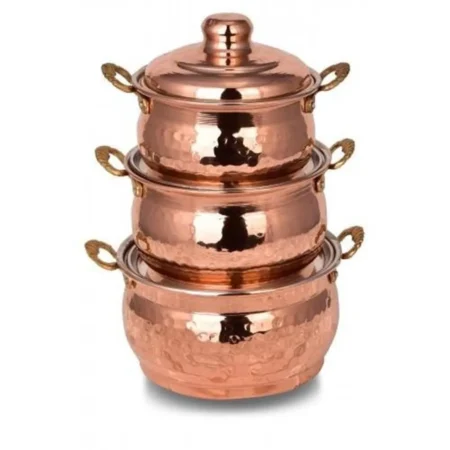

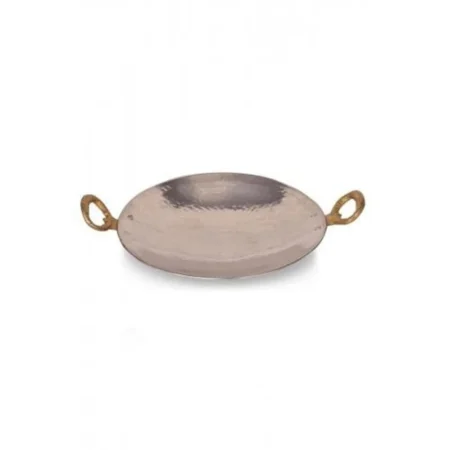
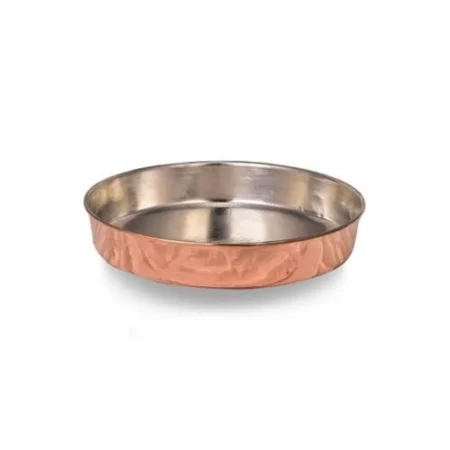
If your line needs something we do not stock, such as a stainless-lined body or a construction built for induction, tell us at the first message. We will say plainly whether the partner workshop can produce it and on what terms, or that it cannot; we will not offer a clad pan under a solid copper description. Made-to-order work, including sizes, forms and marking, is explained on our page about custom copper manufacturing.
For an induction kitchen, the honest recommendation is usually not cookware at all: trays, serving pieces, drinkware and coffee pots are unaffected by the hob, and they carry the copper look onto the table where guests see it.
Questions about solid, clad, core and coated copper
What is the difference between solid copper, copper-clad, copper-core and copper-bottom cookware?
Solid copper pans have a full copper wall with a thin tin or stainless lining. Copper-clad pans bond copper into a layered sheet with steel, often as the outer layer. Copper-core pans hide a copper layer between steel. Copper-bottom pans are steel pans with a copper disc or plating on the base only. The amount of copper falls in that order.
Are “copper” non-stick pans actually copper?
Usually not in any structural sense. Most copper-coloured non-stick pans are aluminium bodies with a ceramic or polymer coating tinted to look like copper, and some advertise copper particles in that coating. The food touches the coating, the heat comes from the aluminium, and the pan is best judged as a non-stick pan rather than as copper cookware.
How can I tell whether a pan is solid copper?
Weigh it against its size, hold a magnet to the base, look at the cut edge of the rim and check the interior. Solid copper is heavy, a magnet does not grip it, the rim shows one metal apart from a thin lining, and the interior is tin or stainless rather than a coloured coating. A written millimetre thickness completes the picture.
Which copper pans work on induction?
Solid copper will not heat, because copper is not ferromagnetic; a steel interface disc lets it cook but takes away most of what copper is bought for. Clad and core pans work when a magnetic stainless layer faces the hob. Copper-bottom and coated pans work only if the maker built a magnetic steel disc or cap into the base, so check the stated base construction.
Why is solid copper lined with tin or stainless steel?
Because bare copper should not meet acidic food. The FDA Food Code, section 4-101.14 of the 2022 edition, says copper and copper alloys such as brass may not contact food with a pH below 6, such as vinegar, fruit juice or wine. Tin is renewable and gently non-stick; stainless is harder and does not need relining in normal use.
How thick should the copper in a pan be?
There is no regulatory minimum and no single right figure. Thickness should match the job: lighter walls react fast for short cooking and service, heavier walls hold heat under load. What matters is a stated millimetre figure, clarity on whether it is starting sheet or finished wall, and for clad pans the copper layer quoted separately from the total.
Is copper-coated cookware safe?
The safety question belongs to the coating, because in most coated pans no copper touches food. Ask the seller to name the coating and show its food-contact documentation for your market. The FDA Food Code tells kitchens to use non-scratching utensils on perfluorocarbon non-stick coatings, and EU Regulation 1935/2004 sets the general rule that food-contact materials must not transfer constituents in harmful quantities.
Which construction lasts longest in a working kitchen?
Solid copper usually lasts longest because the body can be relined and repaired, so the part that wears is a scheduled service. Clad, core and copper-bottom pans are durable but cannot be renewed once the base warps. Coated non-stick pans are the shortest-lived, because the coating wears with use and the pan is replaced when it fails.
What should a retailer specify when ordering a solid copper line?
For each piece: the construction in plain words, copper sheet thickness in millimetres, lining metal, exterior finish, handle metal and attachment, diameter, height and weight with tolerance, and hob compatibility stating that solid copper does not work on induction. Keep a weighed and measured sample on file so later batches can be checked against it.
Related reading — gauge and size choice on copper cookware, why solid copper does not heat on an induction hob on copper and induction, lining renewal on copper cookware lifespan, food contact on is copper cookware safe, and supplier checks on sourcing copper cookware. More guides are on our resources page.
Specifying a solid copper line?
Send the pieces you are considering, the sheet thickness you have in mind, the lining you want and the hobs your customers use. We reply with what we can supply in solid tin-lined copper, the figures in writing, and a plain answer on anything outside our range.
Last updated: 20 October 2026