Copper Pot and Pan Shapes: Rondeau, Sauté Pan, Saucier, Stockpot and Their Turkish Names
Copper pot and pan shapes: the Western names, the Turkish forms behind them, and the gaps
A chef writes rondeau, saucier or sauté pan on a specification; a Turkish copper workshop thinks in tencere, tava and güveç. This guide maps one vocabulary onto the other, shape by shape, says plainly which Western forms are not in our range, and shows how to list shapes so that a quotation can answer every line.
Copper pot and pan shapes carry different names in Western and Turkish kitchens. A rondeau corresponds to the low two-handled karnıyarık tencere, a saucepan to the single-handled tencere, a frying pan to the tava and a small casserole to the güveç. A saucier, a paella pan and a true stockpot are not in the BakırBul range.
BakırBul produces handmade copper cookware in Kahramanmaraş, Turkey, through a long-term production partnership: we specify each piece, our partner workshop produces it to that specification, and we carry it under our own name to retailers, restaurants and importers. The material questions — why copper, why a cooking interior should be tinned, how heavy a wall should be — are covered on our page about Turkish copper cookware. This page deals with one thing only: shape, and how the shape names a Western buyer uses translate into the forms a Turkish workshop actually makes.
The translation matters because the two traditions organise pots differently. French and Anglo-American kitchens classify by wall angle and handle: straight wall or sloped, one long handle or two loops, rounded corner or square. Turkish kitchens name a pot after the dish it is known for and the number of handles it has. A specification written in one vocabulary and answered in the other is where wrong pieces come from, and the table below is meant to close that gap before a quotation, not after a delivery.
Low and wide is the rondeau
The low two-handled tencere is the Turkish form closest to a Western rondeau or brazier, and it goes to the table as often as it stays on the stove.
One handle is the saucepan
The single-handled tencere does the work of a saucepan: sauces, milk, rice and anything that has to be lifted off the flame in a second.
Tin lining, confirmed per model
Whatever the shape, the interior of each model is confirmed in writing on the quotation; for cooking, ask for a tin-lined model.
Gaps stated, not hidden
Saucier, paella pan, oval roaster and a true tall stockpot are not in the range, and the table says so line by line.
Made to order is a question
A shape outside the range can be raised with a drawing; the answer comes after we see dimensions and quantities, not before.
No shape fixes induction
Copper is not magnetic, so no pot or pan shape works on an induction hob without a steel interface disc underneath.
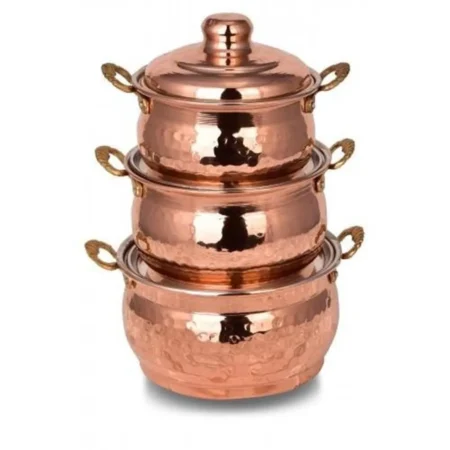

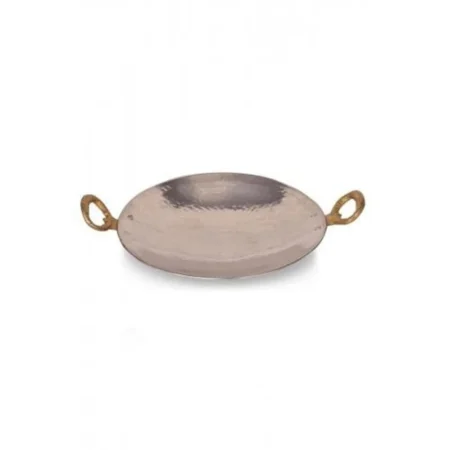
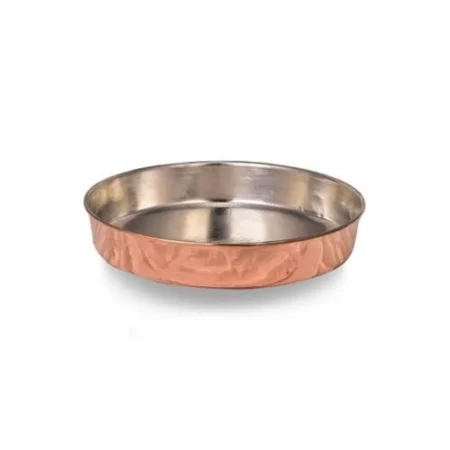
134 items in stock right now, from 12 cm to 36 cm. Other sizes and finishes are produced to order.
Western shape names and their Turkish counterparts
Western shape names map onto Turkish copper forms only approximately, because Turkish kitchens name pots by dish and by handle rather than by wall angle. The table pairs each Western name with its closest Turkish form and states whether that form is in the BakırBul range, not in it, or a made-to-order question to discuss with a drawing.
Read the last column literally. “In the range” means the shape family is part of the catalogue; which diameters are in stock on the day you ask is confirmed in the written quotation, because stock moves and this page is not a stock report. “Close counterpart” means a form we carry does the same job but is not built the same way, and the difference is described in the section for that shape. “Not in our range” means exactly that.
| Western name | Shape | Turkish name | In our range? | Typical use |
|---|---|---|---|---|
| Rondeau (brazier) | Wide, low, straight wall, two loop handles, lid | Karnıyarık tencere (low two-handled tencere) | Yes | Braising, shallow stews, vegetables in one layer, serving at the table |
| Casserole pan / two-handled pot | Medium depth, straight wall, two handles, lid | Çift kulplu tencere, tall-walled series | Yes | Stews, pulses, rice and stock in moderate batches |
| Stockpot | Taller than it is wide, two handles | No direct Turkish copper equivalent | Not in our range; can be discussed as made to order | Stock, pasta water, large-batch boiling |
| Stockpot with spigot | Tall pot with a draw-off tap near the base | None | Not in our range | Large-volume stock drawn off without lifting |
| Saucepan | Straight wall, one long handle, lid | Tek kulplu tencere; small süt ve sos tenceresi | Yes | Sauces, milk, rice, reheating |
| Sauté pan | Wide flat base, straight wall, long handle, usually a lid | Closest: kapaklı tava, or a large tek kulplu tencere | Close counterpart, not identical | Searing and then finishing with liquid under a lid |
| Sauteuse | Sloped wall, long handle | Closest: tava | Close counterpart, not identical | Reducing, tossing, quick sautés |
| Saucier | Rounded base, flared wall, long handle | None | Not in our range; can be discussed as made to order | Emulsions, custards, risotto, constant whisking |
| Frying pan / skillet | Low sloped wall, one handle | Tava | Yes | Frying, sautéing, pan sauces |
| Wok | Deep, flared, rounded bowl | Wok tava | Yes, with or without a lid | Stir-frying and fast cooking with movement |
| Small casserole / cocotte / serving pot | Rounded belly, lid, two small handles | Güveç; mini güveç | Yes | Cook-and-serve portions and slow-finished dishes |
| Egg pan / shirred-egg dish | Shallow, round, cooks and serves | Sahan (from the tava family) | Yes, from the tava family | Eggs, menemen, small sizzling dishes |
| Paella pan | Very wide, very shallow, two loop handles | None | Not in our range; can be discussed as made to order | Rice cooked in a thin layer over a broad flame |
| Oval roaster / fish kettle | Oval plan, deep or long | None | Not in our range; can be discussed as made to order | Whole birds, joints, whole fish |
Two cautions apply to the whole table. First, the borders between Western shapes are themselves loose: one supplier’s rondeau is another’s brazier, and a “casserole” in a British catalogue is a lidded two-handled pot while in an American one it can mean an oven dish. Second, diameter on its own says little about how much a pot holds, because wall height varies so much between shapes. Wherever this page gives a size, it gives both numbers.
For trays, griddles and oven pieces, which are not pots or pans in the sense used here, the relevant pages are copper griddles and copper baking trays.
The rondeau and the low two-handled tencere
A copper rondeau is a wide, low pot with straight walls, two loop handles and a lid, used for braising and shallow stews. The Turkish counterpart is the karnıyarık tencere, named after the stuffed-aubergine dish, with a wall of roughly seven to eight centimetres and catalogue diameters recorded from 16 cm to 36 cm.
The rondeau exists because some dishes need floor space more than depth. Pieces of meat browned and then braised, aubergines laid side by side, stuffed vegetables, chicken thighs finished in a sauce — all of these want to sit in one layer with liquid around them rather than piled on top of one another. A low wall lets steam escape fast enough for a sauce to reduce, and the broad base puts the whole load over the flame.
The Turkish kitchen arrived at the same shape for the same reasons. The low two-handled tencere is the pot in which karnıyarık, the split aubergine filled with minced meat, is traditionally cooked, and the dish has given its name to the form. In our catalogue data this family has a wall of about 7 cm to 8 cm across most diameters, sheet thickness recorded between 0.70 mm and 1.00 mm, and capacity rising from a little over a litre on the smallest body to well over five litres on the larger ones.
Where our low tencere differs from a classic French rondeau is weight. Western professional rondeaux are often built from heavier sheet with cast handles, made to sit on a range all day. A Turkish low tencere is lighter in the hand, responds faster to the flame, and is meant to be carried to the table and served from. For a kitchen that braises in the back and plates the food, that matters less; for a restaurant that brings the pot to the guest, it is the reason to choose this shape.
If your specification says “rondeau”, the line we would expect to see accepted is: low two-handled tencere, diameter, lid, tin-lined, finish. If the specification requires a particular wall height or a cast handle, say so, because that moves the line from the stocked family to a production question.
Two-handled pots, casseroles and the stockpot question
A Western stockpot is taller than it is wide, and no copper body in the BakırBul range has that proportion. The tallest two-handled tencere in the range has a straight wall of about 13 cm on the larger diameters, which makes it a casserole pan or deep braiser by Western naming rather than a stockpot.
The tall-walled two-handled tencere is the workhorse of the Turkish copper kitchen: soups, pulses, pilaf, stews and boiled dishes for a household or a small service. In our catalogue data the wall rises from roughly 8.5 cm on a 16 cm body to about 13 cm from 26 cm upward, with diameters recorded up to 36 cm and capacities recorded in the region of 1.5 to 7 litres. That is a generous casserole, and it is the right pot for anything that simmers with a lid on.
It is not a stockpot, and we would rather say that here than have a buyer discover it on delivery. A stockpot’s height exists to reduce surface area: less evaporation over hours, a deep column of liquid around bones, room for pasta to move in boiling water. Our tallest copper pot is still wider than it is tall. Asked to do a stockpot’s job, it will lose liquid faster than a stockpot would and hold less for the same floor space.
There is also an honest commercial point. A true tall stockpot in solid copper is a heavy, expensive object, and much of what it does — boiling water, holding stock for hours — gains little from copper’s fast response. Many kitchens that cook in copper keep their stock in steel for exactly that reason. If you still want a copper stockpot, it can be raised as a made-to-order question; the section on shapes we do not carry explains what that involves. A stockpot with a draw-off tap is not in our range in any form.
A last note on the word “casserole”. In British usage it is a lidded pot with two handles, which is what this tencere is. In American usage it often means a baking dish that goes in the oven, which this is not. If your market uses the American sense, the piece you are looking for is closer to a tray or a güveç, and the line on your list should say which.
The saucepan: the single-handled tencere
A copper saucepan is a straight-walled pot with one long handle and a lid, used for sauces, milk, rice and small quantities. The Turkish counterpart is the hand-hammered tek kulplu tencere, with a soldered metal handle and its interior confirmed on the quotation; a small 14 cm milk and sauce pot sits at the bottom of the range.
The long handle is the whole point of a saucepan. It lets one hand pull the pot off the heat the moment a sauce starts to catch, tilt it to pour, and move it between burners without reaching for a cloth on both sides. Copper suits this job better than almost any other material because the base answers the flame immediately: turn the heat down and the sauce stops thickening at once rather than thirty seconds later.
The single-handled tencere family in our catalogue data runs in diameters recorded from 16 cm to 36 cm, most with a wall of about 10 cm, and sheet thickness around 0.80 mm with some heavier bodies. At the small end, a dedicated milk and sauce pot of 14 cm with a 7 cm wall covers the jobs a Western kitchen gives to a small saucepan or butter warmer: melted butter, a single portion of custard, milk for coffee.
Above about 28 cm, a single handle stops being an advantage. A full pot of that size weighs several kilograms, and holding it level by one handle is awkward even when the handle is strong enough to take the load. In a working kitchen we would steer large quantities to the two-handled forms and keep the big single-handled bodies for dishes cooked with a low fill level, where they behave more like a deep pan than a saucepan.
The handle is metal and it conducts heat, as every copper handle does. It stays cooler than the body but not cool, and a kitchen that uses these pots on a busy line should plan for a cloth or a handle sleeve rather than assume otherwise.
Sauté pan, sauteuse and the lidded tava
A sauté pan has straight walls, a wide flat base, a long handle and usually a lid; a sauteuse has the same handle but sloped walls. Neither has an exact Turkish twin. The closest counterparts in the BakırBul range are the lidded tava, with the handle form stated per model, and the larger single-handled tencere with a low wall.
The sauté pan is a frying pan that learned to braise. Its straight wall holds more liquid than a skillet, so food can be seared and then finished with stock or wine under a lid without moving it to another pot. The sauteuse, with its sloped wall, is the version for tossing and reducing: the angle lets food slide back into the pan and lets steam leave quickly.
The Turkish lidded tava — kapaklı tava, literally “pan with a lid” — does a good part of the sauté pan’s work. It has a low wall and a copper lid; the handle form varies by model and is stated on the quotation line. In our catalogue data it is recorded in diameters from 18 cm to 27 cm. Food can take colour with the lid off and then finish covered, and where a model has short side handles instead of one long handle, it goes onto the table without a long handle in the way.
What a side-handled model does not do is toss. A pan with two side handles is moved with two hands or with a cloth, not flicked with one wrist. A kitchen whose line cooks rely on tossing should check the handle form on the quotation, treat a side-handled tava as a braising pan and look to the ordinary tava for anything that has to move.
The other near match is a large single-handled tencere with a low wall, which has the long handle of a sauté pan and enough depth for a sauce. It is heavier than a Western sauté pan of the same diameter in some sizes and lighter in others, so if the handling matters, ask for weights on the quotation. A true straight-sided sauté pan with a long handle and a helper handle opposite is not a stocked shape; it can be raised as a made-to-order question.
The saucier: not in our range
A copper saucier, the pan with a rounded base and flared walls that lets a whisk reach every part of the surface, is not in the BakırBul range. A small single-handled tencere is the nearest stocked form for sauces, but its corner is square, and a saucier can only be discussed as a made-to-order piece with a drawing.
The saucier solves one specific problem. In a straight-walled saucepan the corner where wall meets base is the one place a whisk or spoon cannot reach cleanly, and it is where custards scramble, roux catches and risotto sticks. A rounded base removes the corner. The flared wall then gives a wider surface for evaporation, so sauces reduce faster than in a saucepan of the same diameter.
Turkish copper cookware did not develop this shape, and we do not carry one. The small single-handled tencere and the milk and sauce pot handle most sauce work well, especially with the fast response of a copper base, but a cook who whisks a sabayon or a beurre blanc every night will feel the difference.
A saucier is not an unreasonable shape to produce in copper. Rounded interiors take tin without difficulty, and a raised or spun body can follow the curve. What it would need is a drawing or a reference piece, a target diameter and depth, and a quantity that justifies the work of setting up a new form. That is a conversation for the custom copper manufacturing page, and the answer depends on what you send.
Frying pans and the wok
A Western frying pan corresponds to the Turkish tava, a low round pan with sloped sides and one handle, made hand-hammered, machine-forged or plain. The copper wok in the BakırBul range is a deeper flared body of about 25 cm, supplied with a lid or as an open pan, with its interior confirmed on the quotation.
The tava is the most varied family in the catalogue. Its diameters are recorded from 14 cm to 27 cm, walls are generally low — about 4 cm to 6 cm where the depth is recorded — and sheet thickness ranges from 0.50 mm on lighter bodies to 1.30 mm on the heaviest. Some series are hand-hammered (in a few, only the base), some machine-forged, and some plain; some are listed with a copper lid, others without. That variety is useful, because a frying pan for a home kitchen and one for a breakfast line want different things, but it also means the series has to be chosen deliberately rather than by photograph.
The shallowest tava bodies are also the ones Turkish cafés use as sahans for eggs and menemen. That use has its own page, the Turkish copper sahan, which covers sizes per portion and serving a hot pan safely.
The wok needs one honest qualification. Classic wok cooking heats an empty pan until it smokes and then works it at very high temperature. A tin lining cannot take that: tin melts at 231.9 °C, according to the Royal Society of Chemistry, and an empty pan on a strong burner passes that point within minutes. A tinned copper wok is a wok for cooking with oil already in the pan over a strong but not maximal flame. It moves food fast and responds instantly; it is not a carbon-steel wok for searing at the limit, and we do not present it as one.
The same ceiling applies to every tava. Put the fat in first, never preheat empty, and keep steel utensils off the lining. The full routine is on our copper care page.
Güveç and sahan: shapes that cook and then serve
A güveç is a rounded lidded pot and a sahan a shallow egg pan, and both are Turkish shapes that cook the food and then carry it to the guest. Western buyers usually list them as small casseroles, cocottes or egg pans. BakırBul carries güveç bodies from mini portion sizes upward, and sahans from within the tava family.
The güveç is the shape a Western buyer most often mislabels. It has a rounded belly, a lid and two small handles, and in a restaurant it is used as a portion vessel: the dish is finished in it and goes to the table without being plated. In our catalogue data the mini güveç bodies are recorded at 12 cm to 14 cm and the larger ones at 18 cm to 22 cm. The traditional güveç is earthenware; copper güveç pots are a related but different object, and the distinction, together with portion sizes and how they behave in service, is covered on our page about copper güveç and mini serving pots.
A specification that says “cocotte” or “mini casserole” is usually asking for a güveç, and a specification that says “egg pan” or “shirred-egg dish” is usually asking for a sahan. Writing the Turkish word next to your own on the line removes the guesswork.
Shapes we do not carry, and what made to order means
Paella pans, oval roasters, fish kettles, sauciers, true stockpots and stockpots with a tap are not in the BakırBul range. Any of them except the tapped stockpot can be raised as a made-to-order question, answered once we have seen a drawing, dimensions and quantities. A made-to-order shape is a discussion, not a promise, and no threshold is published.
The gaps follow from where these pots come from. Turkish copper cookware grew around stews cooked in pieces, rice, pulses, eggs and coffee; it never needed an oval pan for a whole goose or a shallow pan a metre across for rice. A Western range that includes those shapes is drawing on a different kitchen, and there is no shame in a Turkish range lacking them. There would be a problem in pretending otherwise.
What can be done is to treat a missing shape as a production question. A new form usually needs its own tooling or a reference piece to raise against, a technical drawing with diameter, height, wall form and handle positions, a stated sheet thickness, and a quantity. Whether that is worth doing depends on the numbers, and the quotation says so before any work starts. A sample is charged, and the approved sample becomes the reference against which the series is checked. The details of that process are on the custom manufacturing page.
Two limits apply to every made-to-order shape. We do not copy another maker’s registered design, however familiar the shape looks. And a surface that will touch food is never left untinned, whatever the drawing says, because bare copper in contact with acidic food is exactly what the lining exists to prevent.
Lids, handles and how they are fixed
Lids, handles and fixings differ by shape. Pots and the lidded tava are generally supplied with a matching copper lid, single-handled pots carry one long metal handle, and on BakırBul pieces handles are soldered to the body rather than riveted. A buyer whose specification requires rivets should state it for each shape, and the quotation answers line by line.
Lids. Two-handled tencere bodies, single-handled pots, the lidded tava and the güveç are generally supplied with a copper lid matched to the diameter; frying pans and the wok come in versions with and without one. Lid or no lid is confirmed on the quotation line for each model rather than assumed from a photograph. A lid that seats properly sends condensation back into a braise; one that rocks lets steam out on one side and dries the dish there, which is why a lid ordered separately should be matched to the exact body.
Handles. Two-handled pots carry loops or lugs on opposite sides; the saucepan family carries one long handle; on the lidded tava the handle form varies by model and is stated on the quotation. Handles are metal throughout, so every handle gets hot on the stove; oven use, always below the temperature limit set by the tin, is confirmed model by model on the quotation rather than assumed for the whole range.
Fixings. On BakırBul pieces the handle is soldered to the body. We state this because many buyers ask for riveted handles as a matter of habit, and the honest answer is that riveting is not how these pieces are built. A soldered joint is sound in normal use; it dislikes thermal shock — cold water into a hot pan — and the long heat cycles of a dishwasher, both of which a copper pan should avoid anyway. If your specification makes rivets a condition, write it on the line for each shape and we will answer whether that shape can be built that way.
Which gauge suits which shape
Sheet gauge should follow each shape’s job. Frying pans and sahans under direct heat benefit from heavier sheet, large pots need wall stiffness at wide diameters, and serving shapes such as mini güveç can be lighter. BakırBul catalogue data records sheet thickness from 0.50 mm on light serving bodies up to 1.30 mm on the heaviest frying pans.
Gauge is the thickness of the copper sheet, given in millimetres. How it is measured and what the numbers mean in general is explained on our page about solid copper versus copper-clad pans; here the question is narrower — which thickness belongs to which shape.
- Frying pans and sahans. These sit directly over the flame with little liquid to buffer the heat, so heavier sheet spreads heat more evenly and resists warping. In the tava family the range runs from 0.50 mm to 1.30 mm, and for a busy line the heavier end is the one to ask for.
- Low two-handled pots. A wide, low body is stiffened by its own rim less than a tall one is. Recorded thickness in this family is 0.70 mm to 1.00 mm, with the heavier sheet on the larger diameters, which is where it matters.
- Tall two-handled pots. Liquid buffers the heat, so evenness matters less than strength: a full 36 cm pot is heavy and is lifted by its handles. Recorded thickness here is 0.80 mm to 1.00 mm.
- Saucepans. Around 0.80 mm is typical in this family. A saucepan is moved constantly, and a lighter body is easier on the wrist for the same diameter.
- Güveç and serving pots. These are mostly 0.50 mm, a sensible weight for a portion vessel carried to the table. They are not built to sit on a strong flame for hours, and they should not be specified for that.
The trade-off is the same everywhere: thicker sheet holds and spreads heat better and dents less, thinner sheet responds faster and weighs less. A specification that states the use lets us propose a thickness; one that states only a number gets that number.
Cooking shapes and serving shapes
Cooking shapes and serving shapes overlap in Turkish copper more than in most Western ranges. The low karnıyarık tencere, the güveç, the sahan and the lidded tava all go from heat to table, while the tall two-handled pot, the large saucepan and the wok normally stay in the kitchen. Serving use changes which finish and handle details deserve attention.
In a Western brigade kitchen, cooking vessels rarely leave the pass; food is plated. Turkish copper grew up in a different service, where the pot often is the plate. That changes the order of priorities. For a back-of-house shape, the questions are gauge, handle strength and how the piece survives cleaning. For a front-of-house shape, the questions become how it looks after a month of service, whether its handles can be touched when it arrives, and what it sits on.
Three practical points follow for any shape that goes to the table. A hot copper body needs a trivet or a wooden underplate, both for the table and for the guest’s hands. The exterior finish matters more, because it is seen: an aged or brushed exterior shows handling far less than polished copper. And the lid becomes part of the presentation, so a shape listed without a lid in the kitchen may want one in the dining room.
Restaurants and hotels planning a mixed order of cooking and serving shapes will find the wider picture — finishes, cleaning routines, staff habits — on our page about copper for restaurants and hotels.
Induction: does any shape change the answer?
No copper pot or pan shape works on an induction hob, because copper is not magnetic and the hob does not detect it. A flat-based shape set on a steel interface disc is the only workaround, and that disc is a separate purchase that slows the response. Gas, electric coil, ceramic and open-fire heat need no adapter.
An induction hob heats a pan by inducing current in a magnetic base. Copper is not ferromagnetic — the property is explained in Britannica’s entry on ferromagnetism — so a solid copper pan, whatever its shape, will not register on an induction zone. Changing the shape does not change the metal. A rondeau, a saucepan, a wok and a güveç are equally unsuitable for induction on their own.
Shape does matter for the workaround. A steel interface disc placed between hob and pan heats up and passes heat to the copper, so the pan works, slowly and at some cost to the response that makes copper worth having. The disc works best under a flat base: frying pans, saucepans and the low two-handled pot sit on it well. A wok’s flared bowl and a güveç’s rounded belly touch the disc over a small area and are not shapes we would suggest using that way at all.
We say this before a quotation rather than after a delivery. If your kitchen is induction throughout, the disc is not a substitute we would recommend for daily service; serving shapes and table pieces are the better use of copper in that kitchen. The physics, the disc and the alternatives are covered in full on our page about copper and induction hobs.
How to list shapes in a purchase specification
A shape specification for copper cookware works best as one line per piece: the Western name you use, the Turkish form you accept, diameter, wall height, handle form, lid, sheet thickness, exterior finish, quantity and destination. Writing the accepted substitute on the same line lets a quotation answer each shape directly, including the shapes that fall outside the range.
A list in this form makes three things possible. It lets us match stocked bodies to your lines without guessing what a word means in your market. It shows at once which lines are production questions rather than stock questions. And it gives you a quotation that can be compared line by line with the specification you wrote, which is what an importer or a purchasing department needs to sign it off.
An example of how such a list might read:
- Rondeau — accept low two-handled tencere — 32 cm, wall 7 to 8 cm — two handles — lid — 1.00 mm — hand-hammered, red copper — quantity — destination.
- Saucepan — accept single-handled tencere — 18 cm — long handle — lid — about 0.80 mm — hand-hammered, red copper — quantity.
- Sauté pan — accept lidded tava — 24 cm — handle form as quoted — lid — red copper — quantity.
- Small casserole for table service — accept mini güveç — 14 cm — lid — quantity.
- Saucier — no substitute accepted — 20 cm, rounded base — please quote as made to order or decline.
The last line is as useful as the others. “No substitute accepted” tells us not to offer a near match, and “quote or decline” tells us that a clear no is an acceptable answer. It saves a week of correspondence on both sides.
Two further items belong on any list that will cross a border. If your market requires food-contact documentation, say so in the first message, not after the order: we do not hold a food-contact test report for these pieces, testing can be arranged, and it takes time and costs money. The European framework is Regulation (EC) No 1935/2004, and in the United States the FDA Food Code restricts bare copper in contact with acidic food in commercial service, which a tin lining addresses; our food contact compliance page sets out what that means for an import. And say whether the pieces will go to a dishwasher, because the answer for every shape on this page is that they should not.
When the list is ready, send it through the quotation form on our wholesale page. There is no single minimum figure; the quotation answers the list as written, and lines that fall outside the range are answered too.
Questions about copper pot and pan shapes
What are the main types of copper pots and pans?
The main copper shapes are the rondeau or brazier, the two-handled casserole pot, the stockpot, the saucepan, the sauté pan and sauteuse, the saucier, the frying pan, the wok and the small casserole or cocotte. Turkish copper adds its own forms: the low karnıyarık tencere, the single-handled tencere, the tava, the güveç and the sahan. Not every Western shape has a Turkish equivalent.
What is a copper rondeau?
A copper rondeau is a wide, low pot with straight walls, two loop handles and a lid, used for braising and dishes cooked in a single layer. Its Turkish counterpart is the low two-handled karnıyarık tencere, with a wall of about 7 cm to 8 cm, which is light enough to be carried to the table and served from.
What is the difference between a sauté pan and a saucier?
A sauté pan has a flat base, straight walls and a long handle, and is used for searing and then finishing with liquid. A saucier has a rounded base and flared walls so that a whisk reaches every part of the surface, which suits custards and emulsions. BakırBul carries close counterparts to the sauté pan but no saucier.
Do you make a copper saucier or a copper paella pan?
Neither is in our range. Both can be raised as made-to-order questions with a drawing or a reference piece, a target diameter and depth, and a quantity. Whether a new form is worth setting up depends on those numbers, and the quotation says so before any work starts. A sample is charged and becomes the reference for the series.
Is there a copper stockpot in your range?
Not in the Western sense. Our tallest two-handled copper pot has a wall of about 13 cm on the larger diameters, so it is still wider than it is tall and works as a deep casserole rather than a stockpot. A tall copper stockpot can be discussed as made to order; a stockpot with a draw-off tap is not in our range.
What is a tencere?
Tencere is the Turkish word for a cooking pot. In copper it comes with two handles, as a low form close to a rondeau or a taller form close to a casserole pot, or with one long handle, as a saucepan. The word says nothing about depth on its own, so a specification should give diameter and wall height together.
Do your copper pots come with lids?
Pots, the lidded tava and the güveç are generally supplied with a copper lid matched to the diameter, and frying pans and the wok come in versions with and without one. Lid or no lid is confirmed on the quotation line for each model rather than taken from a photograph. A separate lid should be matched to the exact body it will sit on.
Are the handles riveted?
No. On BakırBul pieces handles are soldered to the body. A soldered joint is sound in normal kitchen use but dislikes thermal shock and dishwasher cycles, both of which copper should avoid anyway. If your specification requires riveted handles, state it for each shape and the quotation will say whether that shape can be built that way.
Which copper shapes work on induction?
None of them on their own. Copper is not magnetic, so an induction hob does not detect a copper pan of any shape. A steel interface disc under a flat-based pan makes it usable but slows the response, and rounded shapes such as a wok or a güveç sit poorly on a disc. Gas, electric and ceramic hobs work without any adapter.
Can I mix several shapes in one wholesale order?
Yes. A mixed order is normal, and the simplest way to request one is a list with one line per shape: your name for it, the Turkish form you accept, diameter, wall height, handles, lid, thickness, finish and quantity. Stocked bodies are matched from the catalogue, and shapes outside the range are answered on the same quotation.
Send us your shape list
One line per shape — your name for it, the Turkish form you accept, diameter, wall height, handles, lid and quantity — plus the destination country. We reply with the stocked bodies that match, a price for anything that has to be produced, and a direct answer for shapes that fall outside the range.
Last updated: 20 October 2026