Can Copper Pans Go in the Oven? Tin, Handles and Broilers in °F
Can copper pans go in the oven? Yes, and three things decide how hot
Solid copper cookware goes into an oven without complaint. What sets the limit is never the copper: it is the lining on the food side, the handle and lid knob, and whether the heat comes from the air around the pan or from a broiler element aimed straight at it. This guide gives the numbers in °C and °F for home cooks and commercial kitchens in the United States, compares tin-lined, stainless-lined and unlined copper, and explains what quietly ruins a tin lining in an oven.
We produce copper cookware and oven trays in Kahramanmaraş, Türkiye (Turkey), in partnership with a local workshop, and supply them to trade buyers. The temperatures below are physical facts with their sources named; the working advice is ours.
Copper pans can go in the oven, because the copper body melts at 1084.62 °C (1984.3 °F). The real limit on a tin-lined pan is the tin, which melts at 231.93 °C (449.5 °F), so it goes in only with food inside, in the moderate baking band, and never under a broiler. Wooden or plastic handles lower the limit further.
The copper is never the limit
The body melts at 1084.62 °C (1984.3 °F), far above anything a kitchen oven reaches.
Tin sets the number
A tin lining melts at 231.93 °C (449.5 °F). Every rule about tin-lined copper in an oven starts from that figure.
Food in, then heat
Moisture in the food keeps the metal far cooler than the oven air. An empty pan has nothing holding it down.
Handles and knobs
Metal handles go into a moderate oven, and how they are joined is confirmed per model; wood dries and cracks, and plastic follows its maker’s rating.
No broiler, no salamander
Radiant heat from above lands directly on the lining, whatever temperature the oven dial shows.
Oven yes, induction no
Copper does not heat on an induction cooktop, but an oven heats the cavity, so oven work is unaffected.
Can copper pans go in the oven? The answer, part by part
A copper pan is several materials joined together, and each one has its own oven limit. The copper body tolerates any oven temperature; a tin lining is the lowest metal limit at 231.93 °C (449.5 °F); a stainless lining raises it; and handles, knobs and joints can bring it back down. The weakest part decides.
The question “is this copper pan oven safe?” usually gets a yes or a no, and both answers are incomplete. A solid copper frying pan, saucepan or casserole is a copper body, a thin lining on the food side, one or two handles fixed by solder, rivets or welding, and sometimes a lid with its own knob. In an oven every one of those parts reaches roughly the same temperature, so the useful question is which part gives up first.
The figures for the two metals that matter most come from the element records published by PubChem, the chemistry database of the US National Library of Medicine: tin melts at 231.93 °C and copper at 1084.62 °C. Converted for an American oven dial, that is 449.5 °F for tin and 1984.3 °F for copper.
| Part of the pan | What happens as the oven gets hotter | What decides the limit |
|---|---|---|
| Copper body | Nothing a kitchen oven can do; it melts at 1084.62 °C (1984.3 °F) | Physics; never the constraint |
| Tin lining | Melts and runs at 231.93 °C (449.5 °F) | The oven setting, the time and above all whether food is in the pan |
| Stainless steel lining | No low melting point in the kitchen range; it can discolor | Usually the handles rather than the lining |
| No lining (bare copper) | Darkens and oxidizes, but does not fail in an oven | Food contact rules, not heat |
| Brass, iron, steel or copper handle | Gets as hot as the pan | Your oven mitt, not the metal |
| Wooden handle or knob | Dries, darkens, shrinks and eventually cracks or chars | Keep it out of the oven |
| Plastic or phenolic handle | Softens or degrades above its rated temperature | The handle maker’s own rating |
| Joints (solder, rivets, welds) | Depends on how the joint is made | Ask the supplier which joints a given model has, and agree the working temperature for anything above a moderate oven |
Read the table from the bottom up and the practical rule appears on its own. A tin-lined copper pan with metal handles and food in it is a good oven pan in the moderate baking band. Take the food out, put the pan under a broiler, or fit it with a wooden handle, and the same pan becomes a poor choice for that job.
Tin-lined copper in the oven, in °F
Tin-lined copper is comfortable in the moderate baking band, up to about 177 °C (350 °F), with food inside. Any higher setting is agreed in writing on the quotation, together with the model’s joint type. At 232 °C (450 °F) and above, under a broiler or in a self-cleaning cycle, a tin-lined pan does not belong in the oven.
The reason tin-lined copper survives daily oven use in kitchens that use it seriously is simple thermodynamics. While there is liquid in a braise, a gratin or a pan of roasting vegetables, water is evaporating from it, and evaporation pins the temperature of the food, and of the metal touching the food, close to the boiling point of water. The oven air may read 375 °F; the tin under a wet dish is nowhere near that. The margin shrinks as the dish dries out and disappears completely when the pan is empty.
That gives a way of reading any recipe against a tin-lined pan. The bands below are oven settings, not food temperatures. The right-hand column assumes food in the pan for the whole time it is in the oven, and it does not replace the model’s own specification: food protects only the metal it touches, while the rim above the food line, the handles and the lid follow the oven air.
| Oven setting in the recipe | Typical jobs | Tin-lined copper with food inside |
|---|---|---|
| Up to about 177 °C (350 °F) | Slow braises, baked rice and pilaf, custards, low and slow casseroles | Comfortable; the lining has a wide margin |
| About 190 to 218 °C (375 to 425 °F) | Roast vegetables, gratins, a roast chicken, most savory bakes | Not a standing promise; if your menu needs these settings, the working temperature and the model’s joint type are agreed in writing on the quotation first |
| 232 °C (450 °F) and above | Very hot roasting, pizza and bread settings, high-heat finishing | No; the setting itself is at or above the melting point of tin |
| Broil, at any setting | Browning tops, melting cheese | No; radiant heat reaches the lining directly |
| Self-cleaning cycle | Oven maintenance | Nothing copper stays in the oven |
The middle band is deliberately left open rather than marked as safe, for four reasons. The margin is narrow: 425 °F sits only about 25 °F below the melting point of tin. Home ovens cycle on and off around the set point and many do not hold the number shown on the knob, so a dial at 425 °F can be running hotter for part of each cycle. The rim above the food, the handles and the lid have no food cooling them and reach the temperature of the oven air. And the handles on our pans are soldered, so the joint, not only the lining, has to suit the setting. That is why we treat any plan to cook above the moderate band as part of the order: tell us the setting and the dish, and the quotation states in writing which model and which joint type it applies to.
Inside the moderate band, two habits still help. An inexpensive oven thermometer on the rack tells you what the pan is actually sitting in. And watch the liquid: a gratin that has bubbled dry around the edges, or a roasting pan whose juices have evaporated to a glaze, is losing the cushion that keeps the tin cool, and that is the moment to lower the heat or take the pan out.
A clean, bright lining is also slower to show trouble than people expect. Tin that has been overheated goes dull and mottled in patches before it ever runs, and that early warning is useful: if a pan comes out of the oven with a gray, uneven patch where the food had dried, the setting or the timing was too aggressive for it. The signs and the repair are covered further down this page.
Stainless-lined copper: the lining stops being the weak point
Stainless-lined copper tolerates far more oven heat than tin-lined copper, because the stainless steel inner layer has no melting point anywhere near the kitchen range. On those pans the handles, knobs and the maker’s stated oven rating become the limit, and the trade-off is a lining that cannot be renewed cheaply if it is ever damaged.
Stainless-lined solid copper is made by bonding a thin skin of stainless steel to the copper sheet before the pan is formed. The bond and the steel together are what most makers of that construction rate for the oven, and the rating printed by the maker is the number to follow: it accounts for the handle and the bond in a way that a general guide cannot. For a US cook choosing between the two, the oven question is one of the clearest differences. A stainless-lined pan can take on high-heat roasting and hot-oven finishing that a tin-lined pan should not.
What stainless gives up is the thing tin is valued for. Tin is renewable: a worn or overheated tin lining is stripped and replaced by a re-tinning shop, and the copper body carries on for decades. A stainless lining wears very slowly, but if it is gouged or the bond fails there is no routine repair. The longer comparison, including how to tell the two linings apart by eye, is on our page about copper cookware lifespan, and the six constructions that are all sold as “copper” are set out side by side in solid copper versus copper-clad.
So the honest position for our own range is this: the cooking pieces we quote are tin-lined, and stainless-lined bodies are not a standard line. If a project genuinely needs stainless-lined pans for high-heat oven work, say so in the first message and we will tell you plainly whether the partner workshop can produce them and on what terms.
Unlined copper: the oven is not the problem, the food is
Unlined copper survives any oven temperature, because there is no lining to melt, but it is not a cooking surface for most food. The FDA Food Code bars copper and brass from contact with food below pH 6, such as vinegar, fruit juice or wine, which is why food-contact copper is lined and bare copper stays decorative.
A bare copper dish in a hot oven simply darkens. It may come out bronze, purple or almost black where the heat was strongest, and that discoloration is oxidation of the surface, not damage to the piece. Physically, then, unlined copper is the most heat-tolerant of the three. The restriction on it comes from food safety rules rather than from the oven.
Section 4-101.14 of the FDA’s model Food Code (2022 edition) states that copper and copper alloys such as brass may not be used in contact with a food that has a pH below 6, and gives vinegar, fruit juice and wine as examples. Most of what goes into an oven dish is acidic or contains something acidic: tomato, wine, citrus, fruit fillings, many marinades. The food code is a model that states and localities adopt, and what it means for a restaurant or a retailer in practice is explained on our food contact compliance page rather than repeated here.
Our policy follows from that. Any surface that is intended to meet food is tinned rather than left bare, and an unlined copper piece is offered for decorative or non-food use only, never described as suitable for baking. If you want an unlined copper dish for display, for holding bread rolls on a buffet that never sees heat, or for a planter, that is a legitimate product; it is simply not ovenware.
Handles decide more than the pan: brass, iron, copper, wood and phenolic
Handle material often sets the oven limit before the lining does. Brass, iron, steel and copper handles go into a moderate oven and come out as hot as the pan, and how they are joined is confirmed per model. Wooden handles and knobs dry out, crack and char, and plastic or phenolic handles follow their maker’s own temperature rating.
Copper cookware made in the French tradition is commonly fitted with cast iron or brass handles riveted through the wall; Turkish copper is often fitted with handles soldered to the body, and some smaller pieces use wood. Each behaves differently in an oven.
- Brass, iron and steel. The metal itself is not the concern in a moderate oven; the joint that holds it to the pan is, and that is confirmed per model. Iron and steel conduct heat more slowly than copper and stay a little cooler on the stovetop; in an oven that difference disappears and every handle is too hot to hold bare-handed.
- Copper. A copper handle conducts heat almost as well as the body, so it is hot on the stovetop and in the oven alike. That is normal for the material, and a folded towel or a mitt is the answer.
- Wood. Wood does not belong in an oven. Repeated heat dries it, darkens it, opens the grain and eventually loosens it in its socket or cracks it; near a flame it scorches. None of that is a defect in the pan.
- Bakelite, phenolic and other plastics. Some cookware sold in the US uses molded handles or knobs, and each one carries an oven rating from its maker. Follow that rating even where the lining would tolerate more.
In our own listed range, wooden handles appear on Turkish coffee pots, small sauce pots (sosluk) and a teapot, which are pieces that never go into an oven anyway. None of the pots, frying pans or güveç casseroles in the listing is described with a wooden handle. Our listing data does not record a handle material for every model, so if an order is for regular oven work, ask us to state the handle material and how the handles are attached on the quotation.
The joint matters too. Handles in our range are generally soldered to the body rather than riveted through it, which leaves the inside wall smooth and easy to keep clean. The solder alloy is not recorded in our listing data, so we do not print a temperature for it. How a soldered joint behaves under long, repeated oven use is answered per model: ask us which joints a model has, and agree the working temperature in writing, before you plan a menu around oven finishing above the moderate band. Whatever the joint, avoid sudden temperature changes, such as setting a pan straight from a hot oven onto a cold steel bench or into a sink.
The wider care routine, including how to live with hot metal handles at a busy stove, is on our copper care page.
Lids, knobs and covered braises
A copper lid can go into the oven with the pan when its knob or handle is metal, and covered cooking is the gentlest oven use a tin-lined pan gets. A lid traps steam over the food, which keeps the lining moist and cool, and taking it off for the last minutes browns the top without needing a broiler.
A lidded copper casserole in a moderate oven is close to the ideal case for a tin lining. The lid holds the moisture in, the walls stay wet with condensation above the food line, and the lining is protected right up to the rim. That is why pot-roasting, braising and covered baked dishes are the oven jobs tin-lined copper has always been used for.
Three practical points follow. First, check the knob: a copper or brass knob is fine, a wooden one is not. Second, the lid gets as hot as the pan after a few minutes in an oven, so it is lifted with a mitt or a folded towel, and in a restaurant the guest is told when a lidded pot reaches the table. Third, when a recipe asks for a browned top, remove the lid for the last part of the cooking at a moderate setting rather than moving the pan under the broiler. The güveç casseroles in our range are each listed with a matched copper lid, and their oven use is covered in detail on our page on copper güveç and mini serving pots.
Broilers and salamanders: the one heat source to rule out
A broiler or a salamander heats by radiation from an element or burner aimed at the top of the dish, so the exposed lining above the food line gets far hotter than the oven air. Tin-lined copper should never go under a broiler, whether in a home range, a broiler drawer or a commercial salamander.
An oven bakes by heating the air in the cavity, and the air heats the pan gradually. A broiler does something different: it throws radiant heat straight down onto whatever is beneath it. The surface facing the element, which in a pan means the rim and the inner wall above the food, absorbs that energy directly with nothing to cool it. The temperature the dial shows has little to do with it. Broilers run far above the melting point of tin, and a tin-lined pan close to the element can lose its lining around the rim in a few minutes.
In American kitchens this comes up in three places. At home, it is the broil setting on a range, either at the top of the main oven or in a drawer beneath it, used for melting cheese on a gratin or charring the top of a dish. In restaurants, it is the salamander or cheese-melter above the line, where a sizzling pan is slid in to finish. And in both, it is the kitchen blowtorch, which does the same job with a flame and has the same effect on a tin rim.
The workaround is to separate the jobs. Cook in the copper, then transfer to a ceramic, enameled cast iron or stainless gratin dish for the broiler step, or brown with the lid off in a moderately hot oven instead. Our page on the Turkish copper sahan explains the same rule for shallow egg pans, which are the pieces most often slid under a salamander by habit.
Convection ovens, preheating and the empty-pan mistake
A convection oven is fine for tin-lined copper with food inside, because the fan only moves hot air faster. The mistake to avoid in any oven is heating the copper pan empty: preheat the oven, put the food in the pan, and only then put the pan in, because an empty copper pan heats up quickly.
Convection, fan-forced and combi ovens move air across the food, which speeds up browning and evens out hot spots. Some ovens apply their own automatic adjustment when the convection setting is used, so check the appliance manual for how yours behaves. For the pan itself, the fan changes little as long as there is food in it; what it does change is how quickly an empty pan follows the air temperature up.
That is the heart of the matter. Copper conducts heat very quickly, which is the reason people buy it, and the same property means an empty copper pan has no thermal inertia to protect its lining. Several popular American recipes are built around exactly the step a tin-lined pan cannot take: heating an empty skillet or a covered pot in a very hot oven before the batter, dough or meat goes in. Skillet cornbread, a puffed oven pancake and a crusty loaf baked in a preheated covered pot all start that way. Those are jobs for cast iron, enameled cast iron or stainless steel, not for tin-lined copper.
The rule for the copper pan is the reverse of the rule for cast iron. Preheat the oven, never the pan. Put the fat and the food in first, then the pan goes in. And when the dish is done, take the pan out with it: a tin-lined pan left in a cooling oven while the next tray goes in at a higher setting is an easy way to lose a lining without noticing when it happened.
Stovetop to oven: searing first, and the induction question
Starting a dish on the stovetop and finishing it in the oven suits copper well, on gas, electric coil or a smooth radiant top. Add fat before the pan meets the heat, sear, then transfer it to a moderate oven. Copper does not work on an induction cooktop, so on an induction range the stovetop step needs a different pan.
Copper earns its price on the stovetop, where it responds to a burner almost instantly, and the stovetop-to-oven method plays to that strength. Sear the meat or soften the vegetables over the flame, add the liquid, and the pan goes into the oven to finish gently. The two stages carry the same rule: never heat the pan dry. On a strong gas burner an empty copper pan can pass the melting point of tin in a very short time, which is a faster route to a damaged lining than anything that happens in the oven afterward.
Induction is where American kitchens divide. Copper is not ferromagnetic, so an induction cooktop does not detect a copper pan and will not heat it. A steel interface disc between the cooktop and the pan makes it usable, but slowly, and it takes away most of what copper is bought for. The oven of an induction range is a different matter: it heats the cavity, so a copper casserole or oven tray works in it exactly as in any other oven. Why the cooktop ignores copper, and what an interface disc costs in speed, is explained on our page on copper and induction.
What damages the tin, and how to tell it happened
A tin lining is damaged in or around an oven by four things: heat with no food in the pan, a broiler or torch, metal tools scraping the surface, and acidic food left standing in the pan. Overheated tin looks dull, gray and mottled, then forms beads or bare patches, and the fix is re-tinning rather than replacing the pan.
Most lining damage is not dramatic. A lining that has been too hot rarely runs off in a sheet; it develops a matte, uneven, slightly granular patch where the metal softened and re-set, usually at the base where food dried out or around the rim under a broiler. If the heat went further, the tin gathers into small beads and leaves thin or bare copper between them. Copper showing through as a pink or reddish area on the food side is the signal to stop using that pan for acidic food until it has been relined.
The other causes are slower but common in oven work:
- Metal tools. Carving a roast in the pan, cutting portions of a bake with a knife, or scraping the base with a metal spatula wears tin quickly. Wooden, silicone or nylon tools last longer and so does the lining.
- Storing food in the pan. A braise left in its tin-lined pan overnight in the refrigerator sits against the lining for hours. Transfer leftovers to a storage container.
- Dishwashers and harsh cleaners. Detergent and long hot cycles attack both the lining and the exterior. Copper is washed by hand.
- Thermal shock. Plunging a hot pan into cold water does not melt anything, but it can distort a thin sheet. Let the pan cool before it meets water.
A damaged lining does not make a copper pan scrap. The copper body melts roughly 850 °C (about 1,535 °F) higher than the tin, and relining a pan is a normal part of owning copper. How often that is needed in a working kitchen, and how to plan for it, is set out on our copper cookware lifespan page. Whether a worn or overheated lining is a health concern is answered separately on is copper cookware safe.
Copper-colored non-stick pans are a different product
Copper-colored ceramic non-stick pans sold under copper names are normally aluminum pans with a colored coating, not solid copper, and none of the advice on this page applies to them. Their oven limit depends on the coating, the handle and the maker’s design, so the only reliable guide is the instructions printed on their own label.
A large share of the pans that appear when someone searches “can copper pans go in the oven” are not copper in construction at all. They are light aluminum bodies with a ceramic or other non-stick coating tinted to look like copper, often sold with “copper” in the product name and advertised on television or online. Some include a steel plate in the base so they work on induction, which solid copper does not do.
Those pans have their own oven ratings, set by the coating and the handle, and the people who know those ratings are their makers. Follow the label. If you are unsure which kind of pan you own, a solid copper pan is heavy for its size, shows copper metal at a worn rim or underside, and has a gray tin or bright steel interior rather than a smooth colored coating. The full guide to telling the constructions apart is on solid copper versus copper-clad.
Copper oven dishes, baking dishes and roasting trays: what we make
BakırBul’s oven-going copper is hand-hammered round oven trays with sided walls, graded from 16 to 36 cm (about 6.3 to 14.2 in), plus tin-lined frying pans, two-handled and single-handled pots, and lidded güveç casseroles. An oval au gratin dish and a rectangular roasting pan are not listed, but can be produced to specification.
The piece designed for the oven first is the round copper oven tray, called a fırın tepsisi in Turkish. It is sided rather than flat, with walls deep enough to hold syrup, fat and batter, and it is made for baklava, börek, bakes and roasts. The listed diameters run from 16 cm (6.3 in) to 36 cm (14.2 in) across two families. Everything about choosing and running those trays, including how copper bakes faster than steel and how to adjust a recipe for it, is on our page on wholesale copper baking trays.
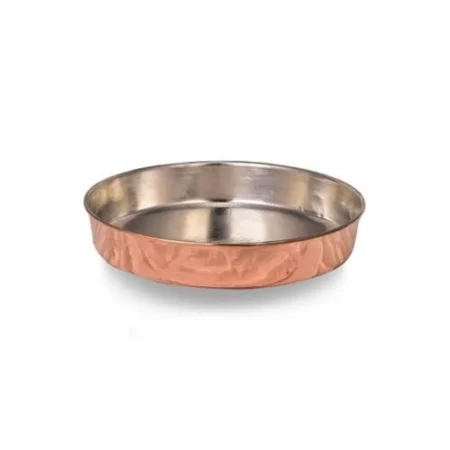
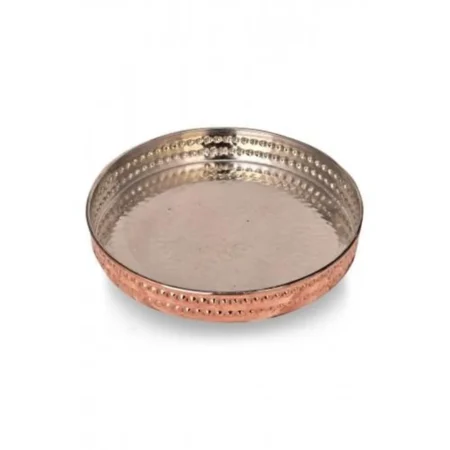
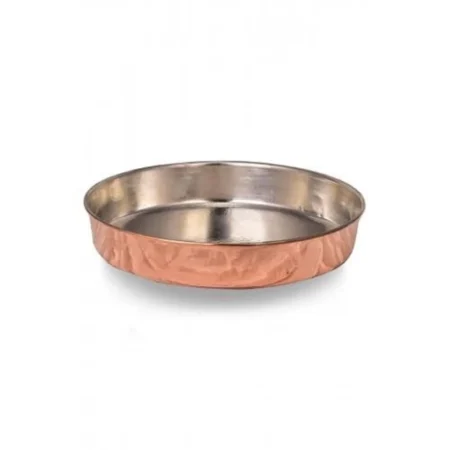
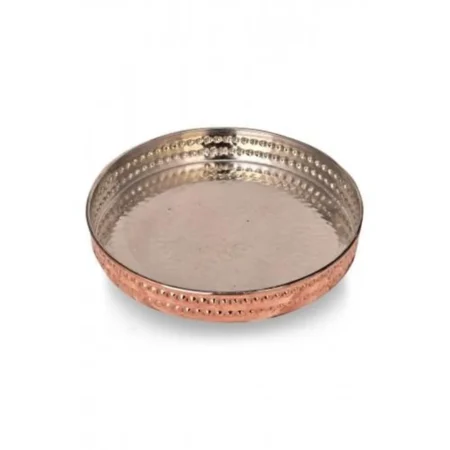
22 items in stock right now, from 16 cm to 36 cm. Other sizes and finishes are produced to order.
Beyond the trays, the pieces that work as oven dishes are the ones that also cook on the stovetop. Two-handled pots go into an oven more easily than single-handled saucepans, because a long handle needs a wider shelf. The güveç casseroles, in mini and sharing sizes with matched lids, are made to finish in an oven and go straight to the table. Frying pans of the tava family double as shallow baking dishes for eggs, gratins and small roasts. The full family of pots and pans, and the gauges each is made in, is on our copper cookware page, and the translation between American shape names and the Turkish forms is in our guide to copper pot and pan shapes.
What we do not list is worth saying plainly. There is no oval copper au gratin dish and no rectangular copper roasting pan in the range shown on this site. A round tray or a shallow pan does the same work for most recipes. Where a buyer needs a specific shape, such as an oval gratin, a rectangular roaster sized to a hotel pan rack or a deeper wall, new tooling can be made at the partner workshop when the quantity justifies it. Any surface intended to meet food is tinned, and we do not copy a design that belongs to someone else.
Commercial kitchens in the US: rules worth posting by the line
Commercial kitchens using tin-lined copper in ovens need short written rules more than special equipment: no empty pans in the oven or on a burner, no salamander or torch, no metal tools on the lining, no food stored in the pan, and hand washing only. Staff turnover is the main risk, so the rules belong on the wall.
A restaurant that runs copper through its ovens is usually doing it for the table: the dish finishes in the oven and goes out in the same pan. That works well and is common, but in a commercial kitchen the pans are handled by many people across many shifts, and the failures almost always trace back to one person who did not know. A short card by the pass works better than a leaflet in a drawer.
- Fat or food goes in before the pan meets the heat, on the range and in the oven.
- Copper never goes under the salamander or the cheese-melter, and no torch on the rim.
- Combi and convection ovens in the moderate band are fine; anything hotter is agreed on the order, and the top of the range is not used.
- Wooden, silicone or nylon tools only; no carving or cutting in the pan.
- Out of the oven onto a board or trivet, never onto cold steel or into a sink.
- Handles and lids are hot; servers carry with a towel and warn the guest.
- Hand wash, dry at once, no leftovers stored in the pan.
Two compliance points are specific to the US. Health inspectors work from their state or local version of the FDA Food Code, so the food-contact surface of every copper piece that touches acidic food should be lined, and the quotation should state the interior in writing. And because we hold no food-contact certificate for these pieces, a buyer whose market or client needs test documentation should tell us before ordering, so that testing can be arranged; discovering the requirement at the border is the outcome to avoid. Our broader guide for restaurants, hotels and cafés covers service planning beyond the oven.
Ordering copper ovenware from Türkiye (Turkey) for the US market
Copper ovenware from Türkiye (Turkey) reaches US buyers as a quoted export order: send the pieces, sizes, the oven work they will do and the destination. Each article or its box is marked “Made in Turkey”, because US Customs does not accept “Made in Türkiye”, and duty rates are confirmed at shipment by your broker.
The useful first message lists the pieces and sizes, the oven settings they will actually see, whether the kitchen is induction, and the destination. Oven use changes the specification, not only the paperwork: it can change the handle choice, the lining we confirm on the quotation and the quantity we would suggest, since pans that cycle through ovens and re-tinning need spares. There is no published minimum order and no single lead time figure; both depend on the list, which is why we answer the list rather than a price sheet.
Two US-specific points save time. The country of origin marking follows 19 CFR Part 134, and US Customs and Border Protection ruled in 2022 (ruling N323837) that “Made in Turkiye” and “Made in Türkiye” are not acceptable markings because they do not give the English name of the country, so pieces and retail boxes are marked “Made in Turkey”. For classification, copper kitchen articles fall under HS heading 7418, with subheading 7418.10 covering table, kitchen and other household articles of copper at the international six-digit level. The national tariff line and the duty rate are for your customs broker to confirm at the time of shipment; classification is the importer’s responsibility.
We do not have a warehouse in the US and do not ship single retail orders there. Freight is arranged by the buyer or the buyer’s forwarder; we can prepare the Turkish export paperwork as a separate, paid service that ends at the Turkish side of the border. The full picture for American buyers is on wholesale copper for the USA and importing copper cookware.
Copper pans and the oven: common questions
Are copper pans oven safe?
Solid copper pans with metal handles are oven safe within the limit of their lining. A tin-lined pan goes in with food inside in the moderate baking band, well clear of 231.93 °C (449.5 °F), the melting point of tin. Stainless-lined pans tolerate more and follow their maker’s rating. Wooden or plastic handles lower the limit for any pan.
What temperature can a tin-lined copper pan take in the oven?
Tin melts at 231.93 °C (449.5 °F), and that is the hard ceiling. With food in the pan, the moderate band up to about 177 °C (350 °F) is comfortable. Any higher setting is agreed in writing on the quotation, together with the model’s joint type. At 450 °F or higher, under a broiler or in a self-cleaning cycle, use a different pan.
Can copper pots go in the oven with the lid on?
Yes, when the lid knob or handle is metal. Covered cooking is the gentlest oven use for a tin-lined pot, because the lid keeps steam over the food and the lining stays moist up to the rim. The lid becomes as hot as the pot, so lift it with a mitt, and avoid lids with wooden knobs.
Can I put a copper pan under the broiler?
Not a tin-lined one. A broiler radiates heat straight onto the rim and the inner wall above the food, which get much hotter than the oven air, and tin can melt there in minutes. The same applies to a restaurant salamander and a kitchen torch. Brown with the lid off in a moderate oven, or move the food to a ceramic dish.
Can copper frying pans go in the oven?
Yes, if the handle is metal and the pan has food in it. A long handle may need a wider shelf, and it will be as hot as the pan when it comes out. Searing on the stovetop and finishing in a moderate oven suits copper well; preheating an empty frying pan in a hot oven does not.
Is it safe to preheat a copper pan in the oven?
No, not a tin-lined pan. Copper follows the oven air up very quickly when it has nothing in it to absorb heat, and the lining has no protection. Preheat the oven alone, add fat and food to the pan, then put it in. Recipes that start by heating an empty skillet or pot are better made in cast iron or steel.
Do copper pans work in a convection oven?
Yes. A convection or fan oven only moves hot air faster, and tin-lined copper with food inside behaves as it does in a conventional oven, browning a little sooner. Some ovens adjust the temperature automatically on the convection setting, so check the manual. The broiler and the empty-pan rules still apply.
Are copper-colored non-stick pans real copper?
Normally not. Copper-colored ceramic non-stick pans sold under copper names are aluminum with a tinted coating, sometimes with a steel plate in the base. Their oven limit comes from the coating and the handle, so follow the instructions on their own label. Solid copper is heavier for its size and has a tin or steel interior.
Does an unlined copper dish go in the oven?
Physically yes; bare copper only darkens in an oven. The problem is food contact: the FDA Food Code bars copper and brass from contact with food below pH 6, such as vinegar, fruit juice and wine. We supply unlined copper for decorative and non-food use only, and tin every surface meant to meet food.
Planning copper for oven work?
Tell us the pieces and sizes, the oven settings they will see, whether the kitchen uses broilers, salamanders or induction, an approximate quantity and the destination. We reply with the matching pieces, the handle and lining stated in writing, and a price for anything that has to be produced.
Last updated: 31 October 2026