
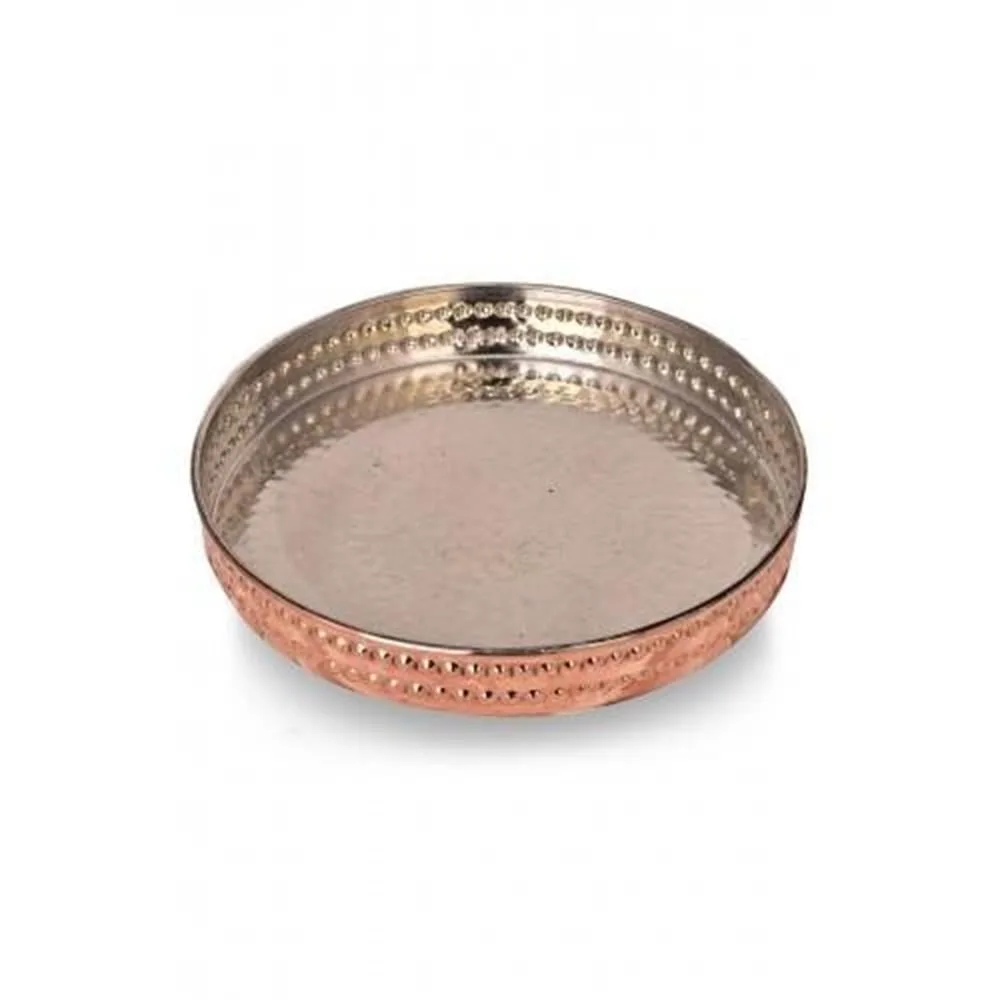
Copper Baking Trays
A copper baking tray is a round, low-sided tray used so that baklava and savoury pastry colour evenly without burning underneath. The food-contact surface is tinned, and tin sets the oven limit: it melts at about 232 °C. The choice is made by diameter and sheet thickness, and BakırBul supplies the trays in wholesale quantities.
The copper baking tray is the round, low-sided tray used to bake baklava and savoury pastry so they colour evenly without scorching underneath. This group has two bodies: the Sultani tray in 0.50 mm sheet and the Yanyana tray in 0.55 mm sheet, heavier at some sizes. Both are hand-hammered and both come in the same diameters, from 16 cm to 36 cm, about 4–5.5 cm deep. Wholesale terms for bakeries and venues are on wholesale copper baking trays.
What a copper tray changes in the oven
The best-known problem of a domestic oven is that heat gathers near the lower element. In an aluminium or enamel tray that heat stays concentrated, so the pastry burns in one area while the edges stay pale. Copper conducts heat fast and evenly, so it spreads the incoming heat across the whole base. In baklava the result is visible: the colour difference between the centre and the edge of the tray shrinks, and the layered pastry stays crisp underneath.
The second difference comes at the syrup and butter stage. Copper gives up heat quickly once it leaves the oven. That helps with the rule of pouring cold syrup over hot baklava; the tray does not hold heat long enough to boil the syrup. It is used most for:
- baklava and similar syrup pastries;
- layered, rolled and tray pastries;
- baked pasta, casserole and vegetable oven dishes;
- tray shredded pastry and kunafa-style desserts that need a short burst of top heat;
- dishes that go straight from the oven to the table.
Choosing size and portions
On a tray, edge height matters as much as diameter; a low edge lets top heat reach the pastry more easily. The table gives an approximate match using baklava as the example. The number of slices varies with pastry thickness and the way it is cut, so treat the table as a guide.
| Diameter | Approximate servings | Suits |
|---|---|---|
| 16–20 cm | 2–3 | A small trial tray, a single-portion oven dish |
| 22–26 cm | 4–6 | Everyday savoury pastry, a small baklava |
| 28–32 cm | 6–10 | A table with guests, a standard baklava tray |
| 34–36 cm | 10–15 | Holidays, weddings and large gatherings |
Measure the inside width of the oven before choosing. A 36 cm tray fits the shelf of many built-in ovens, but if it is tight against the sides hot air cannot circulate and baking suffers; leave at least two or three centimetres on each side. The choice between the two bodies is about thickness: the Yanyana tray, in slightly heavier sheet, is a little sturdier and has an advantage in large sizes used often. The Sultani tray, in 0.50 mm sheet, is lighter and responds to heat a little faster.
Tin, temperature and oven use
Tin is the most important technical point on a baking tray. Tin is the protective layer on the copper surface that meets food, and it melts at about 232 °C (about 450 °F). Baklava and savoury pastry usually bake at 170–200 °C (about 340–390 °F) in a domestic oven, which is the safe zone. Heating the tray empty at a very high setting, or leaving it directly over a flame, softens the tin. The practical rule: never heat the tray empty, put it in the oven filled, and do not hold it above 220 °C (about 430 °F) for long. The full explanation is in can copper pans go in the oven.
Tin wears with time. When the reddish colour of copper appears in patches on the base, the tray is due for re-tinning; under heavy use that is about every one to two years. Cutting with a knife inside the tray wears the tin fastest; when cutting baklava, draw the blade without pressing down.
A copper tray can also be used on the hob, but it does not work on an induction hob unless an interface disc is used, because copper is not magnetic. On washing the rule is clear: it does not go in the dishwasher. Do not plunge it into cold water while hot; let it cool first. Wash it in warm water with a soft sponge, no wire, and dry it at once. Darkening on the outside is copper’s reaction with air and is not a defect; lemon and salt, or a mixture of flour, vinegar and salt, polishes it.
The tray in Kahramanmaraş copperwork
A tray shows the rhythm of the hammer most clearly, because the whole surface is on view. The sheet is hammered out from the centre, and the edge is turned and stiffened; a well-hammered tray sits on a flat surface without rocking. Kahramanmaraş copper handcraft carries a registered Turkish geographical indication, and the tray is the product of that craft people meet most often in daily life.
What shapes the quotation for baking trays
On baking trays thickness sits in a narrow band, so the main factor that separates the cost is size; the larger the tray, the more copper it uses. Every body is hand-hammered, so technique does not separate the pieces, while edge form and depth do. Quotations are prepared per order from your list of bodies, diameters and quantities, with the lead time agreed for that order.
Models and sizes
The choice starts with the inside of the oven; there must be room between tray and oven wall for hot air to move. The second measure is depth. Shallow trays are for layered pastry such as savoury pastry and baklava, deeper ones for wetter dishes and baked pasta.
The finish in this group is polished copper and the body is hand-hammered; the hammer marks leave an irregular texture across the base.
Frequently asked questions
Can a copper tray be used in the oven?
Yes. The 170–200 °C range in which baklava and savoury pastry bake is safe for copper and tin. The one thing to avoid is heating the tray empty at a high setting.
What size tray do I need for baklava?
For a standard home baklava, 30–32 cm is the most popular size and serves about eight to ten people. A small household suits 26 cm, and holiday hospitality 36 cm.
Will the tin melt in the oven?
Not at normal oven temperatures. Tin melts at about 232 °C, and home recipes stay below that. The risk comes when an empty tray is exposed to a very high setting or a direct flame for a long time.
What is the difference between the Sultani and Yanyana trays?
The difference is sheet thickness and weight: the Sultani is 0.50 mm, the Yanyana 0.55 mm and heavier at some sizes. Both bodies are hand-hammered and come in the same sizes from 16 to 36 cm.
Can I wash the tray in the dishwasher?
No. Dishwasher detergent and high temperature damage the tin layer. Washing by hand in warm water and drying at once extends the tray’s life.
What else is in the range for serving?
For wide round pieces on the serving side, see the copper serving trays, and for the oven and hob group as a whole the copper cookware branch.
Type
Technique
Finish
Sheet thickness
Showing 17–22 of 22 results
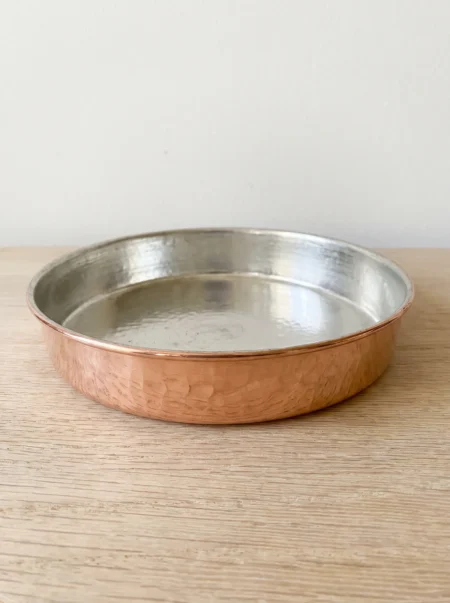
Yanyana Copper Round Baking Tray — 36 cm, hand-hammered, polished copper
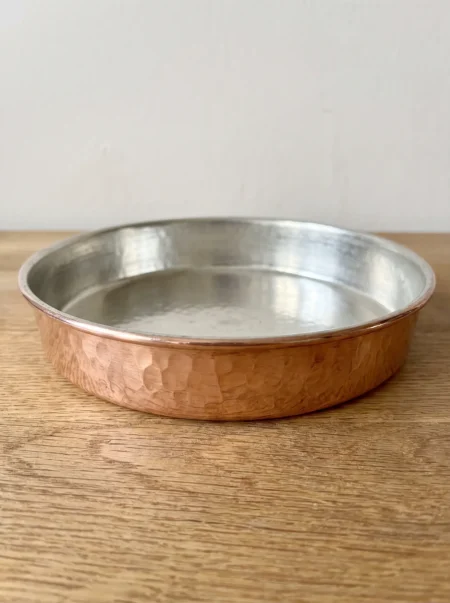
Yanyana Copper Round Baking Tray — 32 cm, hand-hammered, polished copper
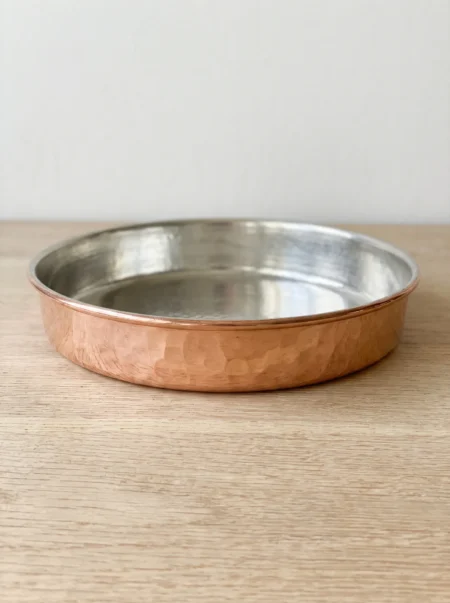
Yanyana Copper Round Baking Tray — 34 cm, hand-hammered, polished copper
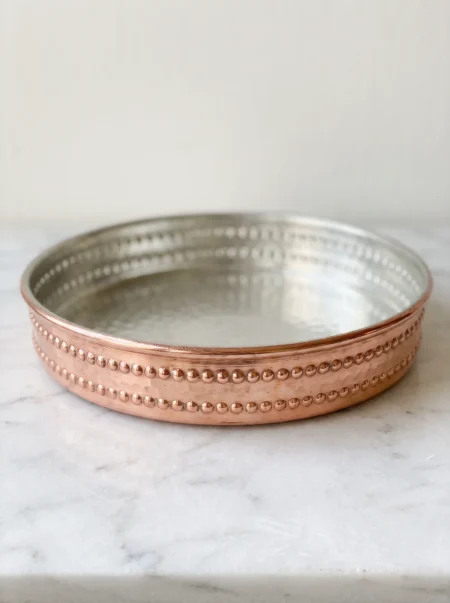
Sultani Copper Round Baking Tray — 34 cm, hand-hammered, polished copper
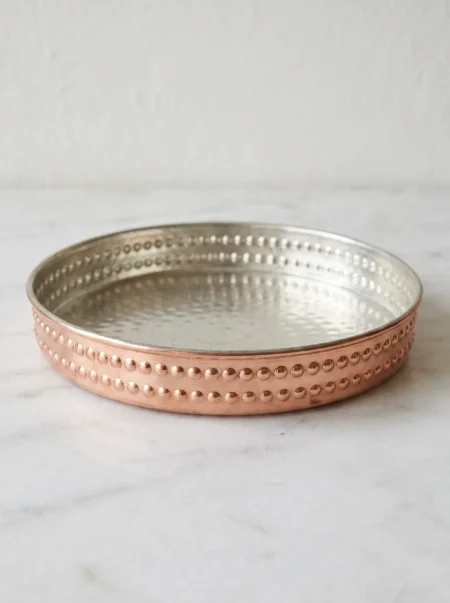
Sultani Copper Round Baking Tray — 36 cm, hand-hammered, polished copper
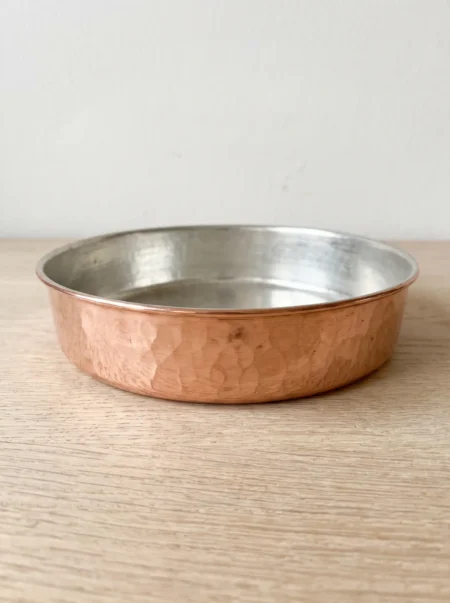
Yanyana Copper Round Baking Tray — 26 cm, hand-hammered, polished copper