

Copper Serving Trays
Type
Technique
Finish
Sheet thickness
Copper serving trays are the oldest way to carry tea, coffee and the glasses beside them in one trip. BakırBul’s tray category holds two scales: 34 cm round serving trays and 11 cm Otağ tea saucers that sit under a Turkish tea glass. Diameter decides first, and rim height second: a carrying tray or a fixed display.
Showing all 11 results
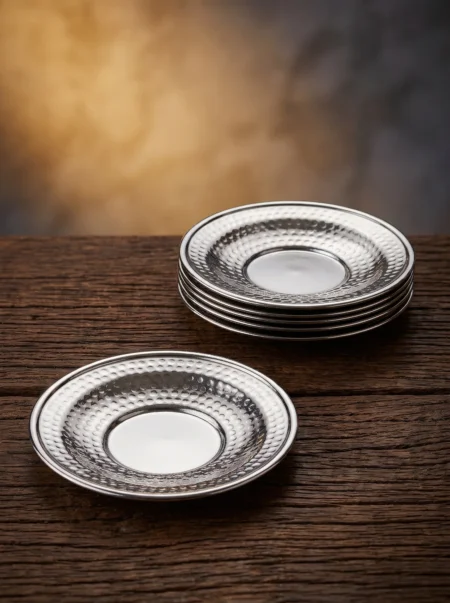
Otağ Copper Tea Saucer, Set of 6 — hand-hammered, nickel-plated
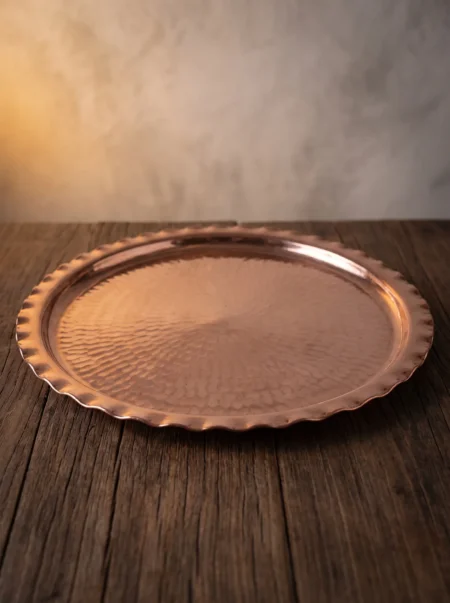
Çaldıran Copper Round Serving Tray — 34 cm, hand-hammered, polished copper
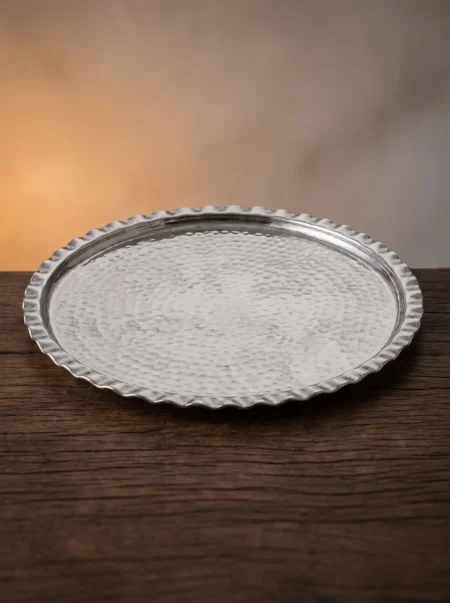
Çaldıran Copper Round Serving Tray — 34 cm, hand-hammered, nickel-plated
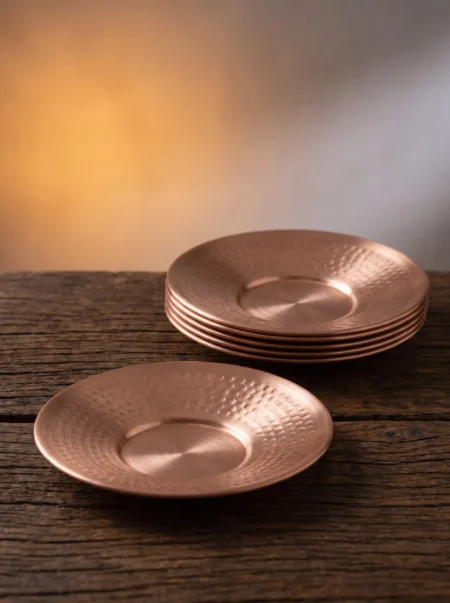
Otağ Copper Tea Saucer, Set of 6 — hand-hammered, brushed matt
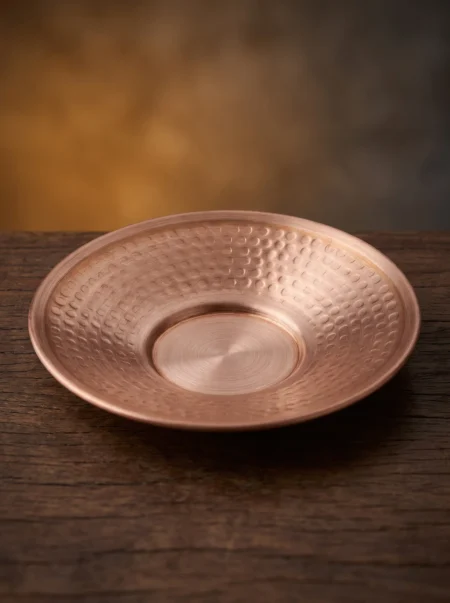
Otağ Copper Tea Saucer — hand-hammered, brushed matt
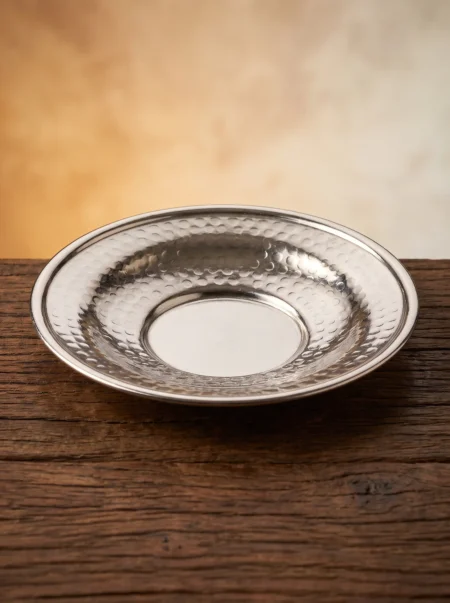
Otağ Copper Tea Saucer — hand-hammered, nickel-plated
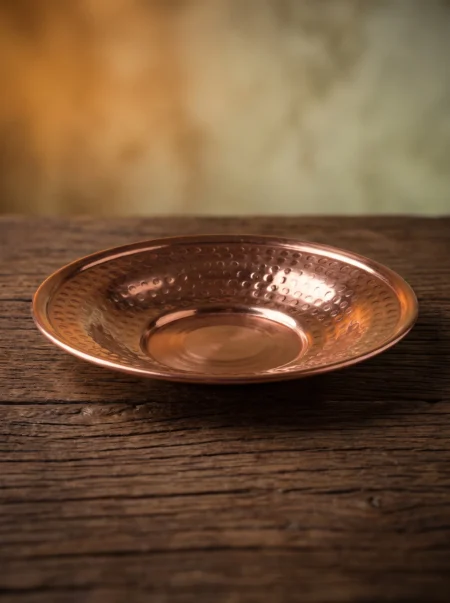
Otağ Copper Tea Saucer — hand-hammered, polished copper
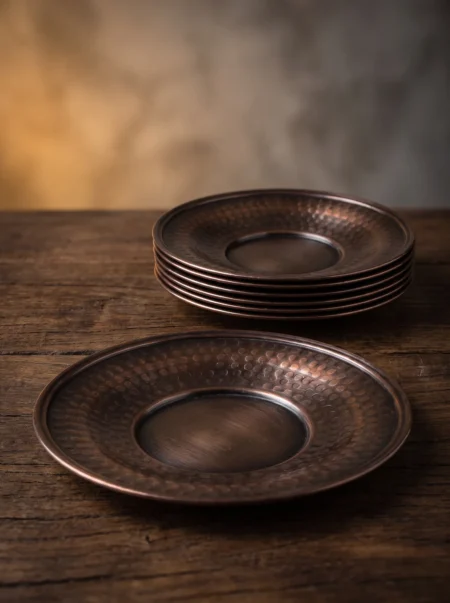
Otağ Copper Tea Saucer, Set of 6 — hand-hammered, oxidised
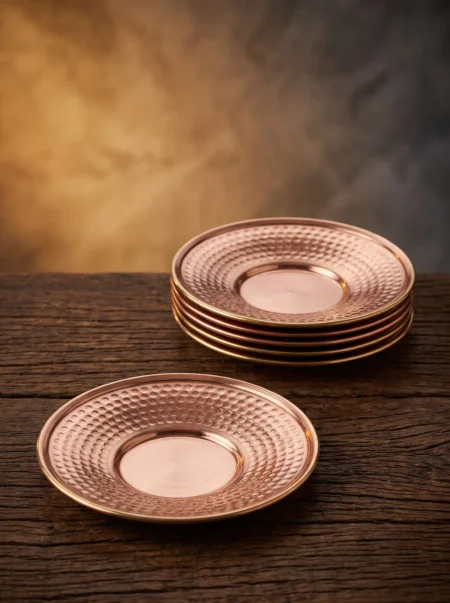
Otağ Copper Tea Saucer, Set of 6 — hand-hammered, polished copper
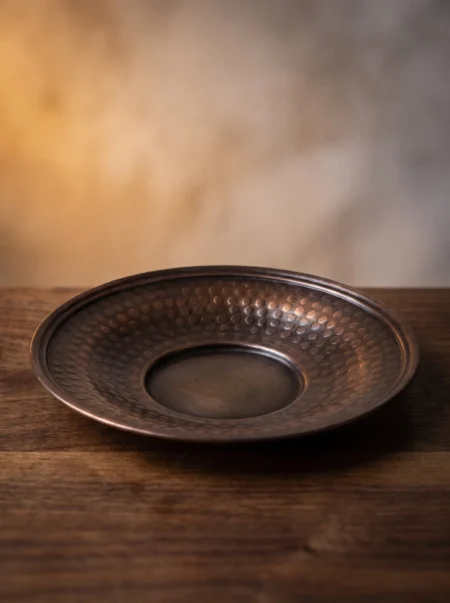
Otağ Copper Tea Saucer — hand-hammered, oxidised
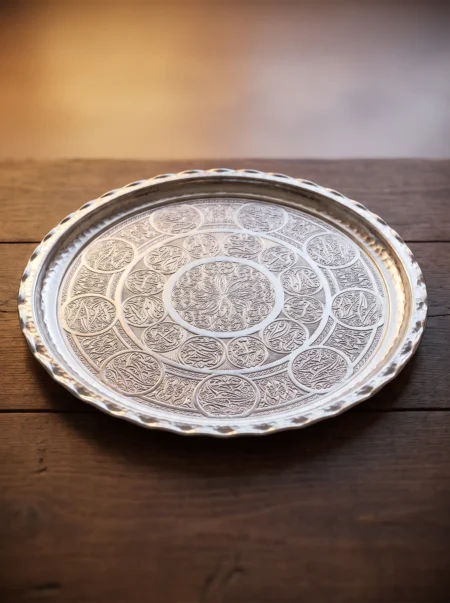
Copper Round Serving Tray — 34 cm, machine-patterned, nickel-plated
A copper tray is the oldest solution for carrying tea, coffee and the glasses beside them in one go. The tray category holds pieces at two different scales: round serving trays 34 cm across, and the 11 cm Otağ tea saucers. Both are worked from a single sheet, with rims turned and hardened by hand. BakırBul produces them to order through a long-term partner workshop in Kahramanmaraş, Türkiye.
Which piece for which job
The 34 cm round tray is the size that comfortably takes six slim-waisted tea glasses and a sugar bowl beside them; it is the size most asked for in tea and Turkish coffee service. Its rim is only 1.5 cm high, so it holds the glasses without sliding but does not make the tray heavy. The same tray works outside service as well: on a coffee table it gathers candle holders, a pitcher or small planters.
The 11 cm tea saucer is the small piece that goes under the glass. It holds the spoon and sugar beside the glass and keeps a hot glass off the table. In English these are tea saucers, not trays. They are listed singly and as a set of six; hosts usually take the set, and buyers for their own use the single piece.
Size, gauge and finish
| Piece | Diameter | Height | Gauge | Weight |
|---|---|---|---|---|
| Round serving tray | 34.2 cm | 1.5 cm | 0.95 mm | 714 g |
| Tea saucer | 11 cm | 1.5 cm | 0.50 mm | 60 g |
The difference in gauge is not chance. A tray is carried loaded, so it is hammered from sheet close to 1 millimetre; that thickness stops it sagging in the middle. A tea saucer carries no weight, so it is made from 0.5 millimetre sheet and stays light in the hand. Trays come in two techniques, hand-hammered and machine-patterned: hand hammering leaves clear marks and every tray looks different, while machine patterning gives a more regular design at a lower price.
The tea saucer comes in all four finishes: polished copper, nickel-plated, oxidised and brushed matt. On trays, polished copper and nickel-plated lead. To pull a table together, the tray, the tea saucers and copper sugar bowls and candy dishes can be chosen in the same finish.
How to tell a real copper tray
Copper does not attract a magnet; a magnet that sticks to the body shows another metal underneath. Weight is the second test: copper is clearly heavier than a steel or aluminium body of the same size. The third is the surface: a tin-lined surface has a dull, pale grey colour. If the product page does not give the interior surface of a tray, ask before ordering.
Before first use
Wash a new tray first in warm water with a soft sponge and dry it straight away. It does not go in the dishwasher, and detergent should not be left standing on it. If the surface is tin-lined, check that the tin is continuous before use. The full routine is in how to care for copper.
Tin, tarnish and daily care
Glasses mostly stand on a tray, but spilled tea, a slice of lemon or jam can still touch the surface directly. So acidic food such as lemon or jam is not left standing on bare copper, and where a tray has tin, that needs protecting too. Keep trays out of the dishwasher; warm water, a few drops of washing-up liquid and a soft sponge are enough, followed by an immediate dry. Wire brushes and abrasive powders strip tin.
Copper darkens as it meets the air. That tarnish is not a fault but the natural behaviour of the metal. Rubbing with lemon and salt, or spreading a paste of flour, vinegar and salt and leaving it for a few minutes, brings the shine back. Nickel-plated trays darken later, and oxidised trays are made in a dark tone to begin with, so tarnish does not show on them. A copper tray is not for the hob or the oven; use a mat rather than putting a hot pot straight on it.
Hammering a flat surface in Kahramanmaraş
Among coppersmiths, hammering a wide flat surface without making it wave is counted as harder than dishing a deep vessel. The centre of the tray thins under the hammer while the rim has to stay level, so in Kahramanmaraş workshops a tray is worked with ordered blows from the rim towards the centre, and the rim is turned in one go at the end. Behind the registered Turkish geographical indication of the town’s copperwork lies exactly this kind of measured hand knowledge.
Hotel and event fit-outs need high quantities of the same size and often a logo or engraving; trays, platters and branding options for that scale are covered in hand hammered Turkish copper trays and platters, and seasonal hospitality service in Eid serving trays and iftar copper serveware.
What sets the price of a copper tray
On trays, diameter sets the price most of all; as the surface grows, the copper used rises with the square of the diameter, so the gap between two sizes can be larger than expected. The second factor is the rim work: a flat-rimmed tray and one with a rolled or patterned rim do not need the same labour even at the same diameter. The finish counts too, because nickel-plated and brushed matt surfaces need extra processing compared with polished copper. Prices are quoted per order; send the sizes, finishes and quantities with your destination.
Lines and sizes
A tray is chosen by where it will be used. Small trays are preferred for tea and coffee service, wide ones for food and hospitality; a large tray, the large low tray that serves as the table itself, is a different object at a different scale. Rim height is the second measure and stops glasses tipping in transit.
Most bodies in this group are hand-hammered; hammer marks leave an irregular texture on the surface that breaks up the light. Finishes are nickel-plated, polished copper, brushed matt and oxidised. Listings that bring several sizes of the same form together are priced separately from single pieces.
Frequently asked questions
How many glasses fit on a 34 cm copper tray?
Six slim-waisted Turkish tea glasses and a sugar bowl beside them fit comfortably. With coffee cups, six cups and six water glasses also fit, because the base of a coffee cup is narrower than a glass. The 1.5 cm rim keeps them from sliding as the tray is carried.
Does a copper tray come tin-lined?
The interior surface is not given for every model on the product pages; if you will carry acidic food on the tray, ask before ordering and the quotation states it in writing. On a tin-lined tray, the tin wears more slowly than on plates and bowls, because food does not usually sit on it directly.
What is the difference between a hand-hammered and a machine-patterned tray?
On a hand-hammered tray the hammer marks are made by hand, so each piece has its own pattern; on a machine-patterned tray the design repeats regularly and the price is lower. The difference lies in the pattern and the labour, not in the copper itself.
Can I buy tea saucers one at a time?
Yes, tea saucers are listed both singly and as a set of six. The same model comes in polished copper, nickel-plated, oxidised and brushed matt, so an existing set can be completed later in the same finish.
Which other serving pieces go with a tray?
The pieces it pairs with most often are Turkish delight dishes and small bowls. For dessert and fruit service, see copper serving bowls, and for the whole table, copper serveware.