Electric Copper Samovars
Type
Technique
Finish
Sheet thickness
An electric copper samovar is a tea urn in which a central heating element warms the water around it while the teapot on top stays hot from the same heat. The BakırBul samovars are electric and need no open flame. The choice is made on water capacity, body form and the mains supply of the destination market.
Showing all 4 results
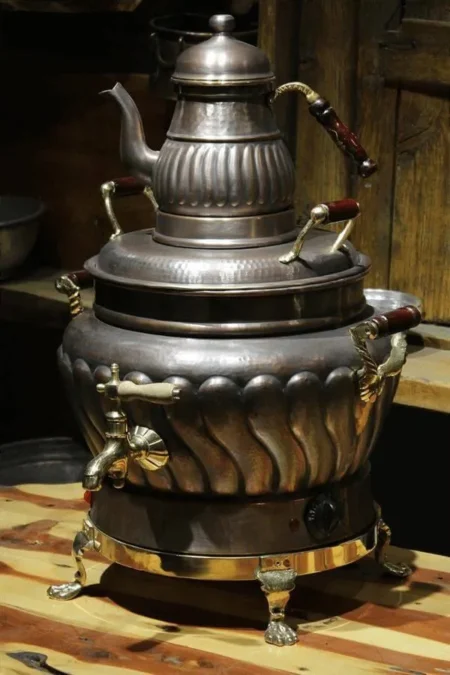
Hünkar Round Fluted Copper Electric Samovar — No. 3, oxidised
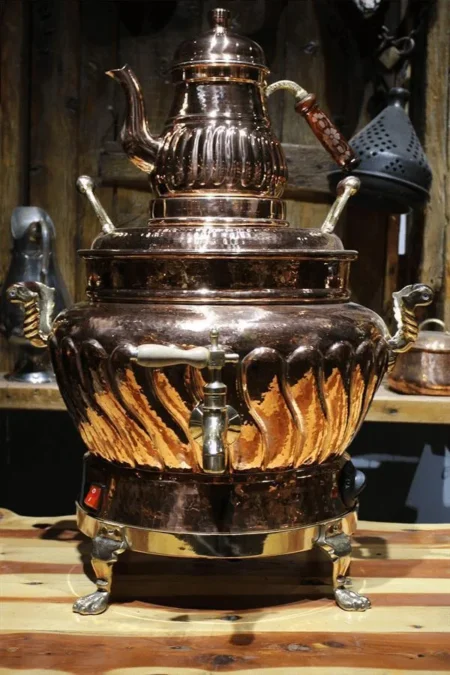
Hünkar Round Fluted Copper Electric Samovar — No. 3, polished copper
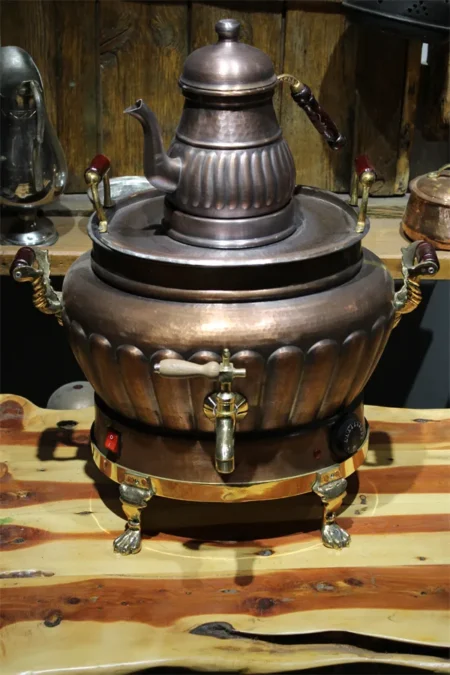
Sultani Fluted Oval Copper Electric Samovar — No. 3, oxidised
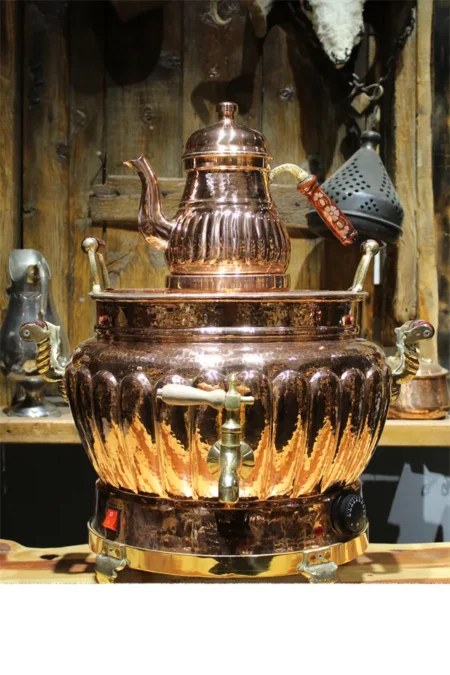
Sultani Fluted Oval Copper Electric Samovar — No. 3, polished copper
An electric copper samovar heats a water jacket around a central core and keeps the teapot on its crown warm with the heat that rises. This group holds two body forms, the oval fluted Sultani and the round fluted Hünkar. Both are No. 3 size, made from 1.00 mm copper sheet and offered in polished copper and oxidised. Every samovar in the range runs on an electric element: it plugs in and needs no fire. Wholesale questions about voltage, plugs and conformity are answered on wholesale electric copper samovars.
How a samovar works
A samovar works in two layers. The central vertical core carries the heat source, and the jacket around it holds the water. Because heat passes into the water from the sides, the water warms from all directions rather than only from the bottom, as it would in a pan, and once boiled it stays close to boiling for a long time. The teapot on top warms from the heat rising from the body, so the tea brews without bubbling or settling.
On an electric body the order of use is:
- Fill the water tank first. Before plugging in, the water must be inside and above the element; an element running dry damages both itself and the body.
- Plug in and start heating; because the water warms from all sides it boils more evenly than in a pan.
- When the water boils, set the teapot on top and brew the tea. Hot water from the tap lets each glass be made lighter or stronger.
- While the table sits, turn the heat down to keep the water at drinking temperature.
- When finished, unplug; once the samovar has cooled, empty the water completely and dry the inside.
Safe use
While a samovar is running the whole body, especially the top lid, gets very hot; carry it by the handles and use a thick cloth if needed. Do not stand it directly on a wooden table; put a heat-resistant mat underneath. Where there are children, keep the samovar away from walls and walkways; tipping it over with hot water inside has serious consequences. If the tap seal starts to drip, replace it before use. Do not let the cable hang over the table edge and never immerse the body in water.
Mains voltage and the destination market
Türkiye runs at 230 volts and 50 hertz on a European socket, and a samovar built for that supply is not automatically suitable for every market. If your market runs on 110–120 volts, or uses a different plug, say so before the quotation; it changes the electrical parts, not just the plug. Which electrical conformity marking the destination requires is a question for the importer to raise at the start, so it can be settled before production rather than at the border.
Capacity and model choice
Samovars are sized by number; the higher the number, the larger the water tank. The models here are No. 3 bodies. When working out how many glasses a samovar will serve, use this measure: a tulip-shaped Turkish tea glass takes roughly 100–120 ml, about a third of which is brew, and the rest is topped up with water from the samovar.
| Feature | Sultani oval fluted | Hünkar round fluted |
|---|---|---|
| Body form | Oval, vertically fluted | Round, fluted |
| Size | No. 3 | No. 3 |
| Sheet thickness | 1.00 mm | 1.00 mm |
| Finish | Polished copper, oxidised | Polished copper, oxidised |
The fluting is not only decoration: the ribs stiffen the sheet and make the body harder to dent. The oval body looks taller and slimmer, while the round body sits more steadily on a wide tray. On finish, polished copper shows the red glow of copper, and oxidised gives a matt look that has already accepted darkening.
Tea and care
The secret of good samovar tea is never to put the teapot directly on a flame; it waits on top of the samovar, warmed only by the rising heat. Keep tea in a closed tin and put it into the teapot dry. Beyond about fifteen minutes the tannins turn bitter, so at long sittings a fresh brew is better.
A copper samovar does not go in the dishwasher. After use, empty the water tank, rinse it with warm water and dry it thoroughly; water left inside leaves limescale and stains over time. If limescale has started to build up, filling the tank with water and lemon and leaving it to stand helps. Darkening on the outside comes from copper’s reaction with air and is not a defect; rubbing with lemon and salt brightens it. If the tin on a food-contact inner surface has worn thin, it needs renewing.
The samovar in Kahramanmaraş copperwork
The samovar gathers almost every workshop operation into a single piece: shaping the body, raising the flutes, fitting the chimney into the body, opening the tap seat and setting the handles are each separate handwork. Kahramanmaraş copper handcraft carries a registered Turkish geographical indication, and the samovar is one of the craft’s most multi-part test pieces.
What shapes the quotation for samovars
Three things set the cost of a samovar: the size of the water tank, the body work and the electrical parts. The bodies here are made from 1.00 mm sheet, among the thickest bands in the cookware branch, which gives the strength a vessel holding hot water for hours needs. A fluted body takes extra shaping compared with a plain one. On electric models the element and thermostat are a separate cost line, and a different voltage changes them. Quotations are prepared per order from the destination country, the supply voltage, the body form, the finish and the quantity, with the lead time agreed for that order.
Frequently asked questions
What heat source does the samovar use?
The samovars in the range are electric: an element inside the body heats the water, and the unit plugs in. They need no fire, chimney draught or open flame.
Will it work on 110 volts?
Not as built for Türkiye, which runs at 230 volts. If your market uses 110–120 volts or a different plug, tell us before the quotation, because it changes the electrical parts. The conformity marking your market requires is confirmed at the same stage.
How long does the water stay hot?
As long as the heating stays on, the water stays close to boiling. After unplugging, the thick copper body holds heat for a while, so the water stays at drinking temperature; that is why samovars are favoured at the table.
What is the difference between a samovar and a teapot?
The samovar is the body that boils water and keeps it hot; the teapot is the small pot where tea brews. In a samovar setup they work together, with the teapot on the crown. They can also be used separately; see copper teapots.
Can a samovar go on the hob?
A samovar is not a hob vessel; it works with its own heat source. To boil water on a hob, the copper Turkish double teapots are made for that job. Copper is also not magnetic, so it does not work on induction unless an interface disc is used.
How should I store it out of season?
Store it completely empty and dry, with the lid slightly open. Water or damp left inside makes the tank smell and stain. For long storage, wiping the body and wrapping it in a cotton cloth protects the surface from scratches.